
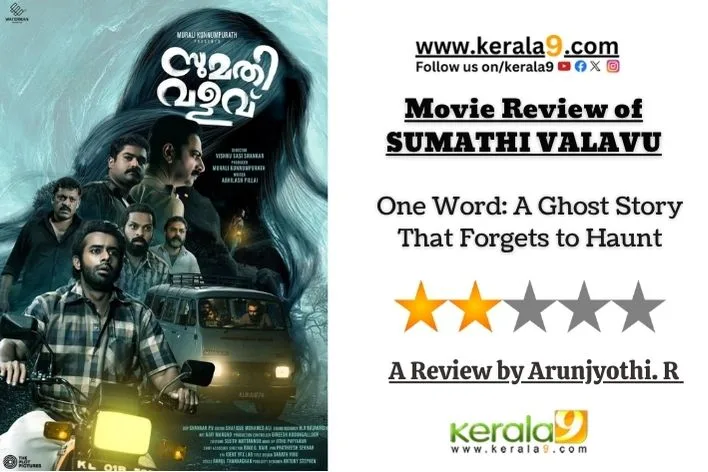
Sumathi Valavu Review: A Ghost Story That Forgets to Haunt
ONE WORD: A Ghost Story That Forgets to Haunt
A Review by Arunjyothi R
RELEASE DATE: August 2, 2025
LANGUAGE: Malayalam
DURATION: 02 Hours 21 Minutes
DIRECTOR: Vishnu Sasi Shankar
GENRE: Supernatural Horror Comedy Thriller
•POSITIVES:
1: Performance of Actors
2: Cinematography and Lighting
3: First Half
4: Editing
5: Background Score
6: Decent Situational Comedies.
•NEGATIVES:
1: Average Direction
2: Predictability in the script
3: Half Baked Screenplay
4: Placement of Songs
5: Flat Romantic Scenes
6: Poor Second Half
7: Worst Action Sequences
STORY:
Set in the early 1990s, Sumathi Valavu transports us to a remote village nestled on the Kerala–Tamil Nadu border, surrounded by dense forests and steeped in folklore. Life in the village flows at its own pace, but there’s one stretch of road that stirs fear in every heart — a narrow, eerie bend ominously known as Sumathi Valavu.
Locals believe this bend is haunted by the ghost of a woman named Sumathi, and over time, the story has evolved into something more than just a rumour — it’s become a part of the village’s collective mindset. Most avoid that road after dark, not out of proof, but out of habit and caution. It’s a tale accepted without question, more tradition than terror, until it starts to affect one man’s life in ways no one expected.
But the story takes a darker, more personal turn when the life of a young villager named Appu begins to unravel due to the events linked to this haunted bend. As we follow Appu’s journey, Sumathi Valavu blends the supernatural with the emotional, exploring how fear, belief, and mystery can change the course of a man’s fate — all triggered by one fateful road that no one dares to cross after dusk.
REVIEW & ANALYSIS OF THE FILM:
Sumathi Valavu begins with an intriguing premise rooted in real-life folklore, drawing inspiration from unsettling incidents tied to a haunted bend in a forest village. The foundation for a compelling supernatural horror film is clearly present, and early scenes manage to create a convincing atmosphere. The cinematography and lighting work in harmony to establish the eerie mood, capturing the isolated village and forest backdrop with authenticity. The background score, especially the use of violin in key moments, adds to the tension and supports the horror narrative effectively. The ensemble cast also delivers commendable performances, especially in handling the horror sequences and subtle comedic beats, which occasionally bring a quirky charm to the overall tone.
Technically, the film shows flashes of promise. The horror sequences are well-shot, with effective transitions and solid colour grading enhancing the visual storytelling. Lighting choices contribute meaningfully to the ambience, and the score remains one of the film’s strongest elements throughout. While not all the comedic scenes land, they generally feel organic and don’t detract from the film’s flow. These elements, along with a relatively engaging first half, keep the audience invested — at least initially.
However, the film falters where it matters most — the writing. The screenplay, while based on a solid concept, lacks structure and depth. The narrative loses momentum quickly, especially in the second half, where a tonal shift steers the film away from its horror roots into an uneven blend of romance and generic hero-villain confrontations. The romantic subplot feels out of place and emotionally flat, while the pacing becomes increasingly sluggish. Predictability creeps in, and the horror elements are pushed to the background, weakening the film’s impact. The addition of four poorly placed songs further hampers the flow, feeling forced and disconnected from the scenes they’re in — clearly an attempt at commercial appeal that backfires.
Direction and action choreography also contribute to the film’s shortcomings. The director struggles to maintain a consistent tone, and the second half suffers from a lack of focus. The climax, in particular, features awkwardly staged action sequences that feel mismatched with the psychological and satirical layers of the protagonist. What could have been a standout horror film rooted in regional myth ends up being a disjointed mix of genres. Despite its potential and a few well-crafted moments, Sumathi Valavu ultimately doesn’t live up to what its promising premise could have achieved.
SO WHAT’S HOT:
1: The core premise of the film is genuinely intriguing, especially since it draws inspiration from incidents that are said to have occurred in real life. A quick search on the internet reveals several chilling and unsettling stories linked to the infamous Sumathi Valavu. The writer has effectively used this concept as the foundation for a supernatural narrative. While the basic plot holds strong potential, the transition from concept to screenplay falls short.
2: The movie is packed with several actors, and it’s their performances that helped me stay engaged and watch it till the end. The actors delivered solid performances, and both the situational comedy and the way they handled the supernatural horror scenes were enjoyable to watch.
3: In any supernatural horror film, effective cinematography is key to building tension and atmosphere — and Sumathi Valavu handles this aspect with notable skill. The visuals are well-composed, capturing the forest-bound village and its mysterious surroundings with authenticity. The eerie events and horror sequences are shot in a way that adds depth to the narrative, creating a convincingly haunted mood. While the story may have its shortcomings, the cinematography succeeds in visually grounding the film in a setting that feels both believable and unsettling.
4: Just like cinematography, lighting plays a vital role in shaping the tone of a supernatural horror film — and Sumathi Valavu gets it mostly right. The lighting is carefully planned and well-executed, especially in the horror sequences, where it effectively enhances the mood and builds the right level of tension. It complements the cinematography well, creating a cohesive visual atmosphere that supports the unsettling moments throughout the film.
5: The editing in Sumathi Valavu stands on mixed ground. The cuts and transitions used in the horror sequences are well-executed, with smooth flow and effective pacing that enhance the eerie moments. The colour grading for both the horror scenes and night sequences is also visually appealing and adds to the atmosphere. However, the overall runtime feels stretched. The inclusion of forced songs disrupts the narrative flow, and a tighter edit — particularly by trimming those unnecessary segments — could have made the viewing experience more engaging.
6: The background score in Sumathi Valavu stands out as one of its strengths. The music, especially during the horror scenes, adds a sense of thrill and tension, with the use of violin enhancing the unsettling atmosphere. From the opening scene to the backstory segments and key horror moments, the score effectively supports the narrative and helps maintain viewer engagement throughout.
7: The situational comedy in the film works in parts — a few moments genuinely land well and deliver laughs, while others fall flat. That said, the humour generally fits the flow of events and doesn’t come across as forced. Interestingly, the blend of light comedy with the horror setting adds a quirky charm to certain scenes, making the eerie atmosphere unexpectedly amusing at times.
SO WHAT DIDN’T WORK OUT:
1: One of the film’s most noticeable weaknesses lies in its screenplay. While the core idea shows promise and offers a solid foundation for an engaging horror story, the writing doesn’t quite deliver. The narrative lacks consistency, with certain scenes feeling underdeveloped or disconnected. The pacing, too, is uneven — moments that should build suspense often fall flat. It’s clear that with tighter writing and better structure, the film could have made much more impact.
2: The writing feels sloppy and unfocused. What begins with promise quickly unravels as the screenplay loses its grip on pacing and structure. The romantic subplot is poorly integrated, offering no real emotional connection and doing little to move the story forward. The momentum built in the early scenes falls apart, and the film soon becomes predictable and flat. Weak writing choices not only dilute the tension but also make the overall viewing experience increasingly dull.
3: The first half of the film manages to maintain a decent flow, with its horror elements and narrative developments keeping the viewer reasonably engaged. The buildup feels appropriate, and the eerie moments help sustain interest. However, the second half marks a noticeable tonal shift. The emphasis moves away from the horror setup and leans more into romance and hero-villain dynamics. This shift in focus disrupts the cohesion of the film, making it feel like it’s straying from its original intent. As a result, the horror atmosphere loses its weight, and the overall experience becomes less compelling.
4: The placement of the songs is another major drawback. Most of them feel forced and disconnected from the unfolding events, adding little to the narrative. It’s evident that the songs were inserted to give the film a more commercial appeal, but this decision ultimately works against the story. While the tracks themselves are passable to listen to, they don’t fit the tone or situation, and their abrupt inclusion disrupts the flow. With four songs scattered throughout, the film often loses momentum, making the viewing experience feel sluggish and unnecessarily stretched.
5: The direction in Sumathi Valavu is serviceable but lacks the sharpness needed to fully elevate the material. The film had the potential to be a standout horror entry in Malayalam cinema if the director had leaned more into a realistic and atmospheric portrayal of the horror elements. However, the inclusion of commercial tropes dilutes the core narrative. This is particularly noticeable in the second half, where the execution feels unfocused and the impact of the story begins to fade. A more consistent and genre-focused direction could have made a significant difference.
6: The action sequences were poorly executed, with the choreography coming across as sloppy—especially in the climax. The fight scenes during the final moments felt unintentionally comical, undermining the intended impact. In an attempt to give Arjun Ashokan’s character a mass appeal, the scene ends up feeling awkward and out of place. It also clashes with the satirical tone and psychological depth of the protagonist, making the entire sequence feel disconnected from the rest of the film.
PERFORMANCE OF ACTORS:
Sumathi Valavu features an ensemble cast, and most of the performances are commendable. Arjun Ashokan takes the lead as Appu and delivers a natural performance, particularly shining in his dialogue delivery and expressions. While his portrayal in horror and situational comedy scenes feels convincing, the action sequences—especially towards the climax—didn’t suit him well and appeared somewhat forced. The romantic subplot didn’t quite work, but Arjun handled those moments with decent effort.
Gokul Suresh brings a solid screen presence as the military officer, while Balu Varghese impresses in a supporting role with his well-timed humour. Saiju Kurup plays the forest officer with composure and contributes significantly to the plot. Malavika Manoj, cast as the female lead, does a fair job, but her character suffers from weak writing, resulting in emotionally flat romantic scenes that limit her impact.
Writer Abhilash Pillai makes a decent appearance in a supporting role, and Sidharth Bharathan manages to entertain with well-placed comedic moments. Sshivada delivers a strong, intense performance in the interval block, while Deva Nandha is effective in her role. The actor portraying the antagonist has potential but needs improvement, particularly in conveying expressions more convincingly.
MUSIC AND BACKGROUND SCORE:
The film features four songs composed by Ranjin Raj. While the songs are pleasant to listen to on their own, their placement within the movie felt completely off. They appeared forcefully inserted, disrupting the flow of the narrative and contributing to a sense of lag. On the other hand, the background score was quite effective, especially in enhancing the horror elements. The violin notes, in particular, added a haunting touch that elevated the eerie atmosphere. The opening scene was accompanied by a fitting score that successfully evoked a sense of fear. Throughout the horror sequences, the background music maintained the right balance to keep the audience engaged. However, in the romantic and action portions, the score lacked impact and didn’t leave much of an impression.
CONCLUSION:
Sumathi Valavu sets out with an intriguing premise, blending horror and satire, but it struggles to maintain consistency. The first half holds promise, but the second half loses grip with a weak screenplay and a shift in tone that undermines the horror foundation. While the performances—especially by Arjun Ashokan—offer some relief, the film’s average direction, forcefully placed songs, and uneven pacing dilute its overall impact. Despite a few engaging moments and a strong background score in the horror segments, Sumathi Valavu ends up being a missed opportunity that fails to deliver a satisfying cinematic experience.
VERDICT: When the Script Falls Apart, Even the Spirits Can’t Save It
RATING: 2/5
A Review by Arunjyothi. R