
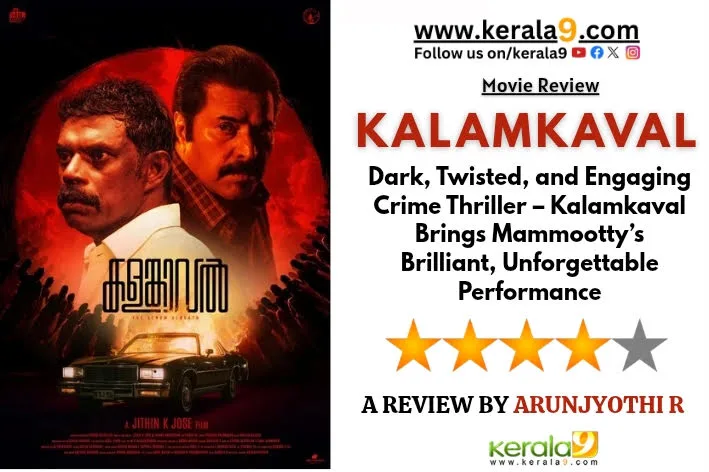
Kalamkaval Review in ONE WORD: Dark, Twisted, and Engaging Crime Thriller – Kalamkaval Brings Mammootty’s Brilliant, Unforgettable Performance
A Review by Arunjyothi R
LANGUAGE: MALAYALAM
DURATION: 02 Hours 19 Minutes
DIRECTOR: Jithin K Jose
GENRE: Crime Thriller
•POSITIVES:
1: Direction
2: Story
3: Screenplay & Dialogues
4: Performance of actors
5: Cinematography
7: Background Score
8: Editing
9: Suspense Mood
10: Negative character arc of Mammootty
•NEGATIVES:
1: Slow build and slightly stretched second half
STORY:
Set against the backdrop of 2000s Kerala, Kalamkaval follows Officer Jayakrishnan, a steadfast and perceptive cop assigned to unravel the mystery behind a sudden communal clash in the region. What initially appears to be a straightforward investigation soon twists into a far more sinister tale. Jayakrishnan soon discovers that the riot was sparked by a seemingly trivial misunderstanding—a young woman eloping—but as he digs deeper, a far darker pattern begins to emerge. Multiple women have gone missing under eerily similar circumstances, and the threads of these disappearances lead him into a shadowy, dangerous world. As he pieces together clues, Jayakrishnan is drawn deeper into a chilling maze of secrets, lies, and hidden motives. His relentless pursuit to uncover the truth forms the heart of Kalamkaval, a story that intertwines suspense, psychological tension, and unexpected twists, keeping viewers gripped and guessing until the very last frame.
REVIEW & ANALYSIS OF THE FILM:
Director Jithin K Jose take inspiration from one of India’s most chilling crime stories—the infamous case of serial killer Mohan Kumar, known as Cyanide Mohan, who murdered around 20 women between 2004 and 2009 by luring them into trust and poisoning them with cyanide. Instead of presenting a straightforward retelling, the filmmakers smartly fictionalise the real events, transforming the material into an engaging psychological thriller. This creative liberty allows them to explore the emotional, moral, and psychological landscape of both predator and pursuer, elevating the narrative beyond simple true-crime documentation.
What stands out first is the solid screenplay of both Jithin and Jishnu, which balances fact and fiction with striking confidence. The writers restructure the real case into a riveting cat-and-mouse narrative between two sharply drawn characters—one inspired by the killer, the other a relentless investigator. Their dynamic becomes the heartbeat of the film. The pursuit is not only physical but also psychological, with both characters constantly trying to outsmart each other. This tension is maintained remarkably well throughout the film, creating a slow-burn thrill that never loses grip. The mystery component is handled with surprising finesse. Despite the audience’s awareness of the real incident, the film manages to craft genuine suspense through cleverly placed twists and narrative misdirections. The screenplay drip-feeds information at the right moments, allowing the story to unfold like a puzzle whose pieces fall into place with dramatic satisfaction. Every twist feels earned, not forced, and the unpredictability keeps the viewer deeply invested.
Debutant director Jithin K. Jose announces himself with astonishing confidence, choosing a subject that many seasoned filmmakers would hesitate to touch and shaping it into a gripping cinematic experience. What stands out immediately is his clarity of vision—he knows the world he wants to create, the tone he wants to sustain, and the emotional weight he wants the audience to carry. For a first-time filmmaker, venturing into such a dark, psychologically complex narrative is a bold decision, but Jithin handles it with maturity far beyond his years. His understanding of the material is evident in the way he constructs tension, builds atmosphere, and allows the narrative to breathe without ever losing intensity. The darker tone is not just a stylistic choice but an integral part of the storytelling, and Jithin maintains it consistently, shaping every frame with precision and purpose. He utilises Mammootty and Vinayakan with exceptional awareness—recognising what each actor brings and crafting scenes that extract their fullest potential. Mammootty’s chilling villainy is magnified by Jithin’s patient framing and psychological detailing, while Vinayakan’s raw intensity as the investigating officer is captured with realism and restraint. Jithin’s direction balances these two towering performances beautifully, ensuring neither overshadows the other but instead creating a dynamic that drives the film’s energy. His control over pacing, his ability to handle complex shifts in tone, and his courage to stick to a grim, uncompromised vision make it clear that he is not just another newcomer—he is a filmmaker with a strong voice and a promising future.
One of the film’s greatest triumphs lies in the immersive atmosphere it creates. The filmmakers craft a dark, unsettling mood that echoes the psychological corrosion at the heart of the story. Through muted colour tones, a brooding musical score, and intentionally measured pacing, they build a visual and emotional environment that feels haunting from start to finish. The direction remains assured and stylistically refined, often bordering on poetic, yet never losing sight of the gravity of the real events. Rather than sensationalising the crimes or glorifying the killer, the film adopts a restrained, respectful tone—one that highlights the terror of the acts while delving deeper into the fractured mind that commits them. Adding to this is the chilling portrayal of the killer’s methods, the twisted psychological gratification he derives from each murder, and the controlled, layered manner in which the narrative reveals its surprises. The tension of discovering new clues, the precision of the investigative trail, and the constant curiosity about what might happen next all combine to deliver the exact mood the film aims for. This impact is strengthened by sharp writing, meticulous execution, and compelling performances, which collectively sustain the film’s dark energy. The atmosphere remains gripping and foreboding throughout, maintaining its intensity right up to the final frame without ever losing momentum.
This is the kind of thriller that tightens its grip scene by scene, keeping your pulse racing as the investigation unravels. From the very beginning, the film draws you into a dark, immersive world where every clue, every silence, and every shift in mood feels loaded with meaning. The narrative is cleverly divided into eight distinct chapters, each one escalating the tension and pushing the story into new, unsettling territory. These stages don’t just move the plot forward—they reshape your understanding of the characters and the danger lurking beneath the surface, making you constantly wonder what the next reveal might be. The interval twist is where the film truly flexes its storytelling muscle. Without warning, it drops a revelation so sharp and unexpected that it instantly changes the stakes. What’s impressive is how flawlessly the film earns this moment: the pacing is tight, the engagement never dips, and the screenplay subtly leads you down one path before pulling the ground from beneath your feet. It’s a rare case where a twist doesn’t just shock—it elevates everything that came before it. By the time the film moves into its later chapters, the momentum is unstoppable, driven by a blend of confident direction, atmospheric tension, and an investigative track that keeps you guessing until the very last frame.
Mammootty has long been celebrated as an actor who refuses to be boxed in by conventional roles. He thrives on experimentation, constantly seeking characters that challenge not only him but also the audience’s expectations. In this film, he steps into a deeply sinister villainous shade—and he does so with remarkable fearlessness. He doesn’t merely play the antagonist; he inhabits him with unsettling precision. The performance is so absorbing that it compels you to wonder which other actor in the industry would dare to take on such a morally dark, psychologically disturbing character with this level of intensity. His commitment to pushing boundaries deserves genuine admiration, for it is rare to see a superstar of his stature surrender so completely to such an unglorified, negative role.
The villain arc he carries is crafted with striking detail. The writing builds the character layer by layer—a chilling combination of charm, psychopathy, disturbing calmness, and a predatory gaze. Mammootty brings all of this alive with an internalised power that is nothing short of mesmerising. The writers, despite being well aware of Mammootty’s massive star value, refuse to dilute the character with hero-like moments or commercial compromises. And that is precisely why the performance lands with such brutal authenticity. He mirrors the psychological depth of a real-world killer with frightening ease: the micro-expressions that flicker across his face, the controlled stillness, the sudden shifts in demeanour, and the eerie conviction in his eyes all speak volumes. The madness, the cruelty, the greedy need to continue killing—he portrays these with a subtlety and weight that linger long after the scene fades. It’s hard not to imagine how different, how diluted, and how less impactful this character would have been in the hands of another actor; Mammootty makes it iconic, unforgettable, and genuinely disturbing.
Vinayakan, playing Nath, stands shoulder-to-shoulder with this towering performance and delivers his own brilliant interpretation of a police officer fuelled by purpose. He brings a raw, lived-in realism to the investigative track. His body language in uniform, the contained aggression, the frustration of chasing a predator, and the desperate urgency to stop the next crime—all are portrayed with remarkable authenticity. He avoids theatrics and instead chooses an understated, grounded approach that suits the film’s tone perfectly. The scenes where Vinayakan and Mammootty confront each other crackle with tension, power, and unpredictability. Their dynamic elevates the film, creating moments that are not just thrilling but also emotionally charged. Together, they craft some of the most gripping sequences in the film, making their combination scenes explosive and unforgettable. If Mammootty is the haunting shadow of the film, Vinayakan is the flame trying to cut through the darkness—and the collision between the two is what makes the narrative truly riveting.
Mujeeb Majeed’s background score becomes the film’s invisible heartbeat, pulsing through every frame and shaping the experience with remarkable finesse. Instead of relying on loud, dramatic cues, he builds tension through eerie textures, creeping undertones, and atmospheric layers that make the darker moments feel alive. The killing scenes, in particular, are elevated by his unsettling mix of low hums, distorted strings, and cold, whisper-like sound patterns that capture the killer’s chilling calmness and the psychological horror of the act. When the film shifts into twist mode, Majeed switches gears with sharp sonic spikes, pulsating rhythms, and sudden orchestral surges that jolt the audience exactly when needed. The interval block becomes unforgettable largely because of his score—it rises like a storm at the perfect moment and makes the twist hit twice as hard. Even in investigative sequences, he subtly mirrors the characters’ tension with heartbeat-like beats and rhythmic textures that keep viewers locked into the mystery. What makes his work truly impressive is how he maintains the film’s dark ambience from start to finish without overpowering the narrative; each scene gets exactly the tone it demands. His score doesn’t just accompany the film—it amplifies the dread, the thrill, the silence, and the shock, ultimately delivering one of the most engaging and atmospheric musical works seen in a crime thriller in recent times.
The cinematography by Faisal Ali plays a crucial role in shaping the film’s haunting atmosphere, bringing visual precision and narrative depth to every scene. The choice of locations across Kerala and Tamil Nadu feels organic to the storyline, grounding the dark narrative in landscapes that are both familiar and unsettling. Faisal captures the duality of these settings—the serene exteriors contrasted against the psychological turbulence at the heart of the plot. His work shines particularly in the sequences involving Mammootty; the killing scenes are shot with chilling exactness, using shadows, tight framing, and controlled lighting to emphasise the character’s sinister calmness without resorting to graphic excess. Each frame is composed with intention, ensuring the visual mood stays aligned with the film’s grim tone.Faisal’s keen eye also enhances Mammootty’s performance, selecting angles and placements that elevate the nuances of his expressions and mannerisms. The camera doesn’t just record; it observes, studies, and sometimes even stalks the character, adding an extra layer of psychological tension. This synergy between actor and cinematographer results in visuals that linger in the mind long after the scene ends. Editor Praveen Prabhakar complements the visuals with clean, thoughtful cuts that maintain narrative flow and momentum. The transitions are smooth, especially in the investigative moments where time and clues connect seamlessly. While the second half carries a slight sense of stretch, a tighter trim could have made the pacing even sharper; still, Praveen’s overall editing choices preserve the immersive nature of the film. His handling of the colour tone deserves praise—the darker palette is consistent, atmospheric, and perfectly suited to the film’s psychological depth. The visual rhythm he crafts enhances the tension, keeps the narrative cohesive, and supports the oppressive, unsettling mood that defines the film.
One of the minor shortcomings of the film lies in the slight sense of stretch felt during the second half, where the pacing momentarily loosens and the narrative takes its time to settle into the intensity of its final act. The early portions of the film also dedicate considerable time to establishing the world, characters, and psychological tone, which some viewers might perceive as slow or overly deliberate. However, this slow-burn approach is intentional, designed to build tension layer by layer rather than rushing into the central conflict. What initially feels like a measured setup gradually evolves into something far more gripping, rewarding the patience of the audience with a cascade of unexpected twists, revelations, and nail-biting turns. The film’s gradual unfolding allows its atmosphere to seep in slowly, making the eventual shocks more impactful and the narrative payoffs far more satisfying. In hindsight, the slower portions function as essential groundwork that enhances the emotional weight and dramatic power of the film’s climactic moments.
CONCLUSION:
I will definitely recommend Kalamkaval for its gripping narrative, dark atmosphere, and masterful handling of a story inspired by real-life events. The film takes the chilling case of a serial killer and adapts it into a taut psychological thriller, maintaining a consistently darker tone that keeps the audience on edge throughout. Mammootty delivers a truly memorable and shocking performance, embodying the villain with terrifying precision—his expressions, mannerisms, and cold calculation leave a lasting impact. Vinayakan matches him with grounded intensity, while debutant director Jithin K. Jose confidently orchestrates the story, balancing suspense, tension, and character dynamics with skill. The plot unfolds with cleverly executed twists and turns, keeping viewers guessing and fully invested until the very end. Coupled with Faisal Ali’s atmospheric cinematography, Praveen Prabhakar’s precise editing, and Mujeeb Majeed’s tension-filled background score, Kalamkaval becomes an immersive, unforgettable thriller. Despite a few slow moments in pacing, the film’s dark tone, suspense, and powerful performances make it an absolute must-watch.
RATING: 4/5
A Review by Arunjyothi. R