
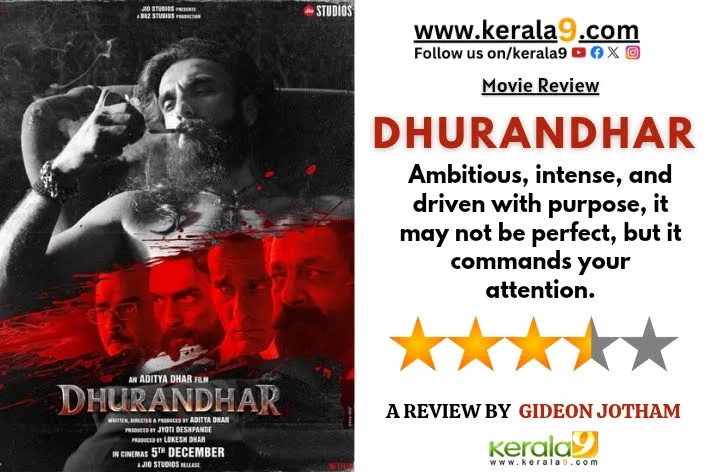
Dhurandhar Review: Ambitious, intense, and driven with purpose, it may not be perfect, but it commands your attention.
A Review by Gideon Jotham
Movie : Dhurandhar
Director: Aditya Dhar
Duration: 212 Mins
Language: Hindi
Genre: Political action thriller
Positives
- Direction.
- Casting
- World-building
- Tone
- Cinematography
- Music
- Performance of actors
Negatives
- Screenplay
- Pacing
- Editing
- Duration
- Emotional depth
- CG
STORY
India and Pakistan share a tense history, and in the middle of that sits Ajay Sanyal, a man who believes peace talks are nothing but noise. He isn’t a chest-thumping hero; he’s quiet, calculating, and convinced that the only way to deal with the enemy is to hit first and hit hard. But he needs a political climate that will let him run the game his way, no hesitation, no moral sermon. Once that leadership arrives, Sanyal finally moves. His battlefield isn’t the border it’s Karachi, where crime and politics sleep in the same bed. The Lyari underworld is run by Rehman Dakait, a feared gangster with charisma and blood on his hands, backed by the ambitious politician Jameel Jamali. Together, they control the streets, the police, and everyone too afraid to oppose them.
Into this world walks Hamza Ranveer Singh’s undercover avatar. He doesn’t step in with swagger; he melts in, slowly earning Rehman’s trust. He becomes a loyal foot soldier first, then a strategic advisor, and eventually someone Rehman can’t imagine functioning without. Hamza sells him the dream of power beyond gun power that sits in parliament, not on street corners.
To deepen that divide, Hamza gets close to Jamali’s daughter. Not by accident, by design. His presence quietly poisons the relationship between Rehman and Jamali, turning loyalty into doubt and partnership into rivalry. Sanyal watches it unfold from a distance, like a man watching dominoes fall exactly where he placed them.But every operation takes a toll. The deeper Hamza goes, the thinner the line between duty and identity becomes. The violence grows, alliances shift, and the chaos he created begins circling back at him. He’s no longer just an agent undercover, he’s a man trapped inside a life he can’t fully control.
By the end, the mission feels less like a victory and more like a loaded pause. The stage is set, enemies are exposed, and the war Sanyal wanted has only just begun. The story stops not because it’s finished but because the next chapter demands an even bigger fire.
DIRECTION
Aditya Dhar swings for the fences with the direction, sometimes he hits clean, sometimes he overreaches. He builds the film like a war documentary fused with gangster cinema: gritty textures, handheld frames, muted colours, and sudden bursts of brutality. The tone is clear, this isn’t diplomacy, it’s vengeance dressed as realism.
His biggest strength is atmosphere. Karachi feels alive: chaotic, unpredictable, and hostile. The soundscape, the slang, the political tension it all feels intentional. Dhar treats the space like a pressure cooker, slowly raising the heat until characters either explode or turn into monsters. He uses silence, glare, and violence as storytelling tools instead of just relying on dialogue.
But Dhar also falls in love with his own scale. Instead of tightening the narrative, he begins expanding it adding characters, subplots, and political layers that eventually slow down the momentum. The pacing becomes uneven: explosive highs followed by meandering buildup. You can almost sense he wanted to make a two-season OTT series and then force-packed it into a single film.
Where he shines most is in extracting performances. Akshaye Khanna becomes an unblinking menace, Rakesh Bedi shockingly fluid, and Ranveer intense to a fault. Dhar gives actors space to breathe, stare, linger sometimes too long, but never without intention.
In the end, Dhar’s direction is ambitious, aggressive, and unapologetic. He wants the film to feel like a statement, not just a story. And while the execution isn’t flawless, the confidence and scale make it hard to ignore.
SCREENPLAY
The screenplay tries to operate on two tracks: espionage and gangster drama. On paper, that blend is explosive. In execution, it’s uneven. The opening stretch lays out the political intent clearly India wants to hit back, not negotiate. But the writing spends too much time introducing characters and power circles, turning the first hour into a dossier rather than a narrative.
Once Hamza infiltrates Lyari, the screenplay finally finds rhythm. The tension between Rehman, Jamali, and Hamza becomes the spine of the story, and the dialogue sharpens into political chess moves disguised as street talk. The scenes between Akshaye Khanna and Ranveer Singh feel alive layered with mistrust, admiration, and manipulation. That’s where the writing works: intimate, psychological, and unpredictable.
But the script keeps drifting. Side characters arrive with dramatic build-ups yet barely influence the arc. The ISI angle, Baloch politics, and internal police rivalries are compelling ingredients, but the screenplay tries to give everything equal weight, instead of choosing a dominant emotional anchor. The result: momentum breaks, and the urgency dilutes.
The writing relies on chapter-style progression, which gives structure but also makes the narrative feel episodic rather than cinematic. Moments hit hard, especially confrontations, betrayals, and moral dilemmas, but the connective tissue between scenes sometimes feels stretched or rushed.
Still, the screenplay has bite. The dialogues are sharp, the moral worldview is unapologetic, and the character motivations are clear even when the plotting isn’t. The film knows what it wants to say, even if it takes the long way to say it.
MUSIC
The music is where the film gets its swagger. Shashwat Sachdev doesn’t play safe he goes for a tense, industrial soundscape with heavy percussion, gritty synth, and a constant undercurrent of danger. The score isn’t pretty; it’s aggressive, nervy, and built to make the audience feel like something violent is always around the corner.
The standout choice is the way he mixes nostalgia with menace. Usha Uthup’s iconic voice over gunfire shouldn’t work, but it does. “Rambha Ho” feels less like a song and more like a countdown to chaos. The use of retro tracks isn’t romantic filler; it’s an ironic reminder that even softer emotional beats are just temporary illusions in a world built on betrayal.
Background scoring is used like pressure scenes don’t just play, they throb. Low-frequency pulses turn conversations into confrontations, and silence becomes a weapon. Sachdev understands the tone of the film better than anyone. Nationalism here isn’t delivered via soaring orchestras; it’s delivered through cold adrenaline.
Where the music falters is in the romantic portions. The medley of yesteryear hits tries to humanise Hamza, but instead feels like the film briefly forgets what genre it belongs to. Those moments don’t land emotionally; they feel like filler on a playlist.
Overall, the soundtrack is bold and memorable. It adds grit, identity, and momentum even when the screenplay loses steam. The music doesn’t just support the film, it gives it teeth.
CINEMATOGRAPHY
The visuals lean heavily into realism with a bruised, documentary-like texture. The camera doesn’t flatter anyone, it exposes them. Karachi isn’t shot like a postcard; it’s shot like a wound. Narrow streets, dim interiors, flickering tube lights, and dusty skylines create a claustrophobic tone that matches the political tension. Handheld shots amplify paranoia, while tight framing turns conversations into psychological duels. When violence erupts, the camera doesn’t cut away, it observes, cold and unflinching. The contrast between Delhi’s clean bureaucracy and Lyari’s lawless chaos is deliberate and sharp, making the shift in geography feel like a shift in morality. The cinematography succeeds in putting the audience inside the mission, not just watching it.
EDITING
The editing is where the film struggles. The intention is clear: build tension slowly, layer characters, let silence speak. But the execution stretches too long. The chapter-based structure gives the story a series feel, but also breaks momentum. Some scenes linger far past their emotional peak, while others, especially crucial turns, are cut too abruptly. The action sequences and confrontations are edited with bite, sharp, rhythmic, and impactful, but the narrative portions suffer from bloat. The trailer was cut tight and explosive; the film feels like its slower, heavier cousin.
PERFORMANCE OF ACTORS
R. Madhavan (Ajay Sanyal)
Madhavan plays Sanyal like a man who has already made peace with the darkness he operates in. His stillness isn’t emptiness it’s calculation. He rarely raises his voice, yet the room shifts when he speaks. The character is clearly modelled on a real strategist, and Madhavan leans into that methodical pauses, measured reactions, and quiet confidence. The downside? That emotional detachment means he never gives the audience a crack to climb into his psyche. He’s powerful on-screen, but his arc feels more functional than personal a brain directing war, not a man carrying its weight.
Ranveer Singh (Hamza)
Hamza is a man living two lives and slowly losing both. Ranveer commits fully the walk, the voice modulation, the simmering rage under the beard everything screams internal combustion. His best moments are silent ones: listening, judging, withholding. But the screenplay traps him in the same emotional pitch for too long, so his intensity becomes predictable instead of evolving. There are glimpses of vulnerability and identity crisis moments where the mask slips and those are the strongest beats. With tighter writing, this could’ve been one of Ranveer’s most layered performances.
Akshaye Khanna (Rehman Dakait)
This is the kind of role Akshaye thrives in morally ambiguous, unpredictable, and charismatic enough to pull the audience into enemy territory. He plays Rehman like a man who knows everyone fears him and enjoys that power quietly. His stare alone does half the acting. Rehman isn’t a cartoon villain; he’s a man whose ambition, trauma, and hunger for respect have fused into ruthlessness. Akshaye gives him intelligence and emotional depth, making him more compelling than the protagonist. Every scene he’s in feels charged like anything could snap.
Rakesh Bedi (Jameel Jamali)
Bedi’s performance is the surprise punch. He plays Jamali as a political snake charming one minute, venomous the next. His comedic timing doesn’t dilute his threat; it amplifies it, making him unpredictable. One moment he’s smiling like a lovable uncle, the next he’s sanctioning bloodshed without blinking. This duality makes his character terrifyingly real a politician who hides brutality under social grace. His evolution from puppet master to paranoid power-broker is one of the most engaging shifts in the film.
Sara Arjun
Sara plays the emotional anchor in a world ruled by violence and strategy. Her character represents innocence not naive innocence, but the kind people guard because it’s rare. She brings warmth and vulnerability, making her scenes feel like emotional oxygen. However, the script doesn’t give her agency she reacts more than she influences. Still, she adds emotional stakes to Hamza’s journey, even if the chemistry doesn’t fully ignite.
Sanjay Dutt (Chaudhary Aslam)
Aslam feels like a man who has been at war so long he’s forgotten what peace looks like. He brings raw energy and unpredictability to the scenes, but his arc feels rushed. He has the personality to dominate the narrative, but the screenplay uses him more as a thematic reminder: not all enemies are across the border.
Arjun Rampal (Major Iqbal)
Rampal plays Iqbal with icy calm a man who doesn’t need to raise his voice to show danger. He’s the strategist on the opposing side: elegant, controlled, and always three steps ahead. His presence adds balance as a smart villain instead of a caricature. But like Madhavan, he’s written more as an idea than a fully explored human. He leaves an impression, but the film never digs into what drives him.
Final Verdict:
Dhurandhar is a film with ambition larger than its discipline. It wants to be a political statement, a gangster thriller, and a covert-operation drama all at once and somewhere in that ambition, the tight storytelling it needed slips away. The world-building is sharp, the tone is consistent, and the performances especially Akshaye Khanna and Rakesh Bedi, give the film bite. The theme is clear: no mercy, no apology, no soft edges.
But the pacing drags, the screenplay wanders, and the emotional core never fully settles. Ranveer’s arc feels underfed, and the film often prioritises scale over storytelling. The music, cinematography, and atmosphere do the heavy lifting, while the editing struggles to keep control.
Still, when the film hits, it hits hard. The brutality, the politics, the power dynamics all leave an impact. And despite its flaws, it succeeds in creating enough tension and curiosity to make the audience return for Part 2.
Rating: 3.5/5
A REVIEW BY GIDEON JOTHAM