
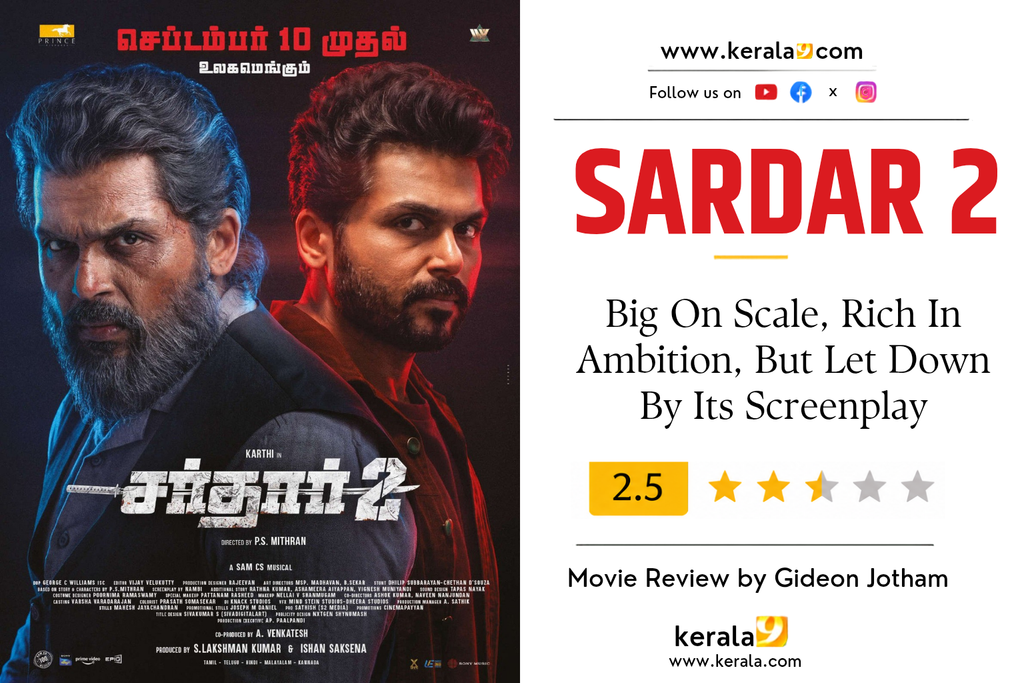
SARDAR 2 Review: Big On Scale, Rich In Ambition, But Let Down By Its Screenplay
Director: P. S. Mithran
Cast: Karthi, S. J. Suryah, Malavika Mohanan, Ashika Ranganath, Rajisha Vijayan, Yogi Babu
Language: Tamil
Genre: Spy Action Thriller
Review by: Gideon Jotham
Postives
- Story
- Cinematography
- DI
- Performance
- Action
- Concept
Negatives
- Vfx
- Duration
- Screenplay
- Lose comedies
- Direction
- Editing
STORY
Sardar 2 expands the spy world established by its predecessor, bringing back Karthi in his dual roles while introducing S. J. Suryah as the new antagonist, Black Dagger. The narrative moves between the past and present, connecting an earlier mission with consequences that eventually return to haunt Sardar and those around him. The film attempts to build a larger espionage universe rather than simply repeating the structure of the first part. The basic premise has enough scope for a strong sequel, particularly because the story deals with unfinished missions and their consequences across time. The film also carries a socially relevant idea within its spy-action framework. However, the execution occasionally becomes too convenient and stretches the narrative beyond what the material can comfortably sustain. The film works best when it treats itself as a spy thriller and becomes weaker whenever it tries too hard to manufacture mass moments.
DIRECTION
P. S. Mithran continues to approach the Sardar universe with ambition. The scale is clearly larger, and the director attempts to expand the mythology rather than simply delivering another standalone mission. The opening portions establish the conflict efficiently, and the film gets into its central storyline without wasting excessive time. Audience reactions have particularly highlighted the interval stretch as one of the film’s strongest portions. However, the ambition occasionally works against the film. Mithran packs the narrative with action, espionage, emotional elements and social commentary, but not every component receives enough breathing space. The second half especially feels less controlled, with the narrative taking longer than necessary to arrive at its intended payoff. There is a good filmmaker underneath the spectacle here, but the film needed tighter control over its scale.
SCREENPLAY
The screenplay has several genuinely engaging ideas, especially in the way it connects the past mission with the present conflict. The first half benefits from momentum, mystery and the anticipation surrounding the Karthi–S. J. Suryah confrontation. The problem is consistency. Once the film crosses the interval, the screenplay begins to feel increasingly stretched. Some developments are designed for immediate theatrical impact rather than logical progression, and certain action passages continue beyond the point where they have already made their dramatic impact. The sequel has enough material for a compelling spy thriller, but the writing occasionally mistakes more events for more drama.
KARTHI – PERFORMANCE
Karthi remains one of the biggest reasons the film works. His ability to differentiate between the two characters continues to be effective, and he brings authority to the senior Sardar while maintaining the necessary vulnerability in the other portions of the story.
The senior Sardar portions are particularly enjoyable because Karthi understands the character’s physicality and attitude without turning every scene into an artificial mass moment. His performance gives the film its emotional and commercial centre. The sequel once again proves that Karthi can carry a large-scale action film without sacrificing the characterisation completely. A strong and dependable performance.
S. J. SURYAH – PERFORMANCE
S. J. Suryah is superb.
As Black Dagger, he brings a completely different energy into the Sardar universe. His performance doesn’t merely depend on shouting or exaggerated villainy. There is an unpredictable quality to his presence that makes even his quieter moments interesting. Suryah understands how to make a villain entertaining without making him feel harmless. His expressions, voice modulation, body language and eccentricity give Black Dagger a distinctive personality. More importantly, his scenes with Karthi carry the electricity the film needs. Their confrontation is one of the major attractions of the sequel. The character could arguably have been written with greater depth, but S. J. Suryah makes every opportunity count. A superb performance and one of the film’s biggest highlights.
MALAVIKA MOHANAN – PERFORMANCE
Malavika Mohanan gets a role that contributes to the narrative’s past timeline and emotional dimensions. She carries herself well on screen and fits comfortably into the film’s larger-scale presentation.
However, the character doesn’t receive enough dramatic development to leave a major impact. The performance is competent, but the writing doesn’t give her the same opportunities that Karthi and Suryah receive.
RAJISHA VIJAYAN – PERFORMANCE
Rajisha Vijayan brings familiarity and emotional grounding to the portions connected with the previous film. Her performance remains natural, but the character is primarily utilised in support of the central conflict. She does what the role requires, although the screenplay could have provided her with more substantial dramatic material.
ASHIKA RANGANATH – PERFORMANCE
Ashika Ranganath fits the commercial tone of the film and contributes effectively to the narrative. Her presence works within the action-oriented structure, although the character doesn’t receive enough depth to become a major takeaway.
CINEMATOGRAPHY
George C. Williams gives Sardar 2 the visual scale expected from a big-budget spy action film. The cinematography handles the contrast between the historical portions and contemporary sequences effectively, while the action blocks are framed with enough clarity to maintain their impact. The film benefits particularly from its larger environments and production scale. There is a sense that the filmmakers are attempting to make the sequel visually bigger rather than simply making another chapter with the same template. The imagery is polished and theatrical, although the visual grandeur occasionally becomes more important than the storytelling itself. A technically strong department.
MUSIC & BACKGROUND SCORE
Sam C. S.’s music is a mixed bag.
The background score works effectively in certain action and elevation sequences, particularly when the film is attempting to create momentum around Karthi’s character. However, the score doesn’t consistently provide the memorable musical identity that one would expect from such a large-scale action sequel. The film’s strongest moments often come from the combination of visuals, performances and staging rather than the music alone.
EDITING
Vijay Velukutty’s editing maintains a reasonably fast pace through several portions of the first half. The film moves quickly between its different timelines and action segments, helping the espionage narrative retain momentum. However, the biggest editorial issue is the overall length. Audience reactions have specifically pointed towards the extended runtime and slower portions of the second half. A tighter edit could have significantly improved the film. Several sequences could have been shortened without affecting the central narrative. Effective in parts, but the film needed more trimming.
ACTION
Action is one of Sardar 2’s primary strengths. The film understands that a sequel of this scale needs set pieces that feel bigger than its predecessor. The action sequences have theatrical energy, and several moments are designed specifically for a big-screen response. The interval block is particularly effective and provides one of the film’s strongest peaks. The weakness is that some sequences continue for too long. When action becomes repetitive, the impact naturally decreases. Big, energetic and theatrical but occasionally excessive.
PRODUCTION DESIGN
The production design successfully sells the expanded world of Sardar. The different periods, locations and environments have enough scale to make the sequel feel larger than a routine continuation. The film clearly benefits from its production value, particularly during the espionage and action sequences. The scale is convincing, even when the screenplay isn’t.
VFX
The VFX is functional and supports the film’s large-scale requirements. Some sequences benefit considerably from the visual effects, while others show limitations. The visual effects are rarely the reason to admire the film, but they also don’t consistently become a distraction.
Serviceable for the scale of the film.
SOUND DESIGN
The sound design works particularly well during the action sequences. Gunshots, explosions and large-scale set pieces receive the required theatrical weight. The soundscape complements the background score and contributes to the film’s commercial energy.
CLIMAX
The climax attempts to provide the scale and emotional payoff expected from a sequel of this magnitude. There are moments that work, especially because of the performances and action staging.
However, the extended buildup creates an expectation that the final stretch doesn’t completely satisfy. The emotional impact could have been stronger with a more tightly constructed payoff.
The climax isn’t disastrous, but it doesn’t reach the level of the film’s best interval material.
CONCLUSION
Sardar 2 is a decent sequel that works best as a large scale theatrical action entertainer. It doesn’t possess the freshness of the first film, and the screenplay becomes increasingly uneven as it progresses. But Karthi’s screen presence, S. J. Suryah’s superb performance, the action blocks and the film’s production scale provide enough reasons to make it a reasonably satisfying big-screen experience. The biggest missed opportunity is that the film has the ingredients for a much stronger spy thriller but occasionally allows spectacle to overpower storytelling. S. J. Suryah steals the show, Karthi holds the film together, and Mithran delivers a sequel that is watchable but not as sharp as it could have been.
FINAL RATING: 2.5/5
Review by Gideon Jotham