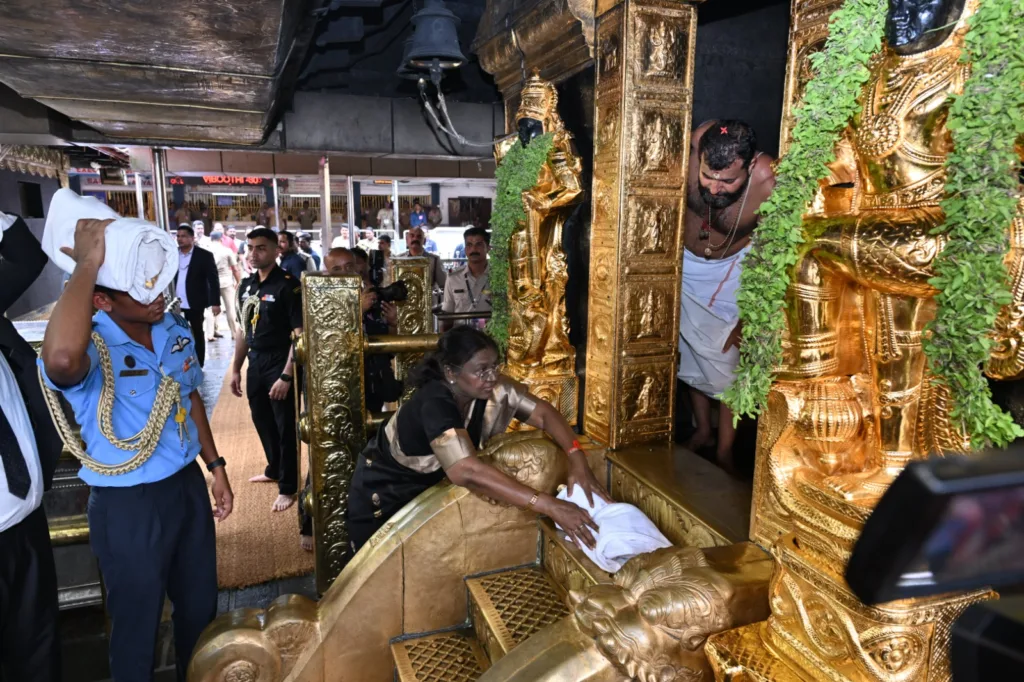
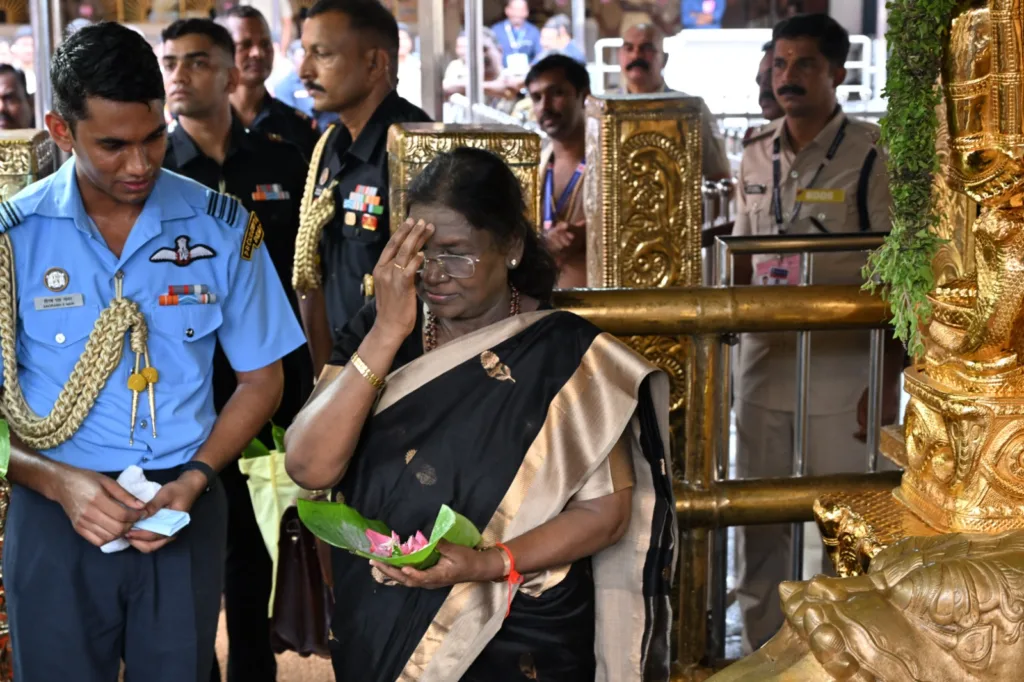
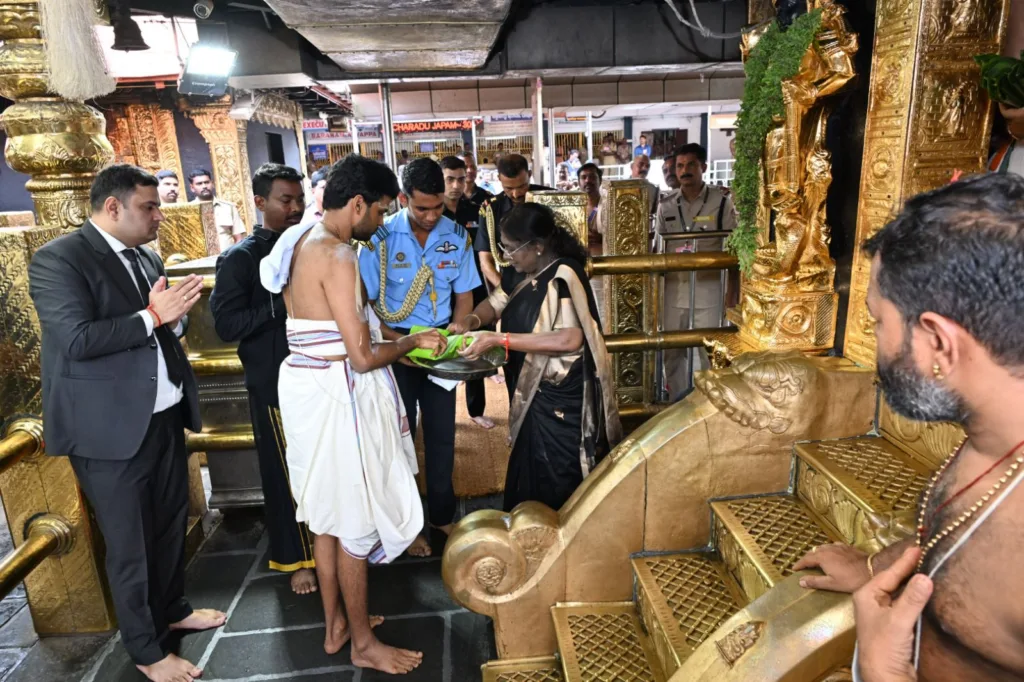
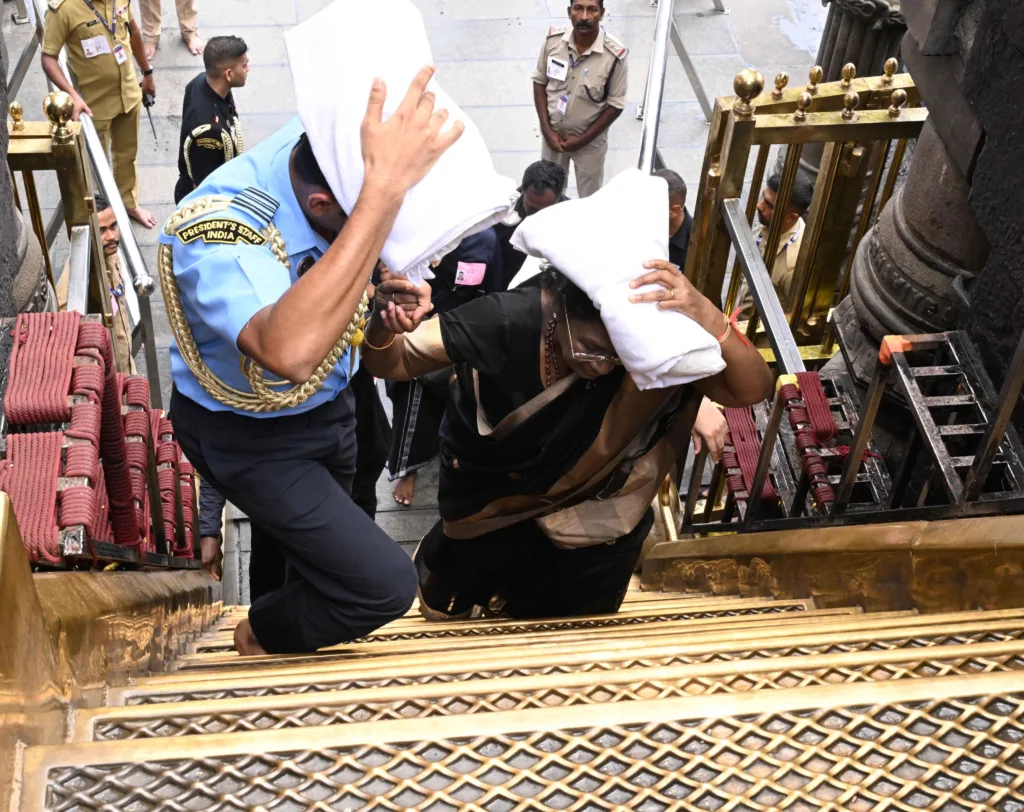
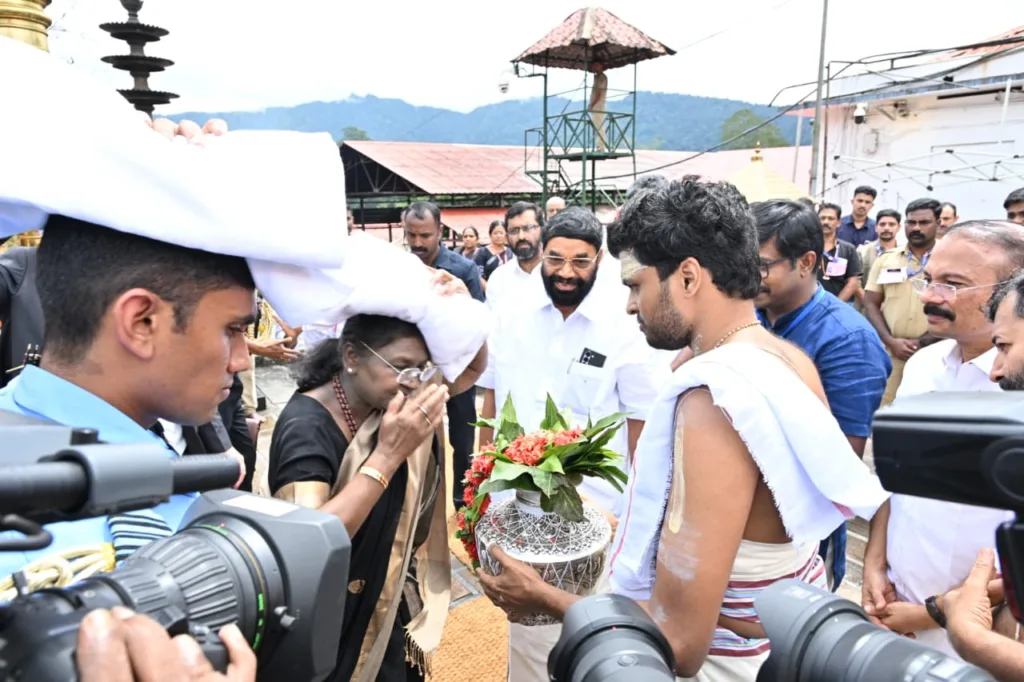
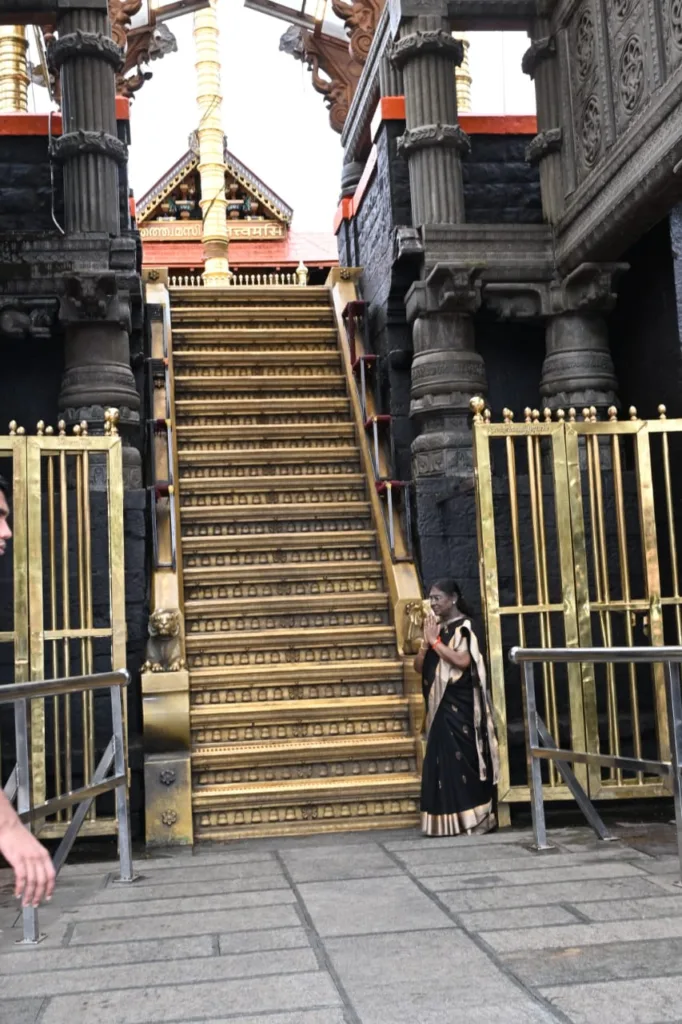
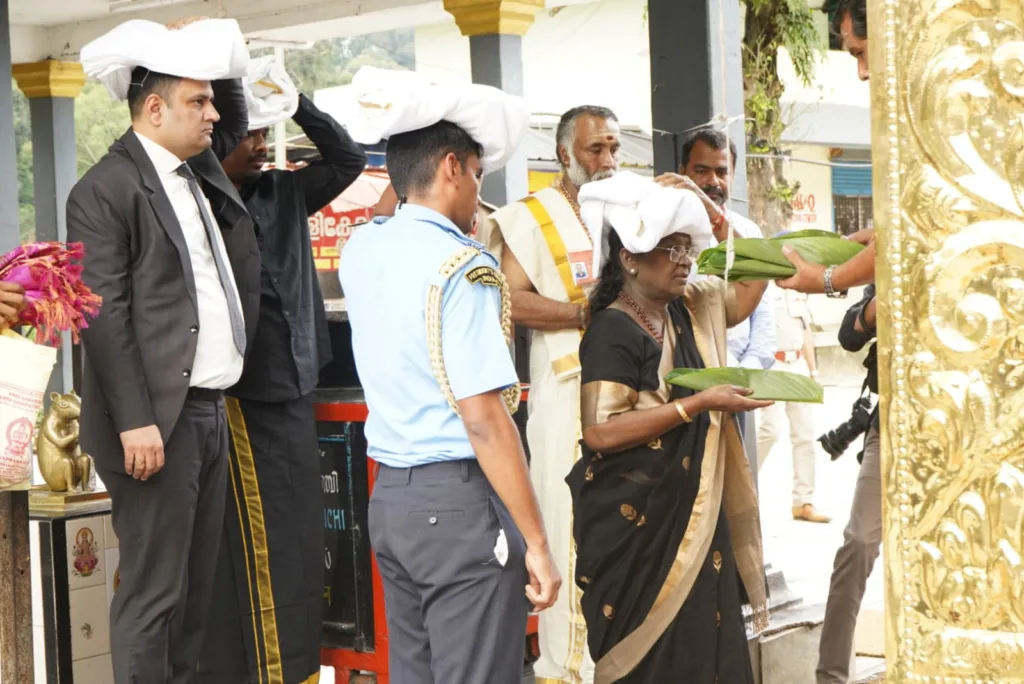
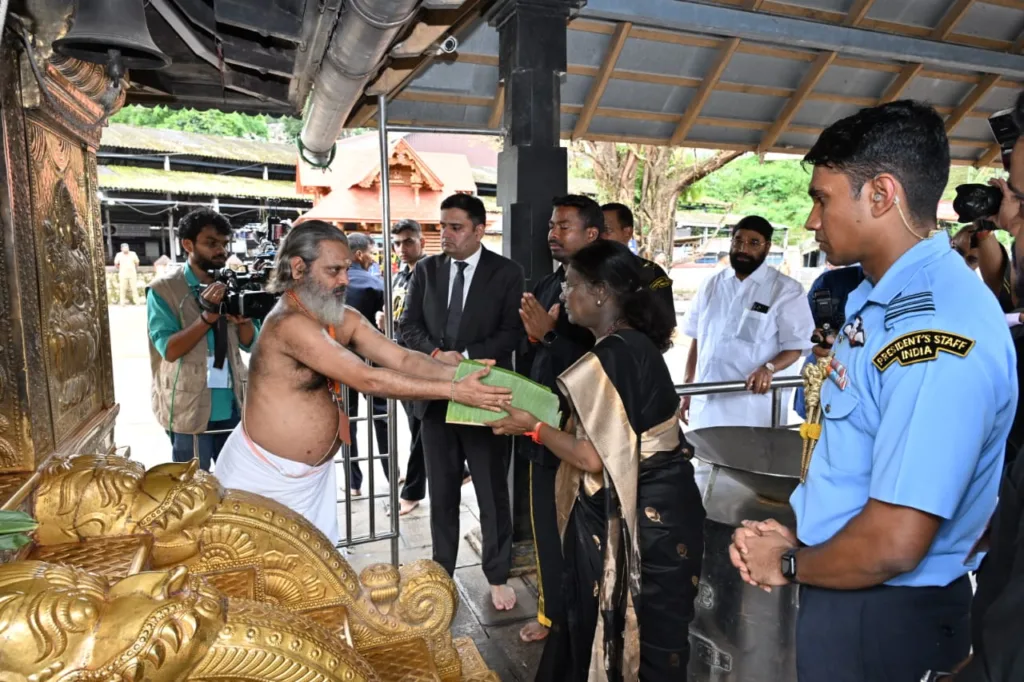
In a landmark moment for India’s spiritual heritage, President Droupadi Murmu today became the first sitting President to offer prayers at the revered Sabarimala Sree Ayyappa Temple in Kerala, ascending the sacred 18 steps with the traditional irumudikettu.
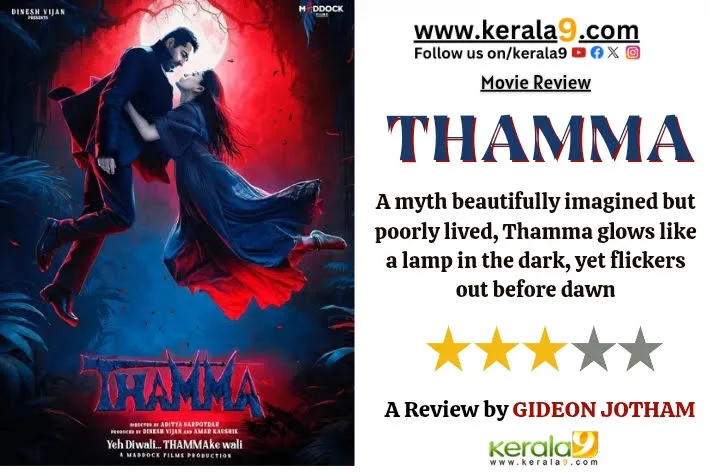
Thamma: “A myth beautifully imagined but poorly lived, Thamma glows like a lamp in the dark, yet flickers out before dawn.”
A REVIEW BY GIDEON JOTHAM
Film: Thamma
Director: Aditya Sarpotdar
Language: Hindi
Duration: 2hr 28 Min
Genre: Horror, Comedy, Romance
Positives
Story
Performance of actors
Screenplay.
Music and Songs
Artworks
1st Half
Negatives
1. Predictability
2. Link to the other films
3. Cinematography
4. Second half
Story
Long before independence, when white men ruled the land and faith was sold for science, the British dug through the soil of India not for treasure but for truth they could cage. In their arrogance, they unearthed what should have stayed buried the myth of Thamma, a being that wasn’t god or ghost, but the very balance between life and death. Those who tried to understand it vanished into madness, their research sealed in forgotten colonial archives.
A century later, in modern-day India, Alok Goyal (Ayushmann Khurrana), a young historian working for the National Museum, stumbles upon one of those lost British manuscripts. Its pages speak of “Thamma The Blood of the Eternal” a cryptic line that grips Alok’s mind like a curse. He dismisses it as superstition at first, but curiosity becomes obsession. He travels to an abandoned British outpost in South India, where myth and history blur into something far more dangerous.
There he meets Tadaka (Rashmika Mandanna) a woman who seems to know his past before he speaks it. She moves through the village like a ghost in daylight, her presence magnetic, her eyes filled with centuries of silence. When she touches him, Alok feels a pulse that isn’t his own.
Slowly, his world begins to unspool. Mirrors refuse to reflect him. His body rejects the sun. Dreams of old British explorers, blood rituals, and firelit chants invade his nights. The transformation is not cinematic it’s slow, painful, and terrifying. Alok realizes that the manuscript he found wasn’t a record of a myth it was a warning.
As Alok’s humanity fades, he becomes the reincarnation of the very creature the British feared the Thamma. But his awakening also reawakens Yakshaashan (Nawazuddin Siddiqui), the last living Thamma from centuries ago a once-noble guardian now twisted by eternal hunger. Their connection is both ancestral and apocalyptic.
The final act unfolds during Diwali lamps glowing, streets alive as Alok’s body burns from within, torn between his human love for Tadaka and the monstrous instinct calling him to Yakshaashan’s side. The festival of light becomes a battle between creation and decay, between love and hunger, between man and myth.
By the end, Thamma isn’t just a supernatural tale it’s a haunting reflection on colonial greed, eternal punishment, and the dangerous thirst for truth. Alok’s tragedy is that he didn’t find history; he became it.
Direction
Aditya Sarpotdar’s direction in Thamma feels like a grand visual poem trapped inside a confused screenplay. There’s no denying that he is a director with vision his sense of atmosphere, tone, and texture is striking. From the colonial ruins to the candle-lit interiors, from the haunting shadows to the surreal transitions between dream and reality, every frame feels aesthetically alive. But beauty alone cannot hold a film together and that’s where Thamma slowly loses its soul.
Sarpotdar begins the film with a strong foundation: myth meets modernity, love meets legend, and horror meets philosophy. The first act is promising, filled with a sense of mystery and intellectual curiosity. But as the story deepens, the direction begins to wander without purpose. The tension that he builds so carefully never fully explodes; instead, it dissolves into fragments of misplaced subplots and emotional confusion.
There’s a constant struggle in his storytelling as if he’s torn between making an artistic horror film like Tumbbad and a commercial mythological entertainer. This tonal tug-of-war creates a rhythm that feels inconsistent. Some scenes linger too long, milking atmosphere without advancing emotion, while others rush past crucial character moments, robbing the story of its depth.
The romance between Alok and Tadaka, which could have been the film’s emotional heartbeat, is treated like a subplot instead of a central force. Their chemistry flickers in glimpses but never glows not because the actors lack effort, but because the direction never lets them breathe. Moments that demand silence are often drowned by visual gimmicks or misplaced background music.
To his credit, Sarpotdar handles scale well. The world of Thamma feels grand and believable, and the mythological layers are fascinating. But he fails to connect that grandeur with emotional gravity. His eye captures beauty, but his hand forgets to guide emotion. The film looks like it’s about gods and curses yet what it really needed was pain, intimacy, and quiet madness.
By the climax, when the lights of Diwali glow over the chaos of gods and monsters, the audience feels visually stunned but emotionally disconnected. Sarpotdar has built a temple of atmosphere but one without a beating heart.
In the end, his direction in Thamma stands as a reminder that a filmmaker can master the craft but still lose the soul of storytelling. Aditya Sarpotdar gives us a film that looks like mythology reborn, but feels like emotion forgotten.
Screenplay
If Thamma had one fatal flaw, it was not the story it was the way it was told. The film had the bones of brilliance: colonial history, mythical horror, and a love story torn between light and blood. But the screenplay, instead of weaving these layers together, scatters them like broken fragments of a forgotten script.
The first act begins with intrigue Alok’s discovery of the British manuscript, the mysterious Tadaka, and the slow emergence of the myth. For a while, it feels like the film is building toward something grand. But soon, the writing loses focus. Scenes drift without purpose, dialogues become overly symbolic, and subplots emerge without emotional consequence. What should have been a steady descent into darkness becomes a clumsy fall into confusion.
The structure feels rushed in parts and painfully stretched in others. Moments that should breathe Alok’s realization of his transformation, his moral struggle, his love for Tadaka are brushed past as if the film is afraid of silence. Instead of exploring his internal collapse, the screenplay jumps from one visual metaphor to another, mistaking mystery for depth.
The emotional beats are unbalanced. The romance feels half-written, the horror lacks buildup, and the mythology is reduced to scattered exposition. There’s no rhythm between tension and release the story unfolds in bursts, never settling into a consistent tone. Even the dialogues, though occasionally poetic, often sound like they’re written for the trailer rather than the scene.
One of the screenplay’s biggest crimes is its inability to connect emotion with logic. Characters behave erratically; motivations are murky. Tadaka appears and disappears like a symbol rather than a person. Yakshaashan’s backstory, which could have grounded the myth, is delivered too late and too briefly. The result is a film that constantly teases brilliance but never earns it.
There’s also a frustrating lack of perspective. The story begins as Alok’s personal journey an academic’s descent into legend but halfway through, the narrative loses sight of him. The focus shifts aimlessly between mythic backstory, political undertones, and visual grandeur, making the emotional center vanish completely.
What hurts most is the wasted potential.Thamma could have been a rare blend of Indian mythology and gothic horror a story that questions identity, colonial guilt, and eternal punishment. Instead, the screenplay flattens it into a series of visually arresting, emotionally hollow scenes.
By the final act, you realize that Thamma isn’t incoherent because it’s complex it’s incoherent because it’s unfinished.The story knows where it wants to go but not how to get there.
In short, Thamma’s screenplay feels like a sacred text translated without understanding its soul. The myth is there, the world is there, but the heart is missing. And when the writing lacks heart, even the most powerful legends fall silent.
Cinematography and Editing
If Thamma stumbles in writing, it at least tries to redeem itself visually but even that redemption feels partial, uneven, and at times self-indulgent. The cinematography by Pratheep Kaliraja (if we go by the credits) aims for mysticism, grandeur, and texture but often mistakes visual density for depth. The film is bathed in tones of decay sepia, smoke, and desaturated golds trying to recreate a mythic past haunted by colonial echoes. On the surface, it looks impressive; the frames are carefully composed, the lighting symbolic, and the camera movements deliberate. But beyond the beauty lies a sense of disconnection.
The lens constantly tries to tell a story the screenplay forgot to lingering too long on metaphors, ruins, and cryptic imagery. The problem is not the ambition but the execution. The camera romanticizes what it should fear, aestheticizes what it should haunt. As a result, Thamma becomes visually beautiful but emotionally hollow every shot screaming for meaning that never arrives. The transitions between reality and hallucination are blurred, but not in a way that invites the viewer in; they confuse rather than mesmerize.
That said, there are flashes of brilliance especially in scenes involving the forest, the temple ruins, and Tadaka’s appearance. The use of shadows and reflections conveys an otherworldly tension that the writing fails to support. The DP clearly had a vision, but without narrative rhythm, those moments float like paintings in search of a story.
Editing, on the other hand, worsens the film’s imbalance. The cuts are either too abrupt or painfully delayed, leaving sequences hanging in awkward silence or rushing through emotional beats. The pacing never stabilizes it’s as if the film keeps forgetting what mood it’s in. One moment, it’s meditative; the next, it’s chaotic. The transitions between timelines and realities, rather than adding intrigue, often blur the viewer’s comprehension.
The editing also struggles with tone. It doesn’t know when to breathe and when to bite. Key emotional scenes like Alok’s confrontation with Tadaka or his descent into obsession are chopped too short, while less essential sequences are stretched unnecessarily, breaking momentum. The visual rhythm collapses under its own ambition.
In essence, Thamma’s cinematography and editing mirror the film itself filled with intention but lost in translation. Every frame promises poetry, but the cut kills the rhythm before the emotion can bloom. What could have been a haunting visual epic turns into a fragmented gallery of half-realized dreams.
Music and Sound Design
If Thamma falters in story and screenplay, its music and sound design are the closest things to salvation though even here, brilliance is uneven. The soundtrack attempts to mirror the film’s mythic ambition, blending traditional instruments, haunting chants, and subtle electronic textures. Moments of tension, particularly when Alok’s transformation begins, are supported by layers of sound that are ethereal, eerie, and emotionally resonant. These cues give fleeting life to a narrative that otherwise struggles to grip.
The background score often works beautifully during ritualistic sequences, temple scenes, and moments of supernatural suspense. The thrum of drums, low humming vocals, and choral swells immerse the viewer in a world where mythology collides with reality. In particular, Tadaka’s appearances are often accentuated by sound motifs subtle enough to suggest mystique, strong enough to create anticipation.
However, the sound design is inconsistent. In some action sequences or transformational moments, the audio overwhelms the visuals rather than complementing them. Loud crashes, overused crescendos, and sudden musical shifts sometimes distract instead of heightening the tension. Silence, which could have been used as a powerful tool to let the horror or emotional weight breathe, is rarely exploited. There’s very little subtlety in moments that demand it; instead, the soundscape frequently opts for the obvious “dramatic cue” approach.
Songs, where they appear, feel inserted rather than earned. Their placement interrupts the flow of the narrative, breaking the immersion and reducing tension. While each track individually has merit and occasional emotional punch, the overall integration with story and characters is flawed.
In short, Thamma’s music and sound design oscillate between brilliance and overstatement. They occasionally lift the film, offering glimpses of the mythic and supernatural grandeur it aims for, but cannot fully compensate for the narrative and structural weaknesses. The score and soundscape whisper what the story often fails to shout: a haunting, ancient world caught between history, legend, and human frailty.
Performance of Actors
In Thamma, the performances reflect both potential and frustration the actors clearly tried to give life to their roles, but the writing and direction frequently leave them stranded.
Ayushmann Khurrana as Alok Goyal carries the film’s emotional weight, and to his credit, he commits fully to the transformation from a curious historian to a man grappling with a mythic curse. His subtle expressions, hesitant body language, and moments of quiet fear convey vulnerability. However, the inconsistent screenplay and abrupt character shifts leave his performance underutilized Alok’s internal struggle is sometimes lost between rushed transitions and visually striking but emotionally empty sequences. Despite this, Khurrana’s screen presence is enough to make the audience care, even if just slightly, about his fate.
Rashmika Mandanna as Tadaka exudes grace, mystery, and elegance. Her physical presence and controlled expressions add depth to a character that is otherwise thinly written. Tadaka is meant to be the bridge between myth and human emotion, yet the abruptness of her arc and limited dialogue prevent her from fully inhabiting the role. While she shines in visual and mystical moments, the emotional connection with Alok never quite ignites, leaving their romance only partially realized.
Nawazuddin Siddiqui as Yakshaashan is magnetic in brief appearances. He brings menace, gravitas, and an underlying sense of ancient sorrow, but the script doesn’t give him enough screen time or context to make the character truly memorable. His presence hints at immense potential, yet his role feels fragmented, a shadow of what could have been a mythic antagonist.
Supporting cast members village elders, colonial figures, and other mystical beings perform competently but are largely underwritten. Many characters exist to move the plot forward rather than as fully realized humans, leading to emotional detachment in key narrative beats.
Overall, the performances in Thamma are a mix of dedication and frustration. Talented actors attempt to breathe life into a film that rarely allows them the space to do so. Their efforts provide intermittent glimpses of engagement, but the screenplay’s shortcomings prevent the performances from reaching their full impact.
Final Verdict: 3 / 5
Thamma is a film of ambition and beauty trapped in inconsistency. It promises myth, horror, and romance wrapped in a haunting colonial past, but the narrative never fully delivers. The direction dazzles visually, the performances hint at depth, and the music and cinematography evoke wonder, yet the screenplay collapses under its own weight, leaving characters underdeveloped and the story emotionally hollow.
What could have been a gripping, mythic journey instead becomes a collection of striking images and fragmented ideas. The romance falters, the mythology feels underexplored, and the tension rarely sustains itself leaving the audience more impressed by what they see than what they feel.
Thamma is watchable for its aesthetic ambition and occasional supernatural thrills, but it is ultimately a film where potential outweighs execution. A fascinating myth emerges from shadows, yet the light of storytelling barely reaches it.
Deepti Sati is an Indian movie actress who mainly works in Malayalam films. Deepti Sati Photos . Check out the latest pictures, pics, Deepti Sati new photos, movie stills, event photos, Deepti Sati photoshoot and images of Deepti Sati .
A ceasefire agreement has been reached between Pakistan and Afghanistan after diplomatic talks mediated by Qatar and Turkey. The announcement was made by the Qatari Ministry of Foreign Affairs following discussions held in Doha. The ceasefire follows recent clashes along the Afghanistan-Pakistan border, which escalated after a Pakistani airstrike that reportedly killed several individuals, including three cricketers, according to the Afghanistan Cricket Board. Pakistan claims that Afghanistan has been providing refuge to individuals responsible for orchestrating terrorist attacks within Pakistani territory. Despite both countries initially agreeing to a temporary 48-hour ceasefire, Pakistan reportedly carried out further airstrikes, targeting residential areas near the border. In the latest development, both sides have agreed to continue further talks in an effort to ensure the ceasefire remains stable and long-lasting.
The India Meteorological Department (IMD) has predicted heavy rainfall in Kerala over the next five days and issued orange and yellow alerts for various districts across the state. Today, several central and northern districts are under orange alert due to the likelihood of intense rain, while southern and central districts are under yellow alert. The pattern is expected to continue through the coming days, with varying degrees of rainfall anticipated in most parts of the state. According to the IMD, districts including Thiruvananthapuram, Kollam, Pathanamthitta, Alappuzha, Kottayam, and Thrissur will be affected at different points throughout the forecast period. The department has urged the public to remain cautious, avoid low-lying flood-prone areas, and follow safety measures as the state prepares for more adverse weather conditions.
In connection with the investigation into the missing gold plating from the Dwarapalaka idol at the Sabarimala temple, the Special Investigation Team (SIT) has recovered gold ornaments and cash from the residence of Unnikrishnan Potti, the sponsor who was recently arrested in the case. The search was conducted at his family home in Karette, Thiruvananthapuram, and lasted nearly eight hours. The gold found was in the form of jewelry, which the family claims is for personal use. However, the investigation team has also recovered documents related to land transactions, raising suspicions that land might have been purchased using funds obtained through fraudulent means. Potti is expected to be taken to Bengaluru by the investigation team for evidence collection. Reports indicate that key information has already been gathered from him during interrogation.
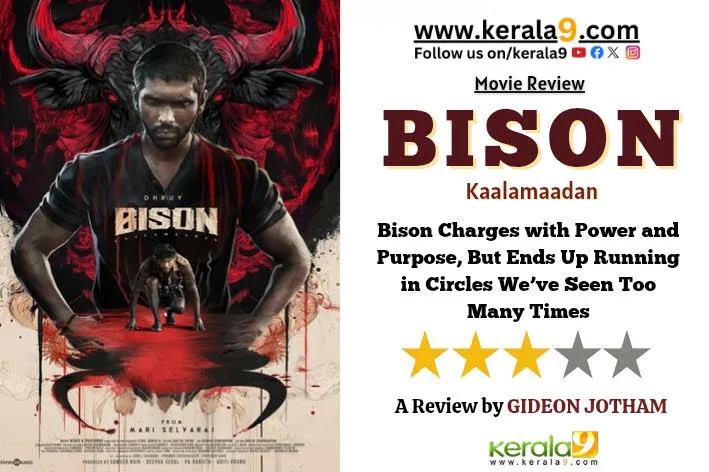
Bison Movie Review: Bison Charges with Power and Purpose, But Ends Up Running in Circles We’ve Seen Too Many Times.
REVIEW BY GIDEON JOTHAM
Film: Bison Kaalamaadan
Director: Maari Selvaraj
Language: Tamil
Duration : 168 minutes
Genre: Political Sport Drama
Positives
1. Cinematography
2. Dialogues
3. Performance of actors
4. Screenplay.
5. Artworks
Negatives
1. Story
2. Predictability
3. Usual colour theory
Story
If Pariyerum Perumal was about the fight for dignity, Karnan about the rebellion for justice, and Bigil about reclaiming respect through sports, then Bison is where all three worlds collide pain, politics, and perseverance merging into one man’s journey.
Maari Selvaraj, once again, returns to his familiar soil a world where caste breathes through the cracks of dreams, and politics hides beneath the banner of pride. But this time, the battlefield isn’t a classroom or a village street it’s the Kabaddi court, a ground where sweat, blood, and identity clash for something larger than victory.
The film opens with thunder an India vs Pakistan National Kabaddi Final. The stadium roars, lights blaze, the nation holds its breath. Amid the chaos sits Dhruv, the protagonist, quietly waiting on the substitute bench. His eyes are restless, his heart louder than the crowd. Somewhere far away, in a small dusty village, his people gather around a projector screen, chanting his name, waiting to see their boy step into the ground.
But fate, as always, remains cruelly silent. A referee’s mistake ties the game, ending in controversy. The headlines scream for a rematch, and the coach, afraid of losing, debates who deserves to play. Amid the noise of ego and fear, Dhruv rises, excuses himself for a restroom break and in that small, symbolic moment, the film transitions into his past.
The flashback isn’t glamorous; it’s raw and heavy. We meet a younger Dhruv a boy whose talent on the Kabaddi field couldn’t erase the label society had stamped on him. Born in a lower-caste family, he learns early that no matter how high he jumps or how hard he tackles, the world still sees the name before the number.
His father, calm and wise, is a man of patience one who believes peace can heal where protest cannot. But Dhruv carries a different fire not loud, not violent, but burning quietly under his skin. The village, divided by caste and pride, mocks his ambition. Every game he wins becomes a reminder that he is crossing invisible boundaries.
Maari Selvaraj draws us deep into this suffocating reality showing how systemic bias slips into every corner: from local Kabaddi selection politics to the playground where friendships die over surnames. The lens lingers on faces that smile in daylight and conspire in the dark.
Dhruv’s love story blooms in this dust a simple, fragile relationship that gives him hope, only to be tested by the same cruel structures that break everything beautiful. Their moments together walking by the riverside, laughing over little things feel like stolen breaths in a world that doesn’t allow love to exist without condition.
As Dhruv’s talent grows, so does the resistance against him. Local politicians use his victories as tools for power, while others try to destroy him through manipulation and betrayal. When a rival player, driven by caste arrogance and personal vengeance, challenges Dhruv, the story shifts from emotional struggle to brutal confrontation.
The second half of Bison bleeds literally and metaphorically. Violence erupts, not for sport, but for identity. Bodies fall, hearts break, and the color red floods the screen a recurring metaphor that Maari has mastered but, this time, perhaps overused. The Kabaddi court becomes a mirror of society the tackles representing oppression, the scores symbolizing survival.
When the narrative returns to the present, Dhruv is no longer just a player; he’s a man who has lived through betrayal, discrimination, and loss. As he steps onto the court for the rematch, the question isn’t will India win? it’s will Dhruv forgive the world enough to play for it?
The final minutes are haunting. The stadium echoes, the crowd roars, but the camera stays on Dhruv’s face scarred, calm, and ready. The whistle blows. Every move he makes carries the weight of generations who were told they don’t belong.
Like Pariyerum Perumal, Bison speaks about identity. Like Karnan, it rages against injustice. And like Bigil, it uses sports as a language of resistance. But beneath all those layers, Bison is deeply human the story of one man learning that true victory isn’t about medals or applause; it’s about surviving in a world determined to see you fall.
Direction
Maari Selvaraj’s direction in Bison is powerful, but familiar. From the very first frame, you can sense his trademark the earthy landscapes, the emotionally heavy silences, the political undertones that breathe through his characters. His control over the craft is undeniable; every frame is purposeful, every pause is loaded with meaning. But the larger question that lingers is have we seen this before?
Much like Pariyerum Perumal, Karnan, and his recent Vaazhai, Bison too travels through the same emotional and visual corridors. The frames look hauntingly similar dusty roads, wounded men, piercing gazes, and color palettes drenched in red and brown. His choice of symbolism, particularly in representing oppression and caste politics, once felt revolutionary. Now, it feels like a pattern he’s too comfortable repeating.
That said, Maari’s ability to connect the audience with pain, struggle, and silent rebellion is still unmatched. His actors don’t just perform; they live the roles he gives them. The way he extracts emotion through the stillness of a character’s face or a long, uninterrupted take shows his mastery over human storytelling.
However, what Bison lacks is evolution. The direction feels like a continuation rather than a leap. The same emotional beats, the same narrative rhythm, the same color-coded metaphors they all work, but without surprise. It’s a film beautifully directed, yet stuck in its own shadow.
In short, Maari Selvaraj directs Bison with conviction, precision, and heart but not with discovery. It’s the work of a filmmaker who knows his voice well, perhaps a little too well.
Screenplay
The screenplay of Bison could have been far more gripping. Maari Selvaraj, known for his layered and symbolic storytelling, seems to have diverted much of his attention toward emotional subplots and caste commentary both powerful, but overextended. While these elements carry strong social relevance, they often overshadow the core of the story and dilute its cinematic tension.
Maari is a director capable of weaving hard truths into seamless narratives, as seen in Pariyerum Perumal and Karnan. But here, the screenplay feels uneven brilliant in moments, yet loosely held together as a whole. The transitions between the Kabaddi sequences and the secondary political drama lack the sharpness needed to sustain engagement.
Instead of deepening the sporting arc or developing the protagonist’s internal journey through strategic narrative beats, the film spends too much time reiterating its message on caste and oppression themes that, while vital, begin to feel repetitive within Maari’s filmography. As a result, the emotional intensity remains high, but the narrative drive weakens midway.
Had Maari focused more on tightening the screenplay crafting stronger conflicts within the sport, elevating the structure of the flashbacks, and giving the characters more layered motivations Bison could have held its audience with greater grip and freshness.
The script carries heart and purpose, but it misses rhythm. In short, the screenplay doesn’t fail it just falls short of what Maari Selvaraj is truly capable of.
Cinematography
The cinematography of Bison stands as one of its strongest pillars. The visual narrative mirrors the tone of the story raw, grounded, and soaked in emotion. Each frame feels lived in, not staged. The lens moves between the dust and the light, capturing the soul of rural Tamil Nadu and the intensity of the Kabaddi court with equal precision.
The match sequences are choreographed and shot with striking realism sweat, soil, and tension fill every corner of the frame. The use of handheld shots immerses the viewer into the chaos, while wide angles showcase the scale of both the sport and the society it reflects. The play of natural light enhances authenticity, especially in dawn and dusk scenes, where the sun itself feels like a silent witness to the character’s struggles.
In contrast, the flashback portions are treated with softer tones and slower movements, creating a visual separation between the past and present. The camera lingers on faces, letting emotions breathe. Every tear, glare, and pause is captured with quiet respect.
However, while the visual quality is undeniably strong, there’s a lingering sense of déjà vu Maari Selvaraj’s trademark palette of reds, browns, and golden hues reappears here too. Though it adds visual continuity across his films, it also limits Bison’s identity as a standalone work.
Still, the cinematography succeeds in making the viewer feel the pain, dust, and heartbeat of the story. It is poetic without being pretentious a visual language that speaks louder than the dialogues themselves.
Editing
The editing in Bison is clean, deliberate, and rhythmically consistent. The transitions between the present and flashback portions are fluid, making the narrative flow effortlessly despite its non-linear structure. The film opens with high-energy sports tension and gently slips into emotional memory without abruptness a sign of careful, thought-out editing.
Each segment has its own pace: the Kabaddi scenes are cut fast and sharp to build adrenaline, while the emotional sequences breathe slowly, allowing silence and pain to settle. This contrast keeps the viewer engaged and emotionally aligned with Dhruv’s internal rhythm.
However, the second half occasionally drags especially during the political subplots and revenge stretches. A few sequences could have been trimmed to preserve intensity, as the emotional weight sometimes slows the storytelling momentum.
Despite this, the editing ensures that Bison never loses its emotional focus. The cuts are not flashy; they are functional and sensitive to the tone of the story. The final match sequence, edited with pulsating energy and emotional restraint, stands out as one of the film’s most powerful moments.
In essence, the editing complements the film’s mood tight when needed, tender when required helping Bisonmaintain its emotional pulse from start to finish.
Music
The music of Bison truly rocked and served as the film’s emotional backbone. From the very first Kabaddi sequence to the final act, the soundtrack carries the film with both rhythm and soul. The background score doesn’t just underline the visuals it breathes with them, amplifying every emotion Maari Selvaraj intends to convey.
The composer delivers a perfect blend of rustic folk and modern orchestration. The drums thump with raw energy during the match scenes, echoing the heartbeat of the sport, while the softer instrumentals in the flashback portions tug gently at the audience’s emotions. The music moves seamlessly between rage and tenderness, mirroring Dhruv’s journey from humiliation to pride.
The songs, too, stay rooted in the soil lyrical, haunting, and honest. They connect deeply with the film’s setting and themes, never feeling forced or commercial. One can feel the pulse of the land, the pain of the people, and the hope within despair through every note.
In short, Bison’s music is both energetic and emotionally resonant it uplifts the narrative when words fall short and ensures that the film’s emotions reach beyond the screen, straight to the heart of the listener.
Performance of Actors
Dhruv Vikram as Kittan His portrayal captures the internal and external struggles of his character, balancing vulnerability with resilience. Critics have lauded his nuanced acting, noting his ability to convey complex emotions without resorting to melodrama.
Anupama Parameswaran as Rani Anupama Parameswaran portrays Rani, Kittan’s love interest. Her performance adds warmth and tenderness to the film, providing a contrast to the intense themes explored. Her chemistry with Dhruv Vikram is palpable, and she brings a sense of hope and humanity to the narrative
Pasupathy as Velusamy Veteran actor Pasupathy plays Velusamy, Kittan’s father. His portrayal is marked by quiet strength and wisdom, offering guidance and support to his son. Pasupathy’s performance adds depth to the film, grounding the story in familial bonds and generational struggles.
Lal as Kandasamy Lal takes on the role of Kandasamy, a pivotal character whose actions significantly influence the story’s progression. His performance is both commanding and nuanced, effectively conveying the complexities of his character’s motivations.
Rajisha Vijayan as Raji Her performance is subtle yet impactful, contributing to the film’s exploration of community dynamics and personal aspirations.
Azhagam Perumal as Kandippan Azhagam Perumal plays Kandippan, a character whose presence adds to the film’s exploration of societal structures and individual agency. His performance is marked by restraint and depth, enhancing the film’s thematic richness.
Ameer as Pandiaraja Ameer portrays Pandiaraja, a character whose actions and decisions play a crucial role in the unfolding drama. His performance adds intensity to the narrative, reflecting the film’s focus on conflict and resolution.
Final Verdict: 3 / 5
Bison is a familiar journey through caste, politics, and sports, told with Maari Selvaraj’s characteristic emotional intensity. The film shines in its performances, cinematography, and music, with Dhruv Vikram delivering a heartfelt portrayal of struggle, resilience, and quiet rebellion. The visuals are raw and immersive, the score energizes the narrative, and the dialogues resonate with honesty.
However, the story and screenplay feel predictable, treading paths Selvaraj has already explored in Pariyerum Perumaland Karnan. The direction, while competent and visually consistent, doesn’t break new ground, and the secondary subplots sometimes dilute the core narrative.
In essence, Bison is emotionally powerful but narratively familiar a one-time watch for its performances and visual storytelling, yet slightly held back by repetition. It’s a film that touches the heart but doesn’t fully surprise the mind.
Diesel: Starts with a roar but quickly runs out of fuel, leaving the audience stranded at the side of the road.
A REVIEW BY GIDEON JOTHAM
Film: Diesel
Director: Shanmugam Muthusamy
Language: Tamil
Duration: 144 minutes
Genre: Action Drama, Politics
Positives
Story
Second half
Performance of Actors
Stunts
Negatives
Screenplay
Editing
Underdeveloped characters and a Sudden shift of character arc.
Direction
Prediectblity
First half.
Art Direction
Story
Diesel promises a high-octane tale of rebellion and survival, but what it delivers is a clunky, overstuffed narrative that never quite ignites. The film opens with Vasu, a local from Chennai’s fishing community, engaging in the titular diesel smuggling a premise that could have explored the grit, struggle, and moral ambiguity of life on the margins. Instead, the story rushes from one action set-piece to another, leaving little room to breathe, to understand, or to care about the characters’ motivations.
The narrative attempts to balance multiple threads: Vasu’s smuggling exploits, his rise as a “community hero,” a corrupt police antagonist, and a tepid romantic subplot. On paper, this could have made for an intense, layered drama but on screen, it feels disjointed. Scenes collide like poorly synchronized gears; action sequences interrupt emotional beats, and melodrama punctures moments that should have been tense or heartfelt.
Characterization is another casualty. Vasu is written to be both fearless and morally righteous, but the script never gives him the depth to justify his sudden leaps from petty smuggler to savior of his people. The antagonist, too, is painted with broad strokes threatening, predictable, and lacking nuance turning every confrontation into a mechanical exercise rather than an emotionally charged showdown. Even the romantic subplot feels like a checklist item, offering little emotional investment and breaking the film’s already shaky rhythm.
Diesel also struggles with believability. The smuggling operations, the police interventions, and the sudden community hero status are all presented in exaggerated sequences that feel more like commercial spectacle than grounded storytelling. Instead of tension and suspense, the audience is left watching a sequence of predictable tropes: fistfights, narrow escapes, speeches about justice, and melodramatic confrontations that fail to leave a lasting impact.
In short, the story of Diesel is a missed opportunity. It wants to be an edge-of-the-seat thriller, a social commentary, and a heartfelt drama all at once but by trying to do everything, it fails to do anything convincingly. The result is a film that, despite its loud action, glossy visuals, and over-the-top heroics, feels hollow, rushed, and forgettable.
Direction
If the screenplay is the skeleton of Diesel, then the direction is its limp, floppy limb trying to move, but failing at every turn. Shanmugam Muthusamy’s direction in this film is disappointingly mechanical, unimaginative, and uninspired. What should have been a taut, high-octane drama instead feels like a series of loosely connected sequences strung together without rhythm or vision.
The film’s pacing is erratic action sequences are introduced with little buildup, emotional beats collapse under their own weight, and tense moments are robbed of suspense because the director fails to create stakes. Scenes linger unnecessarily, dialogues are delivered flatly, and transitions between plot threads are clumsy at best. There is no tension, no buildup, no sense of flow only a checklist approach to filmmaking: insert action, insert fight, insert melodrama, repeat.
Even the performances, which are solid in parts, are undermined by uninspired direction. Characters are allowed to act without context, confrontations feel staged rather than earned, and emotional moments fall flat because the camera doesn’t know where to focus or how to convey them. The film’s social commentary, smuggling drama, and community conflicts all exist in isolation, as though the director never considered weaving them into a coherent cinematic tapestry.
The only thing Diesel consistently demonstrates is that direction without vision can ruin even a capable cast and a visually interesting setting. There’s no sense of style, no thematic rhythm, and no emotional logic just a movie moving from one scene to another because the script says it must.
In short, Shanmugam Muthusamy’s direction is a textbook example of styleless execution: competent in technical terms but entirely devoid of the imagination, tension, or storytelling instinct needed to make a film engaging. It doesn’t just fail to elevate the material it actively drags it down.
Screenplay
If the screenplay of Diesel were a diesel engine, it would be sputtering, leaking, and breaking down every five minutes. This is, without exaggeration, the weakest link in the film a narrative so full of loopholes, lazy plotting, and illogical leaps that it actively works against the performances, the direction, and even the action sequences.
From the very first act, the script struggles to establish stakes convincingly. Vasu’s transformation from a petty smuggler to a community hero is abrupt, poorly motivated, and emotionally unearned. The audience is asked to cheer, worry, and empathize, but the screenplay never gives us the tools to believe in his journey. Moments that should carry tension, suspense, or drama fall flat because the logic behind the actions is either missing or completely contrived.
The antagonist, instead of being a layered foil, is a cartoonish villain, delivering threats and monologues without nuance. His decisions make little sense, and his repeated encounters with Vasu feel repetitive rather than climactic. The conflicts that should escalate naturally feel artificial, leaving the audience shaking their heads rather than sitting on the edge of their seats.
Secondary plotlines including a romantic subplot and community drama are poorly integrated, often halting the narrative rather than enhancing it. The romance feels tacked on, lacking chemistry or stakes, and serves more as a filler than an emotional anchor. Meanwhile, side characters come and go without impact, their motivations unexplored, their presence barely justifying their inclusion.
The pacing is erratic. Action sequences, which should inject adrenaline and excitement, instead feel disjointed because the script fails to build context or consequences. Police chases, smuggling operations, and fistfights happen in isolation, without tension, and without logical progression. The screenplay attempts to juggle too many ideas social commentary, personal vengeance, love, crime but ends up dropping almost all of them halfway, leaving a patchwork narrative that lacks coherence or momentum.
In short, the screenplay of Diesel is not merely flawed; it is actively destructive to the film. It undermines performances, weakens direction, and makes the story nearly impossible to engage with. The film’s visual style, music, and occasional action sequences cannot mask the fact that the backbone the script itself is riddled with holes, mistakes, and missed opportunities.
This is a screenplay that could have been salvaged with tighter writing, consistent character motivations, and logical storytelling. Instead, it lumbers forward like a broken engine, leaving the audience frustrated, disconnected, and wondering how a film with potential ended up so mechanically lifeless.
Cinematography
If the direction is limp, the cinematography in Diesel is blurry at best and lifeless at worst. Despite being set in the visually rich backdrop of North Chennai, the camera fails to capture the soul of the story. Action sequences, which should pulse with energy, are often shot in chaotic, shaky frames that confuse rather than excite. Long takes and wide shots, meant to create scale, feel empty and purposeless, leaving the audience wondering why we’re even looking at this.
Lighting is inconsistent some scenes are overly bright, washing out the tension, while others are murky, making it hard to follow the action. Even when the story calls for intimate close-ups to convey emotion, the camera lingers awkwardly or frames the characters poorly, stripping the moments of any impact.
In essence, the cinematography in Diesel is technically competent but creatively dead, failing to enhance the narrative, the performances, or the world the film tries (and fails) to build. It’s a film that looks like it should be exciting but never actually feels like it.
Editing
If cinematography is lazy, the editing is actively damaging. The film stumbles from scene to scene with little regard for rhythm, tension, or narrative clarity. Action sequences are cut without logic, leaving audiences confused about who is fighting whom or why a chase matters. Emotional moments, which should have breathed and landed, are cut short or interrupted by abrupt, unnecessary transitions.
The pacing is erratic to the point of frustration; some sequences drag endlessly, others rush past without explanation. Flashbacks and subplots appear and disappear like they were glued together haphazardly, leaving the narrative feeling like a patchwork quilt of unrelated events. There is no build-up, no crescendo, and no payoff; only a series of disjointed beats that exhaust rather than engage.
In short, the editing of Dieseldoes not serve the story, the action, or the emotions. Instead, it highlights the film’s incoherence, making the viewing experience exhausting and disengaging. Even with better actors, stronger music, or brighter visuals, poor editing ensures the film never gains momentum or impact.
Performance of Actors & Characterisation
If the screenplay is weak and the direction limp, the performances in Diesel are equally disappointing made worse by underdeveloped characters and jarring, sudden shifts in character arcs. The cast, despite having capable actors, is left floundering in a story that neither respects their roles nor builds their personalities convincingly.
Harish Kalyan as Vasu: Meant to be the heart of the film, Vasu’s character is poorly fleshed out. He jumps from a small-time smuggler to a community hero with almost no justification, leaving the transformation feeling abrupt and unearned. Kalyan’s performance suffers because the arc demands emotional depth and gradual growth that the script fails to provide. His reactions, expressions, and body language often feel forced or misplaced, amplifying the disconnect.
Athulya Ravi as Rani: Rani is written with minimal purpose, mostly serving as a romantic checkbox. Her interactions with Vasu lack chemistry, and her own character arc is virtually nonexistent. She suddenly becomes emotionally invested in Vasu’s mission, but the narrative gives no buildup to justify this change, making her role feel more like a prop than a partner in the story.
Vinay Rai as the antagonist: The villain’s personality swings wildly from menacing to theatrical without reason. He is threatening in one scene, comical in the next, and his motivations shift inconsistently. This lack of character consistency undermines tension and makes the central conflict unbelievable.
Supporting cast: Every other character, from community members to law enforcement, suffers from the same lack of development. They pop in and out of scenes without clear purpose, their decisions often dictated solely by plot convenience. These abrupt character arcs and missing motivations leave the film feeling hollow, as no relationship or conflict ever resonates emotionally.
In essence, the performances are doomed by poor writing, sudden, unearned character shifts, and a lack of depth. Even talented actors cannot salvage roles that are inconsistent, shallow, and mechanically written. The result is a cast going through motions rather than living their characters, leaving Diesel devoid of human connection or emotional impact.
CONCLUSION
So, Diesel sets out to be a high-octane action-drama, but it stalls before it even hits top gear. The film has flashes of potential, the setting is visually interesting, the music occasionally energises scenes, and some moments hint at tension or emotion. Yet, these sparks are smothered by a weak screenplay, poor direction, underdeveloped characters, and uneven performances.
Harish Kalyan tries to anchor the film as Vasu, but his efforts are undermined by abrupt character shifts and a story that refuses to make sense. Supporting actors, flashy action sequences, and the technical aspects fail to compensate for the lack of coherence, narrative depth, and emotional resonance.
In short, Diesel is a film that looks like it should roar, but ends up sputtering. It is watchable for its occasional moments of action or energy, but the experience is uneven, frustrating, and ultimately forgettable.
DUDE Review: ONE WORD: Too Much Drama, A Weak Script, and Overdone Progressive Vibes — Dude Disappoints”
A Review by Arunjyothi R
LANGUAGE: Tamil
DURATION: 02 Hours 19 Minutes
DIRECTOR: Keerthiswaran
GENRE: Romantic Family Drama
•POSITIVES:
1: Direction
2: Performance of Pradeep Ranganathan
3: Music and Background Score
4: Cinematography
5: Entertaining First Half
•NEGATIVES:
1: Storyline
2: Screenplay
3: Romantic Arch lacks depth
4: Duration and Editing
5: The second half loses momentum.
STORY:
Agan (Pradeep Ranganathan) and Kundhana (Mamitha Baiju) aren’t just cousins — they’re childhood companions who grew up side by side, sharing laughter, secrets, and a bond that always felt deeper than words. But family ties come with tangled roots. Sarath Kumar, a commanding minister and loving father, adores both his daughter and nephew, while his sister (Rohini) has long chosen silence over reconciliation, holding on to old wounds that split the family years ago.
Agan’s journey takes a turn when his college romance with Amudha (Neha Shetty) crashes and burns, leaving him disillusioned about love. Just when he’s least expecting it, Kundhana steps forward, confessing a love that’s been quietly growing since childhood. But Agan, blinded by his own heartbreak, sees her only as his closest friend and gently turns her down. Time drifts, emotions shift — and by the time realization strikes, it’s too late. Kundhana has moved on, finding comfort and affection in Pardhu (Hriday Haroon). And for Agan, that’s when everything he once took for granted starts to hurt. What unfolds next is a bittersweet tangle of love, regret, and family conflict — where pride clashes with vulnerability, and silence speaks louder than words.
REVIEW & ANALYSIS OF THE FILM:
WHAT ARE THE POSITIVES:
1: The first and most striking positive in the film is undoubtedly Pradeep Ranganathan’s performance. He once again carries the film on his shoulders with an ease that feels both familiar and refreshing. His mannerisms might remind you of his previous outings in Love Today and Dragon, but there’s something distinct about the way he molds Agan — a blend of vulnerability, confusion, and understated charm. Despite the film’s uneven writing, it’s Pradeep’s screen presence that keeps you glued, making even the slower moments watchable. He navigates through a wide emotional range — from heartbreak and inner conflict to warmth and playful humor — with remarkable conviction. The transition between these moods feels natural, adding emotional depth to a character that could have otherwise felt flat. His portrayal of Agan’s struggles, self-realization, and emotional turmoil carries the kind of relatability that has become Pradeep’s signature. What’s particularly impressive is his dialogue delivery, especially in emotionally charged or ideologically progressive scenes. There’s a sincerity in the way he speaks that makes those moments hit home without feeling forced or preachy. Even when the script stumbles, Pradeep manages to elevate the material with his timing, expressions, and charisma.
2: For me, the story and screenplay didn’t quite hit the mark, but the making and direction certainly carried a sense of cinematic polish. As a debut director, Keerthiswaran shows commendable control over his craft — blending romance, comedy, and a subtle social message into a film that maintains a lively, upbeat tone right till the end. The movie never feels dull in its presentation; it’s loud, colorful, and confidently staged, reflecting the filmmaker’s effort to balance entertainment with thought. What stands out is how Keerthiswaran handles the social theme. Instead of turning it into a preachy lecture or stretching it into forced emotional moments, he allows the message to emerge naturally through the flow of events. It feels conversational rather than instructional — a welcome approach for a debutant. The transitions between emotional and comic portions are handled neatly, showing his understanding of rhythm and audience engagement.
3: Sai Abhyankkar truly deserves a round of applause for his exceptional musical contribution to the film. His work stands as one of the strongest pillars that keeps the movie alive and engaging even when the narrative begins to waver. Both the songs and background score act as emotional anchors, preventing the film from slipping entirely into dullness. There’s an undeniable energy and pulse in Sai’s music that sustains the rhythm of the storytelling throughout. The background score, in particular, plays a crucial role in holding the audience’s attention. Every important scene feels elevated by his compositions — the tension, romance, and emotional turmoil all find their voice through his carefully crafted soundscape. The music doesn’t just accompany the visuals; it enhances them, amplifying the emotional weight of the moment. “Oorum Blood,” with its vibrant rhythm and infectious energy, lights up the screen — easily one of the most memorable tracks in recent times. The choreography and sound sync perfectly, turning it into a crowd-pleaser that lingers even after the credits roll. On the other hand, during the more emotional stretches, Sai shifts tones gracefully. The soft, melancholic cues he employs during heartbreak sequences bring out a genuine sense of pain and nostalgia, even when the writing isn’t fully convincing. What’s remarkable is how Sai manages to balance mass appeal with emotional depth. His music doesn’t overpower the scenes; it complements them, often becoming the emotional glue that binds the film together. Overall, Sai Abhyankkar’s compositions and background score elevate the cinematic experience, proving that even when the script falters, good music can still make the emotions land right where they should.
4: The cinematography in the film stands out for its vibrant visual appeal and consistent mood. From start to finish, the frames are rich in color and texture, creating an atmosphere that feels alive and engaging. The tone of the visuals never dips into monotony; instead, it maintains a lively, cinematic energy that complements the narrative’s romantic and comedic beats. Close-up shots are particularly effective, capturing the nuanced emotions of Pradeep and Mamitha with precision. Their natural performances are enhanced by the camera work, allowing the audience to connect with their expressions, subtle gestures, and emotional arcs. Every glance, smile, and moment of heartbreak is framed in a way that feels intimate yet cinematic. Action sequences are handled well, with dynamic camera movements that add energy without feeling chaotic. Similarly, the visuals in the song “Oorum Blood” are a treat, perfectly choreographed to enhance the fun and celebratory vibes. The combination of colorful frames, well-composed shots, and thoughtful camera work ensures that the film remains visually engaging, providing a feast for the eyes even when the story struggles to maintain momentum.
5: When it comes to pacing and engagement, the first half of the film clearly outshines the second. The pre-interval portions are lively, entertaining, and consistently engaging, drawing the audience into the world of the characters. The romantic sequences are charming, and the comedic moments land well, creating a balanced mix of humor and emotion that keeps the viewers invested. The first half also does a good job of exploring the nuances of love and friendship. Agan and Kundhana’s bond, the subtle hints of unspoken emotions, and the playful exchanges feel organic and relatable. There’s a sense of promise in the storytelling — the way relationships are built, misunderstandings unfold, and realizations begin to surface adds depth without slowing the narrative. Even the minor conflicts are handled lightly, maintaining the film’s upbeat and engaging atmosphere.
WHAT ARE THE NEGATIVES:
Undoubtedly, the biggest drawback of the film is its script. On paper, it attempts to be a vibrant, festival-style entertainer, packed with romance, comedy, and drama. But in execution, it feels crammed — overloaded with events, subplots, and situations that often strain credibility. The first half manages to charm with its energy, but as the story progresses, the sheer volume of happenings starts to feel overwhelming. Agan’s actions, especially in the name of love and heartbreak, often border on the exaggerated. Scenes that are meant to show his emotional intensity or devotion sometimes push the boundaries of believability, leaving the audience questioning, “Would anyone really do this?”
The narrative keeps piling on incidents — misunderstandings, over-the-top gestures, sudden confrontations — which, instead of adding depth, create a sense of chaos. The second half, in particular, suffers from this cluttered approach. The story jumps from one event to another with little room for natural progression, making key emotional beats feel rushed or unearned. While the performances and technical aspects help carry some weight, the inconsistent script makes it hard to fully immerse in the plot. In short, the film’s ambition to deliver a colorful, high-energy entertainer is evident, but the script’s overstuffed nature and lack of grounded storytelling prevent it from reaching its full potential.
The screenplay, unfortunately, is where the film really starts to buckle. On paper, it wants to be a rollercoaster — packed with twists, suspense, love, and sacrifices — but on screen, it feels like someone just crammed everything into a single suitcase and tried to zip it shut. Events keep coming at you one after another, leaving little room to breathe or process, and most of the so-called “twists” feel forced, like someone thought, “Add more drama, that’ll keep them hooked!” Agan’s character is a cinematic mashup — part Allu Arjun from Arya, part Vijay from Shahjahan. He’s heroic, over-the-top, endlessly sacrificing, and ridiculously earnest. In theory, this should be charming; in practice, it’s exhausting. Every declaration of love, every grand gesture, every selfless act is dialed up to eleven, leaving the audience rolling their eyes just as much as they might laugh or swoon. The “true love and sacrifices” arc becomes so overloaded that it borders on parody at times.
Even the film’s attempts at social commentary — tackling caste issues — land with clarity and sincerity. But these moments shine mostly because the rest of the screenplay feels like a nonstop parade of melodrama. Watching some scenes, you can almost hear yourself thinking, “Seriously? Who actually does this?” When I glanced at my friend, and there’s that mutual resigned chuckle: “Buddy, just sit and watch. This is happening.” The second half particularly suffers, with the story sprinting from one event to another without letting emotions breathe or consequences settle. The screenplay tries to inject progressive ideals and emotional depth, but it ends up feeling overstuffed, almost like someone added extra layers of “look how thoughtful we are” on top of already heavy melodrama. In short, the screenplay has ambition, no doubt, but it’s weighed down by exaggeration, forced drama, and a hero who sometimes feels bigger than the story itself. The film could have been fun, heartfelt, and engaging, but instead, it teeters on the edge of overwhelming — entertaining in flashes, exhausting in full.
The romantic arc in the film, unfortunately, lands as fairly average. When Kundhana (Mamitha) finally expresses her love for Agan, the emotional weight doesn’t quite register. The buildup to her feelings is thin — we’re given just a few looks, fleeting moments, and a single song to convey a lifetime of admiration and childhood affection. Because of this, the intensity of her love feels underdeveloped, leaving the audience wanting more depth and connection. Similarly, Agan’s realization of his feelings and his efforts to win her over feel rushed. The transformation from friend to lover, which should have been a heartfelt journey, is condensed into a few hurried scenes. As a result, his sacrifices and struggles to make Kundhana happy don’t carry the emotional justification they should. The audience is left watching heroic gestures and over-the-top efforts that lack the grounding of genuine, well-established emotional context. Essentially, the writing in these romantic beats is not strong enough to engage fully. The feelings exist, but the storytelling doesn’t give them the space to breathe, making the romance feel more like a checklist of events rather than an emotionally immersive journey. With a little more time and depth, these arcs could have been the heart of the film, but in their current form, they fail to truly resonate.
The film’s second half suffers mainly from pacing and editing issues. Scenes linger too long, and the narrative loses its rhythm, making the story feel heavier and less engaging. A sharper, more disciplined edit could have kept the momentum alive and made the emotional moments hit harder. Agan’s character, with his ultra-modern, open-hearted, “progressive” ideals, was meant to impress, but the execution falls flat. Instead of feeling natural or inspiring, his progressive mindset often comes across as forced and over-stylized, making it hard to fully believe in his persona.
Even the supporting cast, like Pardhu (Hriday Haroon), fails to leave a lasting impression. Though pivotal to the storyline, his character is underwritten, and the script doesn’t give him enough depth or memorable moments to truly resonate.
In essence, the film’s second half struggles to maintain the charm of the first. Overstretched sequences, inconsistent characterizations, and a lack of narrative focus pull the story down, making it difficult for the audience to stay invested despite the performances and technical strengths.
PERFORMANCE OF ACTORS:
Pradeep Ranganathan delivers a performance that anchors the entire film, showcasing both his usual signature style and a nuanced depth that keeps Agan relatable. True to his familiar mannerisms — the quirky expressions, subtle comic timing, and effortless charm we’ve seen in Love Today and Dragon — he brings a sense of familiarity that audiences immediately connect with. Yet, he also adds layers to Agan, navigating heartbreak, confusion, and romantic longing with sincerity and restraint. His comedic timing feels natural, never forced, while his emotional beats — from quiet realizations to intense moments of sacrifice — carry weight without tipping into melodrama. Even in ideologically progressive moments, his dialogue delivery feels grounded and believable, avoiding any sense of preachiness. Despite the screenplay’s overstuffed narrative and occasional implausibility, Pradeep’s signature style, combined with his ability to balance charm, vulnerability, and intensity, makes his performance the heart of the film, keeping the audience engaged and invested from start to finish.
Mamitha Baiju delivers a strong and convincing performance throughout the film. Her emotional scenes stand out the most — the tears, the subtle expressions, and the moments of vulnerability all feel natural and heartfelt, never overacted. She brings a sincerity to Kundhana that makes the character relatable and grounded. Her chemistry with Pradeep is another highlight. The playful banter, romantic moments, and shared comedic timing between the two create a delightful dynamic on screen, adding layers to the story and keeping the lighter sequences engaging. From dialogue delivery to dubbing in Tamil, Mamitha handles her role with ease, maintaining consistency and authenticity in every scene. Even in the latter half, where the story struggles with pacing and the screenplay falters, her performance remains convincing, anchoring the emotional core of the film.
Sarath Kumar delivers a pleasantly surprising performance, bringing a variety of shades to his character. His commanding screen presence, playful comic timing in situational humor, and moments of intense emotion — especially in the climax — make his role memorable. The interactions between him and Pradeep feel natural and add depth to the father-son dynamic. Rohini, though given limited screen space, delivers a solid performance as the mother, bringing warmth and subtlety to her role. Neha Shetty appears briefly in a cameo but leaves an impression with her confident acting, while Satya complements her well in the comedic sequences, providing light-hearted relief. Hriday Haroon’s character carries importance in the plot, and although the writing doesn’t fully explore his potential, his performance is commendable. The actor portraying Agan’s friend also does a reliable job, adding to the ensemble with consistent support and humor. Overall, the supporting cast strengthens the narrative, making the interactions lively and engaging despite some writing limitations.
CONCLUSION:
Overall, Dude is a colorful and lively entertainer that shines largely because of its performances and technical finesse. Pradeep Ranganathan leads the charge with his signature charm and emotional depth, while Mamitha Baiju, Sarath Kumar, and the supporting cast bring warmth, humor, and authenticity to their roles. Sai Abhyankkar’s music and the vibrant cinematography further elevate the film, keeping the audience engaged visually and emotionally. However, the film struggles with an overstuffed script and a cluttered screenplay. Exaggerated emotional arcs, rushed romantic developments, and forced dramatic moments, especially in the second half, weigh down the narrative. At times, the hero’s ultra-modern, too much progressive ideologies feel overdone and unconvincing, making certain scenes difficult to relate to. Despite these flaws, the film manages to entertain with its humor, romance, and lively energy.
Pearle Maaney is a VJ, model, television anchor and movie actress from Kerala, India. Pearle Maaney Photos . Check out the latest pictures, pics, Pearle Maaney new photos, movie stills, event photos, Pearle Maaney photoshoot and images of Pearle Maaney .