
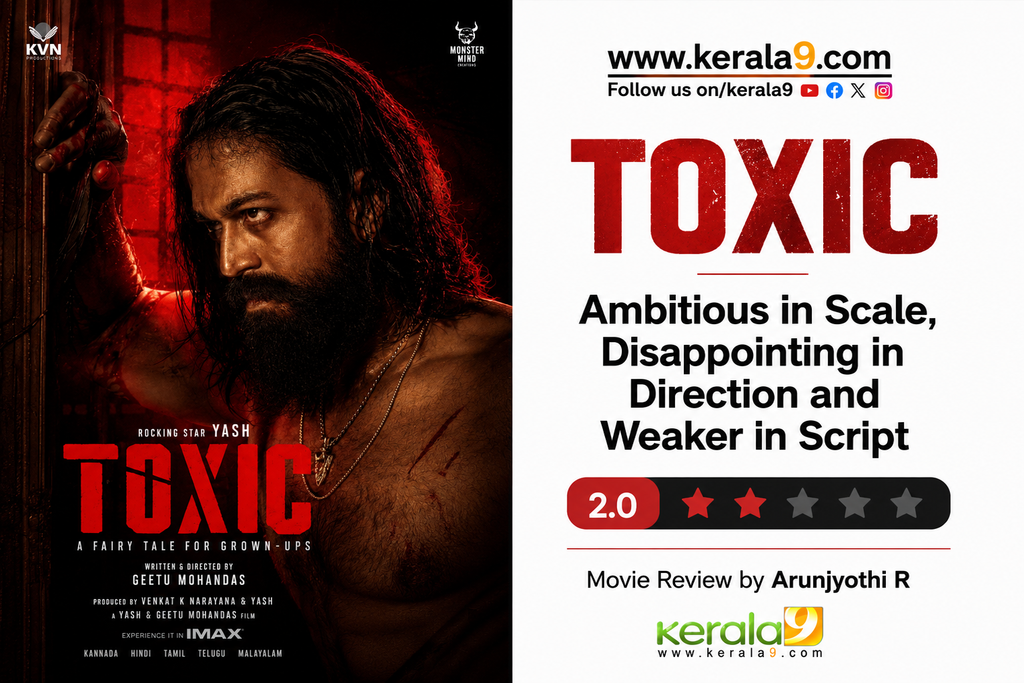
Yash Toxic Movie Review; Ambitious in Scale, Disappointing in Direction and Weaker in Script
ONE WORD: Ambitious in Scale, Disappointing in Direction and Weaker in Script
A Review by Arunjyothi R
LANGUAGE: Tamil Dubbed
DURATION: 194 Minutes
DIRECTOR: Geethu Mohandas
GENRE: Period Gangster Action Drama
•POSITIVES:
1: Production Quality
2: Story
3: Action Sequence
4: Cinematography
5: Performance of Kiara Advani and Nayanthara
6: Technical Side
•NEGATIVES:
1: Direction of Geethu Mohandas
2: Half Baked Screenplay
3: Performance of Yash
4: Duration of the film
5: No emotional connection
6: Poorly Written Characters
7: Badly written dialogues
8: Dragging and Lack of Impact
9: Powerless Background Score
10: Average Tamil Dubbing
11: Unconvincing VFX works
STORY:
Set against the turbulent backdrop of post-independence Goa, Toxic unfolds across several decades, tracing a world shaped by power, greed, violence and betrayal. At the centre of this sprawling gangster saga is Raya, an ambitious outlaw who, alongside his elder sister Ganga, sets out to reclaim and expand the empire left behind by their father. What begins as a struggle for survival gradually transforms into a ruthless pursuit of dominance, taking Raya through the dangerous hierarchy of Goa’s underworld. Raya’s world, however, is not driven by power alone. His strongest emotional attachment is to his sister Ganga, whose presence remains central to his life and decisions. His journey takes another turn when he becomes involved with Nadia, a circus performer, despite being engaged to Salvador’s daughter. Their relationship develops into a passionate romance, eventually resulting in the birth of their son, Rumi. But love soon becomes a source of conflict within Raya’s criminal empire, creating fractures that begin to threaten everything he has built. When tragedy strikes and Ganga dies, Raya holds Nadia responsible, pushing him further into violence, hatred and emotional isolation. From there, the story becomes not just about a gangster protecting his empire, but about a broken man consumed by grief, revenge and the demons of his own past.
REVIEW & ANALYSIS OF THE FILM:
WHAT ARE THE POSITIVES:
1. Production Quality
The biggest strength of Toxic is undoubtedly its production quality. The sets are massive, the production design operates on an enormous scale, and almost every frame carries the visual ambition of a film that wants to look much larger than a conventional Indian gangster drama. The ambience created through the sets, props, locations and overall detailing often gives the film the atmosphere of a Hollywood-style gangster spectacle. This is one area where the enormous budget is visibly present on screen. The makers have clearly aimed to build a world rather than simply construct backgrounds for the characters to perform in. Whether it is the interiors, streets, clubs, warehouses, period-specific environments or the larger action spaces, there is an evident attempt to make the world feel grand and cinematic. The production design does not feel like a compromise-driven attempt to recreate a period; instead, it tries to establish an entire visual universe around the characters. Even when the narrative fails to create the necessary emotional impact, the production design continues to maintain a certain visual richness, making the film technically impressive to look at.
The decision to set important portions of the story in the 90s demanded considerable attention to detail, because recreating a particular period is not simply about changing costumes or placing old cars in the background. The sets, props, architecture, vehicles, interiors, locations and even the smaller objects used within the frame have to collectively communicate the time period. Here, the production department deserves appreciation for putting in that effort. The scale of the sets, combined with the carefully selected props and locations, gives Toxic a sense of grandeur throughout. There is a clear understanding that the makers wanted to tell this gangster story on a massive canvas, and for the most part, there seems to have been no intention of compromising on the visual scale. The production team has successfully provided Geethu Mohandas with a world that allows her to stage the story with a certain cinematic ambition. Even when the screenplay becomes weak, the physical world created around it remains one of the film’s major attractions. In that sense, the production side of Toxic has genuinely delivered what the film demanded from a visual and period-setting perspective.
2. Story
Geethu Mohandas, who also handles the story, has taken a familiar foundation and attempted to place it inside a larger gangster narrative. The screenplay may not be particularly effective, but the basic plot contains certain elements capable of drawing our attention. The father-son rivalry is certainly not a new subject, and Indian cinema has explored similar conflicts in several languages and in different forms. Yet Toxic occasionally manages to find something interesting within that familiar territory. The strongest example comes towards the climax, where the father-son relationship offers a particular thought that can stay with the viewer if the emotional connection works for them. There is a certain layer to that relationship which feels different from the usual treatment of a father and son, and that particular emotion is one of the few places where the film manages to create a genuine impact.
Even though the story itself feels familiar, the way it is presented during the first half is considerably more effective. The film finds some emotional strength in its relationships, particularly in the brother-sister bond. The sacrifice made by the sister, the way the brother turns increasingly ruthless in order to protect her, and the manner in which the two characters work towards achieving something together provide some of the more engaging portions of the narrative. Their chemistry gives the story an emotional foundation that the larger gangster portions sometimes fail to provide. The romantic angle also has some interesting elements. The way the relationship develops, the intimacy between the characters, their arguments and the reasons behind the protagonist’s decision to continue that relationship despite already having a fiancée are presented with enough emotional reasoning to hold attention. More importantly, the protagonist’s choice and the justification behind it offer the viewer something to think about rather than simply presenting romance as an obligatory commercial element. The story, therefore, had enough material and emotional possibilities to become a completely engaging film. There was space for stronger character development, deeper relationships and more powerful conflicts. Unfortunately, the screenplay does not fully utilise that space. The story had potential, but the writing needed a much more controlled, emotionally convincing and layered treatment.
3. Action Sequences
I would not say that Toxic has the best action sequences in recent times, but the action is certainly stylish, violent and technically well executed. Yash fits comfortably into the action space, particularly during the gunfights and physical confrontations, where his screen presence and attitude suit the character. There are moments that remind us of the KGF style of action filmmaking, especially in the way the hero is presented through slow-motion shots, gunplay and stylish movements, but the film does attempt to establish its own action environment.
The Nun fight sequence and the circus fight sequence are among the better action portions in the film. They have interesting settings, strong choreography and a certain visual identity that makes them enjoyable to watch. The choreography itself is precise, and the action is generally staged with an understanding of space and movement. However, the biggest problem is not the choreography but the emotional context surrounding these sequences. Action becomes memorable when the audience feels something for the character during the fight. Here, the writing often fails to provide that emotional foundation. The fights are technically designed to create excitement, but because the characters and conflicts are not developed strongly enough, the emotional impact of those fights remains limited. A punch, gunshot or heroic movement can create a visual reaction, but without proper narrative build-up, it rarely produces the kind of theatre-wide impact the makers are clearly aiming for. Even the climax action sequence, despite being technically fine, feels relatively ordinary because the emotional stakes have not been developed strongly enough. The choreography is not necessarily the problem; it is the writing behind the choreography. The action is visible, but the emotion behind it is often missing.
4. Cinematography
The biggest technical positive of Toxic is undoubtedly the cinematography by Rajeev Ravi. The visual language of the film is one of its strongest aspects, and the collaboration between Geethu Mohandas’s filmmaking vision and Rajeev Ravi’s visual execution is clearly visible throughout. The film demands a particular visual atmosphere, especially because of its period setting, gangster world and larger-than-life scale, and Rajeev Ravi successfully translates that requirement into striking imagery. The shots and camera angles have a distinct identity, and the visual ambience effectively communicates the 1980s and 1990s setting. The colour palette, lighting choices, framing and production design work together to create a world that feels different from the ordinary commercial gangster film. The film frequently looks better than it feels narratively. Yash’s presentation is another major advantage. His rugged appearance, beard, costumes and overall screen presence are captured in a glamorous and stylish manner. The cinematography understands how to present a star and make his physical presence dominate the frame without constantly depending on conventional hero shots. The emotional scenes also benefit from carefully chosen angles and framing, while the action sequences are shot with sufficient clarity and visual energy. Whether it is a wide establishing shot showcasing the production design or a tighter frame concentrating on a character’s expression, the camera work consistently tries to add another layer to the storytelling. Even when the writing fails to deliver the intended emotion, the cinematography often succeeds in creating the visual atmosphere that the film requires.
5. Performance of Kiara Advani and Nayanthara
Kiara Advani and Nayanthara are among the strongest performers in the film. Both actors bring a distinct emotional quality to their respective characters, and their performances are among the few aspects where the intended emotions are communicated convincingly. Kiara particularly manages to give her character a combination of vulnerability, intensity and affection. The romantic track between her and Yash works largely because of her performance. Her expressions, dialogue delivery, body language and ability to communicate emotion through her eyes give the relationship a certain believability. Even when the writing does not provide enough depth, Kiara manages to add something to the character through her performance. The romantic scenes also benefit from the comfort and chemistry between the actors, allowing the relationship to maintain some level of interest. Nayanthara, on the other hand, is a pleasant surprise. The emotional bond she shares with her brother is handled with considerable sincerity. Her affection, concern, pain and willingness to sacrifice for her brother are all communicated effectively. The character requires an actor who can make the relationship believable rather than simply performing the dialogues, and Nayanthara manages to bring that emotional quality to the role. Her performance gives some of the family-oriented scenes their much-needed emotional weight. The problem is that the writing does not always provide enough material for either actress to explore their characters fully. Still, both Kiara and Nayanthara make the most of what they are given, and their performances stand out positively within the film.
6. Technical Side
The technical department of Toxic deserves appreciation for maintaining the film’s visual identity. The art department has done considerable work in recreating the period setting, particularly through the construction of large-scale sets and the use of carefully selected props. The 1980s and 1990s atmosphere is not established through one particular element but through the combined contribution of production design, costumes, locations, props and set decoration. The costume department also deserves mention. The western influences in the costumes suit the world of the film, and the female characters in particular are given stylish and visually attractive costumes. Kiara Advani’s wardrobe complements her character and the period setting, while Tara’s costumes also contribute to the visual character of the film. The costumes do not feel completely disconnected from the environment and help establish the lifestyle and social atmosphere of the characters. Makeup is another area that works reasonably well because it does not feel excessively artificial or distracting. The circus portions deserve special mention because the costumes, makeup and overall appearance of the performers contribute significantly to the visual identity of those sequences. Combined with the cinematography and production design, these departments help Toxic achieve the visual grandeur it was clearly aiming for.
WHAT ARE THE NEGATIVES:
1. Direction of Geethu Mohandas
The ambition of Geethu Mohandas to make a gangster film filled with multiple layers of emotion, while simultaneously attempting to create a film with a large-scale, Hollywood-influenced visual approach, deserves to be acknowledged. There is clearly a vision behind Toxic, and the amount of effort invested in building this world cannot be ignored. But ultimately, filmmaking is not judged only by the ambition of the vision; it is judged by how successfully that vision reaches the audience. In that aspect, Geethu Mohandas’s direction unfortunately falls short.
Her previous film Moothon worked because it carried a distinctive filmmaking voice. The film had an organic quality, strong emotional grounding and a signature style that made it feel like the work of a filmmaker with a clear understanding of what she wanted to communicate. Toxic, however, feels considerably less controlled. The screenplay does not provide the necessary emotional foundation, and the direction is unable to compensate for that weakness. The ideas are present, but their execution often feels mechanical rather than organic. The intended emotions are visible on screen, but the audience does not always feel them. The film attempts to create high moments, emotional moments and mass moments, but several of them fail to land with the expected force.
There is also a feeling that the film moves away from the intimate and grounded filmmaking style that made Geethu’s earlier work distinctive. Had the material been approached through a more realistic and emotionally rooted filmmaking style, the result could potentially have been very different. Instead, somewhere along the way, the film appears to lose the grip of its original identity and becomes a different kind of commercial spectacle. Geethu fails to consistently engage the audience, fails to create sustained emotional impact and struggles to convert the promising story into effective cinematic writing. Even Yash’s casting feels questionable at certain points, because the character’s performance style and the director’s intended emotional treatment do not always seem to completely complement each other. The result is a film where the ambition is visible, the effort is undeniable, but the execution does not consistently reach the level that the vision demands.
2. Half-Baked Screenplay
The screenplay is arguably the biggest weakness of Toxic. The film has a story with enough material for a gripping gangster drama, but the screenplay does not successfully transform those possibilities into a consistently engaging cinematic experience. The writing often feels incomplete, as though several important emotional and dramatic layers are present only in their basic form without being properly developed. The characters have motivations, relationships and conflicts, but the screenplay does not spend enough time developing them to a level where the audience can completely invest in their journey.
There was also considerable discussion around the involvement of Yash in the writing process, and regardless of how much creative responsibility each individual carried, the final screenplay ultimately has to be judged as a collective outcome. As a viewer, the biggest problem is that crucial scenes often end without creating the emotional satisfaction they are supposed to generate. A well-written scene should leave the audience with some kind of reaction, excitement, sadness, shock, tension or anticipation. In Toxic, several important scenes simply finish without producing that desired response. The high moments that are clearly designed to generate whistles and cheers often turn into relatively flat moments inside the theatre. The mass appeal is therefore considerably weaker than expected.
The father-son conflict is particularly affected by this problem. The relationship has the potential to become the emotional core of the film, but the writing does not sufficiently establish the psychological reasons behind their conflict. The audience needs to understand not just what happened between them but why that relationship became so damaged. Similarly, the Nayanthara-Yash relationship works better because the screenplay gives them an emotional foundation, and the interval block involving them is one of the more effective portions. The romantic track is also reasonably engaging, but it does not reach its full potential. The screenplay had enough space to create a powerful emotional gangster drama with family, romance, betrayal and ambition, but instead several of these elements remain underdeveloped. The result is a screenplay that feels like it has ideas but not enough depth, structure or emotional payoff to convert those ideas into a memorable experience.
3. Performance of Yash
Yash looks stunning in Toxic. His rugged appearance, beard, physique, costumes and overall screen presence are perfectly suited for a larger-than-life gangster character. Visually, he carries the image of the protagonist extremely well. However, the performance itself is not as convincing as his appearance. As Raya, there are several moments where Yash appears to be carrying the mannerisms of his KGF character into another film. The body language, dialogue delivery, pauses, facial expressions and overall attitude sometimes create the impression that he is still operating within the world of KGF. Instead of feeling like a completely new character, Raya occasionally feels like another variation of the same Yash persona that audiences have already seen. That becomes particularly noticeable when the film tries to establish Raya’s psychological complexity.
The dual role of Rumi, or Ticket, is more interesting from a performance perspective. Yash brings a younger, more energetic and charming presence to the character, and visually there is a clear difference between the two roles. However, some of the exaggerated mannerisms and psychological expressions become tiring rather than fascinating. The intended eccentricity does not always translate convincingly. His romantic portions maintain a reasonable flow, and the intimate scenes are handled with comfort, but the overall performance does not create the level of conviction expected from a role that required four years of preparation and production. The climax portion is comparatively better, but even there, nothing feels extraordinary enough to completely redefine Yash as a performer. His physical commitment is visible, but the emotional performance does not always match that commitment.
4. Duration of the Film
The 194-minute runtime is one of the major problems of Toxic. A film can absolutely justify a long runtime when its narrative is constantly developing, its characters are evolving and its emotional or dramatic stakes are continuously increasing. Unfortunately, Toxic does not consistently provide that momentum. The excessive duration becomes particularly noticeable during portions where the narrative slows down without offering enough new information, emotional depth or dramatic progression. A tighter edit could have significantly improved the overall experience. Several scenes could have been shortened, some sequences could have been removed entirely, and certain portions of the screenplay could have been condensed without damaging the central narrative. Instead, the film occasionally feels like it is taking too much time to reach moments that the audience is already anticipating. This creates a dragged feeling and gradually tests the patience of the viewer. The problem is not simply that the film is long; the problem is that the length is not always justified by the content. A shorter and more aggressively edited version could have improved the pacing, strengthened the emotional impact and made the high points feel more powerful. When a film is already struggling with screenplay and emotional engagement, an extended runtime makes those weaknesses even more visible. By the later portions, the viewer can begin to feel the duration rather than the story, and that is never a positive sign for a film attempting to maintain a constant sense of scale and intensity.
5. No Emotional Connection
The emotional connection between several of the major characters remains surprisingly flat. This is particularly evident in the father-son relationship, which should ideally have been one of the emotional pillars of the film. The audience is expected to understand the pain, resentment, anger and complicated history between them, but the writing does not provide enough emotional detailing to make that relationship deeply moving. The romantic relationship also remains average in terms of emotional depth. There are moments of affection and intimacy, but the relationship does not consistently create a strong emotional investment. Similarly, the ruthless behaviour of the protagonist needed greater psychological detailing. The audience should understand what shaped him, what drives his violence and what emotional wounds influence his decisions. Instead, much of that remains underexplored. Throughout the film, there is a recurring feeling of incomplete emotion — the scenes tell us that something is important, but they do not always make us feel why it is important. The father-son scenes in particular needed stronger writing and performance direction to create the sentimental impact the film was clearly targeting.
6. Poorly Written Characters
Several supporting characters are poorly developed, and this directly affects the credibility of the conflicts. The henchmen surrounding Yash’s character, for example, do not receive enough characterisation to justify the extent of their loyalty. When supporting characters are willing to sacrifice their lives for a leader, the audience needs to understand the bond, history or ideological connection that makes such loyalty believable. Here, that emotional foundation is often missing.
The character played by Rukmini is another example of underdeveloped writing. Her motives and the reasoning behind her choices are not explored convincingly enough, making several of her decisions feel forced rather than natural. The same issue extends to the villains. The antagonists who stand against the protagonist rarely create a genuine sense of danger or intimidation. Their motivations are not sufficiently developed, their personalities do not leave a lasting impression, and consequently the central conflict often feels ordinary. When the villain is weakly written, the hero’s victory also loses its impact. A powerful protagonist needs an equally convincing opposition, and Toxic struggles to create that balance.
7. Badly Written Dialogues
The dialogues are another area where the film struggles to create emotional or mass impact. Most of the conversations are functional, but they rarely possess the strength required to elevate the important scenes. Emotional scenes particularly suffer because the words do not always carry enough weight to communicate what the characters are feeling.
The counter dialogues delivered by Yash occasionally feel forced and, in some instances, even cringe-worthy. The problem is not that commercial cinema should avoid dramatic dialogues; rather, the dialogue has to emerge naturally from the character and the situation. When a character says something simply because the scene requires a mass punch, the audience can immediately feel the artificiality. Several conversations also become overly dramatic at crucial moments, making the emotional scenes feel less natural. Strong dialogue should strengthen an emotion that already exists within the scene. Here, the writing often tries to create the emotion through dialogue alone, and that approach does not consistently work.
8. Dragging and Lack of Impact
The biggest pacing problem with Toxic is that the film frequently loses momentum despite having all the ingredients required for a high-energy gangster drama. The film has a massive production design, stylish cinematography, action sequences, a star like Yash and several potentially emotional relationships, yet these elements do not always come together to create sustained engagement. Several portions feel stretched beyond their natural requirement, and scenes that should have built anticipation instead reduce the momentum. The narrative repeatedly reaches a point where the viewer expects a major emotional or dramatic payoff, but the payoff either arrives too late or fails to create the expected impact. This creates a sense of narrative drag, particularly because the screenplay does not continuously introduce compelling developments. Even the mass moments sometimes feel strangely muted, as though the film is visually preparing for a huge reaction but the writing has not created enough emotional energy for that reaction to happen. The problem is therefore not merely that the film feels slow; it is that the pacing and dramatic construction do not generate sufficient momentum. A tighter screenplay, sharper editing and stronger emotional build-up could have transformed several ordinary moments into powerful cinematic highs. Instead, the film occasionally feels like it is moving forward without actually building the intensity that the narrative demands.
9. Powerless Background Score
Ravi Basrur’s previous work is enough to understand the kind of impact he is capable of creating through background scoring, which is why the score in Toxic feels particularly disappointing. This is not to say that the background score is completely ineffective, but compared to the expectations surrounding Basrur and a film of this scale, the music often feels less powerful than it should have been.
The biggest issue is the lack of a consistently strong musical identity during crucial moments. Action sequences, particularly those designed to showcase Yash’s mass appeal, require a background score that can elevate the visual energy and transform a good moment into a memorable theatre experience. Unfortunately, several action scenes feel deprived of that extra punch. The choreography may be fine, the cinematography may be stylish and Yash may be delivering the required attitude, but when the background score does not rise to the occasion, the scene can feel surprisingly ordinary. Emotional scenes also do not always receive the musical support required to make the audience connect deeply with the characters. The film needed stronger thematic motifs, more memorable elevation portions and greater musical punctuation at crucial points. Basrur’s score does have moments that work, but overall it does not provide the consistent emotional or mass elevation that a film like Toxic demands.
10. Average Tamil Dubbing
The Tamil dubbing is another element that reduces the impact of several scenes. The primary problem is dialogue modulation. The words do not always sound natural within the situations, and the delivery occasionally feels disconnected from the emotions being portrayed on screen. In an emotional scene, the voice should carry the same intensity as the actor’s expression and body language. Here, there are moments where the dubbing feels like a separate layer rather than an organic extension of the performance. Some dialogues also sound unintentionally funny because of the modulation and pronunciation, particularly during scenes that are supposed to be serious or intense. This can completely destroy the mood of a scene. A gangster film that relies heavily on attitude, emotional tension and dramatic conversations needs dubbing that feels natural and powerful. Unfortunately, the Tamil version does not consistently achieve that. Better dialogue adaptation, more natural modulation and stronger voice performances could have significantly improved the impact of several scenes.
11. Unconvincing VFX Work
The VFX, particularly in the climax, is a noticeable letdown. The aeroplane blast and the overall setting around it lacked the visual solidity and realism required to make the final act convincing. The explosion did not blend naturally with the surroundings and at several points felt artificial, which reduced the intensity of the sequence. The snow-covered setting and the movement within those portions also looked somewhat unrealistic, with the characters and VFX elements not always feeling naturally integrated into the environment. This becomes more disappointing because the film maintains a strong visual standard through its production design and cinematography, making the weaker VFX even more evident. For a climax that was expected to deliver a grand visual payoff, the effects should have been more seamless, detailed and convincing.
CONCLUSION:
Toxic is a film I genuinely wanted to like, but unfortunately, it left me disappointed. There is no doubt that the production design, cinematography, sets and overall scale are impressive, and the amount of effort that has gone into creating this world is clearly visible. But once you look beyond that surface, the film struggles to hold itself together. The writing lacks the emotional depth needed to make the characters and their conflicts truly matter, the screenplay keeps losing momentum, and the 194-minute runtime only makes those weaknesses more noticeable. What hurts the most is that Toxic had everything needed to become a memorable gangster drama, but the execution never reaches the level of its ambition. After waiting through all the anticipation and seeing the four years of effort that went into the film, I expected to walk out with something that stayed with me. Instead, I walked out feeling that the film had more potential than substance. There are definitely things to appreciate here, but as an overall theatrical experience, Toxic did not work for me. If you’re expecting a powerful gangster drama with strong writing, emotion and memorable highs, I would say, watch it at your own risk.
RATING: 2/5
A Review by Arunjyothi. R