Due to continuous heavy rainfall, water levels in several reservoirs across the state have surged. Red alerts have been declared in nine dams.
KSEB dams: Kakki, Mattupetty, Kallarkutty, Sholayar, and Peringalkuthu
Irrigation department dams: Meenkara, Walayar, and Pothundi
Water is being released as a precaution from Mattupetty, Kallarkutty, Peringalkuthu, Meenkara, Walayar, and Pothundi dams. Residents near dam areas have been asked to remain vigilant.
At the Idukki dam, water storage has reached 74.37% of its capacity, with today’s level recorded at 2380.56 ft.
Thiruvananthapuram: Heavy rains continue to lash Kerala. The India Meteorological Department (IMD) has issued an orange alert for six districts on Thursday: Ernakulam, Thrissur, Kozhikode, Wayanad, Kannur, and Kasaragod.
A yellow alert has been issued for Malappuram, Palakkad, Idukki, Kottayam, and Alappuzha districts. On Friday, yellow alerts will be in place in Wayanad, Kannur, Kasaragod, Ernakulam, Thrissur, Palakkad, Malappuram, Idukki, and Kozhikode.
Chennai: Superstar Rajinikanth’s 171st film Coolie will retain its ‘A’ certificate, as the Madras High Court has dismissed the plea filed by the producers, Sun Pictures, seeking a revision.
The court, led by Justice T.V. Tamilselvi, noted that there was no basis for the producers’ complaint. The censor board had granted the film an ‘A’ certificate citing excessive violence. The board had also offered to grant a U/A certificate if certain violent scenes were cut, but the producers refused.
The producers argued that films like KGF and Beast contained more violence, yet did not receive an ‘A’ rating, and claimed that the certification would keep families away from theatres. However, the court did not accept the argument. Despite the certification controversy, Coolie continues to receive strong audience response, having already grossed ₹304 crore from India alone.
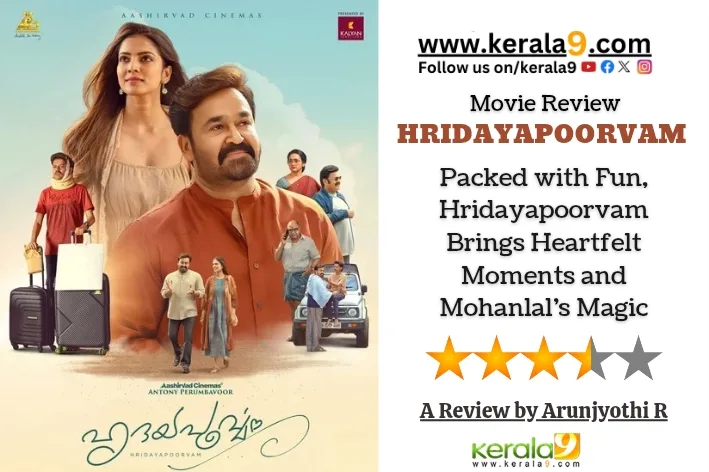
Hridayapoorvam Review :ONE WORD: Packed with Fun, Hridayapoorvam Brings Heartfelt Moments and Mohanlal’s Magic
A Review by Arunjyothi R
LANGUAGE: Malayalam
DURATION: 02 Hours 31 Minutes
DIRECTOR: Sathyan Anthikad
GENRE: Comedy Drama
•POSITIVES:
1: Direction
2: Screenplay and Dialogues
3: Performance of Mohanlal
4: Comedies
5: Combination scenes of Mohanlal and Sangeeth
5: Music and Background Score
6: Performance of Malavika Mohanan
7: Cinematography
8: Editing
•NEGATIVES:
1: Predictable Storyline
2: Duration could have been trimmed
STORY:
Hridayapoorvam follows Sandeep Balakrishnan (Mohanlal), a middle-aged bachelor in Kochi who is learning to live again after a heart transplant, with the help of his spirited caregiver Jerry (Sangeeth Prathap). His quiet life takes a turn when Haritha (Malavika Mohanan), the daughter of his heart donor Colonel Raveendranath, visits him and persuades him to attend her engagement in Pune. But the ceremony collapses unexpectedly when Haritha calls off the wedding, leading to chaos and leaving Sandeep injured and unable to return home.
Stranded in Pune, Sandeep and Jerry are taken in by Haritha and her mother, Devika (Sangita Madhavan Nair). In the days that follow, Sandeep becomes an emotional anchor for both women—reminding Haritha of her father’s presence and offering Devika the empathy she had long been denied in her marriage. In turn, Sandeep begins to rediscover warmth and intimacy he never thought he’d feel again. The story gently unfolds as an exploration of how loss, memory, and second chances can bring unlikely hearts together.
REVIEW & ANALYSIS OF THE FILM:
WHAT ARE THE POSITIVES:
1: The biggest strength of Hridayapoorvam lies in Mohanlal’s stellar performance. His effortless screen presence dominates the film, and his natural style of acting keeps the narrative engaging right till the end. One of his finest qualities here is his impeccable comic timing—he slips into humour with such ease that even ordinary lines turn into laugh-out-loud moments. These lighter touches never feel forced; instead, they flow organically, giving the audience a warm and enjoyable experience. As the story gradually shifts towards deeper emotions, Mohanlal carries the film with remarkable steadiness, never letting it lose its grip. The climax, in particular, showcases his ability to transition from humour to raw emotion seamlessly, leaving a lasting impact. This blend of comedy and sensitivity is what makes his performance special. Truly, this fun-filled yet deeply emotional Mohanlal is a treat to watch, and his presence alone lifts Hridayapoorvam above its flaws.
2: The second standout aspect of Hridayapoorvam is Sathyan Anthikad’s direction. What could have been a very straightforward story is executed with a steady hand, keeping the film free of major flaws. The humour is woven seamlessly into the narrative, never feeling out of place, and each comic situation flows naturally from the characters and setting. This is where Anthikad’s signature style truly shines—his ability to craft everyday scenarios with warmth, simplicity, and a touch of humour makes the film both delightful and cheering to watch.
3: The feel-good mood Sathyan Anthikad sustains throughout the runtime is another strength. Even as the story moves into more emotional territory, the lightheartedness and gentle comedies balance the depth of the plot, ensuring that the audience stays engaged. Anthikad manages to strike a rare balance between entertainment and emotional resonance, and by the end, his direction leaves behind a steady rhythm and consistency. It’s this grasp over tone that prevents the film from ever feeling sluggish or uneven, making Hridayapoorvam a classic example of his trademark storytelling.
4: Though the story of Hridayapoorvam is simple and at times predictable, the screenplay manages to keep things engaging. The writers deserve credit for shaping the narrative with situational humour that not only entertains but also drives the story forward. The comedic moments feel organic and never forced, giving the impression of natural, everyday occurrences rather than staged gags. This ease of writing allows the film to retain its feel-good essence while still moving steadily towards its core emotional beats. Another strength of the screenplay is how it balances humour with warmth and emotion. The lighthearted moments blend seamlessly with the more sentimental scenes, ensuring that the tone never feels inconsistent. Even the romantic angles are handled with restraint, complementing the humour without overcomplicating the narrative. From start to finish, the writing maintains its graph, leading to a satisfying climax that ties the threads together without unnecessary melodrama. It’s this careful blend of simplicity, comedy, and heart that makes the script work.
5: Another major highlight of Hridayapoorvam is the combination of Mohanlal and Sangeeth Prathap. Their scenes together are a constant source of fun, with humour flowing effortlessly and keeping the audience engaged throughout. What makes their comedy work so well is not just the timing but also the way both handle expressions and dialogue delivery—Mohanlal’s subtle reactions paired with Sangeeth’s energetic punchlines create a perfect rhythm that clicks every time. Their chemistry feels natural and unforced, making each interaction a delight. Beyond the laughs, the bond between their characters is portrayed with warmth and charm, adding emotional weight to their entertaining partnership.
6: One of the strongest positives of Hridayapoorvam is its abundance of comedy. From the very beginning to the final moments, the film is peppered with situational humour that keeps the audience engaged without ever slipping into monotony. There is hardly a dull stretch, as each sequence carries some light-hearted touch that makes the viewing experience consistently enjoyable. The comic exchanges between Mohanlal and Sangeeth Prathap, in particular, elevate the humour—Mohanlal with his subtle, effortless reactions and Sangeeth with his energetic, quirky style make for a hilarious combination that works beautifully on screen. What’s refreshing is that the humour never feels forced; it arises naturally from the situations and characters, giving the film an easy flow. This constant dose of fun, mixed with gentle emotional moments, creates the right balance of entertainment and warmth. As a festive Onam release, Hridayapoorvam feels tailor-made for families—it has the right blend of comedy, feel-good emotions, and relatability to leave viewers both entertained and satisfied. The overall package is one of charm and cheer, making it an ideal watch for audiences seeking laughter with a touch of heart.
7: The music and background score by Justin Varghese stand out as another strong positive of Hridayapoorvam. His compositions perfectly complement the film’s tone, making several moments more pleasing and memorable. The songs are thoughtfully placed, each carrying the right emotion to match the on-screen events. “Venmathi,” with its soothing melody and Sid Sriram’s soulful vocals, not only elevates the visuals but also lingers in the listener’s mind long after. On the other hand, “Vida Parayam” beautifully balances the feel-good mood with an emotional undercurrent, striking the right chord with the audience. Equally effective is the background score, which consistently supports the narrative. The playful tunes during comedy sequences enhance the humour without overwhelming it, while the softer, emotional strains gently underline the feel-good and heartfelt scenes. Justin Varghese’s work ensures that the film maintains its rhythm and emotional flow, proving how vital music is in sustaining the charm of Hridayapoorvam.
8: Malavika Mohanan’s performance is another strong pillar of Hridayapoorvam. Beyond her striking screen presence, she delivers a convincing portrayal of a daughter weighed down by emotional baggage. The vulnerability and depth she brings to her character create an instant connection with the audience, making her arc both relatable and heartfelt. Her scenes with Mohanlal are especially noteworthy—together, they generate a natural chemistry that blends moments of warmth, humour, and quiet emotion. These interactions not only add to the film’s feel-good charm but also help in driving the narrative forward with ease. Malavika proves that she is not just there for glamour, but also for substance, leaving a memorable mark on the film.
9: The cinematography of Hridayapoorvam stays simple and rooted in the core of the story. The frames and shots are clean, never distracting, and align well with the film’s family-oriented tone. Since much of the narrative unfolds in Pune, the visuals capture the city’s locations effectively, giving the film a natural backdrop without over-stylisation. What stands out most are the close-up shots, which beautifully highlight the performances of Mohanlal, Sangeeth Prathap, and Malavika Mohanan, allowing their expressions to carry the weight of the scenes. The climax in particular benefits from precise camerawork, with Mohanlal’s emotional speech framed and angled in a way that leaves a lasting impact. The cinematographer wisely avoids flashy experiments or unnecessary gimmicks, instead maintaining a grounded visual style that supports the story. For a simple, feel-good family drama, this restrained approach to cinematography works perfectly.
10: The editing by Rajagopal is neat and effective, with crisp cuts that keep the flow of the film intact. The transitions between scenes are handled smoothly, avoiding any jarring mismatches, and the editing in the climax action portions deserves special mention for maintaining both clarity and impact. The costumes too add to the film’s visual appeal—Malavika Mohanan looks elegant in every frame, while Mohanlal carries his looks with trademark charm and style. The final action sequence is choreographed with care, striking a balance between energy and realism. Here again, Mohanlal elevates the moment with his effortless screen presence, adding his own stylish touch that makes the climax sequence memorable. Together, the editing, costumes, and choreography contribute to making Hridayapoorvam visually pleasing while keeping the narrative engaging.
WHAT DIDN’T WORK OUT:
1: The first and most noticeable drawback of Hridayapoorvam is its overly simple storyline and the predictability that comes with it. Right from the beginning, it is quite easy to foresee how most of the events will unfold, and this lack of surprise weakens the narrative impact. For a film carrying such an emotional premise, one might expect more depth or a few unexpected turns, but the plot largely stays within a safe zone without taking any risks. However, what prevents this simplicity from turning into outright dullness are the lighter moments and situational humour built into the screenplay. The well-placed comedy and feel-good scenes breathe life into an otherwise straightforward story, keeping the audience engaged even when the direction of the plot is obvious. In that sense, while the writing doesn’t escape predictability, it manages to soften its effect by relying on humour, charm, and character interactions.
2: The second drawback of Hridayapoorvam lies in its duration. With a runtime of 151 minutes, the film feels slightly stretched, especially in the second half where a few scenes run longer than necessary. While the first half moves at a lively pace, some portions in the latter half could have been trimmed to maintain the same flow and energy throughout. This isn’t to say the film becomes boring, but the sense of drag does creep in here and there, making the narrative feel a bit heavier than it should. A tighter edit would have made the storytelling more compact and impactful, ensuring that the emotions and humour carried their weight without losing momentum.
PERFORMANCE OF ACTORS:
Mohanlal once again proves why he remains the heartbeat of family entertainers. His effortless charm, natural timing in light-hearted scenes, and measured grace in emotional moments elevate Hridayapoorvam throughout. Whether it is a witty one-liner or a tender exchange, he shifts gears seamlessly, giving the film its soul and making even simple sequences memorable. His ability to balance humor with subtle emotion ensures that the audience stays engaged and invested in the journey.
Sandeep delivers a refreshing performance, holding his ground confidently alongside stalwarts. His youthful energy and convincing expressions in comedy sequences add spark, while his controlled emotional beats make his character relatable. Malavika Mohanan, on the other hand, emerges as one of the strongest positives of the film. She looks stunning on screen but, more importantly, brings depth to her role. The emotional baggage her character carries translates effectively, making her moments resonate with sincerity. Her chemistry with Mohanlal works beautifully, especially in their lighter and feel-good scenes, giving the film both warmth and weight in equal measure.
Sangita Madhavan Nair, as Malavika Mohanan’s mother, delivers a heartfelt performance filled with love, warmth, and affection, making her bond with her daughter feel truly genuine. Her expressive acting, combined with a few light-hearted moments alongside Mohanlal, adds both depth and charm to the narrative. Nishan, in his negative-shaded role, plays it convincingly and brings the required intensity to his character. Meanwhile, veterans Siddique and Lalu Alex infuse the film with well-timed humor, excelling in their supportive roles. The biggest surprise, however, comes from Soumya Bhagyan Pillai, who shines in a fun-filled avatar, bringing freshness and effortless humor to the screen
CONCLUSION:
Overall, Hridayapoorvam works as a wholesome family entertainer that blends humor, emotions, and heartfelt moments. Mohanlal and Sandeep carry the comic portions with effortless timing, making several scenes genuinely laugh-out-loud, while Malavika Mohanan adds charm and grace to the narrative. Beyond the laughter, the film also strikes an emotional chord with its tender, feel good moments that remind us of the value of love and togetherness. With its balance of fun and feel-good sentiment, Hridayapoorvam succeeds in offering something for every kind of viewer, ultimately making it a delightful watch for families during the Onam festival.
Genre: Superhero Drama with strong cultural and mythological flavor
Director & Writer: Dominic Arun
Producer: Dulquer Salmaan under Wayfarer Films.
Positives
1: Direction
2: Story
3: Screenplay
4: Actors performance
5: Stunts
6: inematography
7: Editing
8: pecial effects and Visual effects
Negatives
1: Duration of the film
2: ncomplete characters(few)
3: Forcefully inserted sequence
Story
At its core, Lokah isn’t just another superhero origin tale it’s a meditation on loss, identity, and courage. The narrative uses the disappearance of Chandra’s father not as a mere plot device but as an emotional wound that defines her arc. Every step she takes, whether in fear, anger, or defiance, is tied to that bond. It’s not the wand or the powers that make her rise; it’s the lingering presence of a father she refuses to forget.
Chandra’s transformation from an ordinary daughter caught in tragedy to a reluctant protector feels deeply personal. Unlike many superhero films where the journey is driven by destiny alone, here the conflict is internal: Will she allow grief to consume her, or will she channel it into something larger than herself? That question shapes her choices and makes the spectacle meaningful.
Yes, the superhero blueprint is familiar the discovery of powers, the resistance to accept them, the reluctant embrace, and the eventual rise. But what differentiates Lokah is the way these stages are filtered through a Kerala-specific sensibility. The landscapes, the language, the cultural nuances, even the way family and community ties are written into the script they root the film in a context far removed from Western superhero templates. This grounding makes Chandra feel less like an imitation of Marvel or DC and more like a uniquely Malayali heroine whose struggles resonate beyond capes and costumes.
Screenplay
Dominic Arun approaches the screenplay with a clear sense of rhythm. The first half is deliberately paced, giving Chandra’s personal world enough breathing room before plunging her into larger-than-life conflicts. We witness her as a daughter first, as a human second, and only gradually as a superhero this careful layering makes the emotional beats land with impact.
The interval block is where Arun’s writing shines brightest. It isn’t just a technical “set-piece”; it feels like the natural culmination of Chandra’s inner struggle. The way the scene escalates from quiet grief into a thunderous moment of acceptance gives the audience that rare cinematic shiver not because of CGI or sound, but because the emotion has been earned.
Of course, the screenplay isn’t flawless. Certain segments lean heavily on exposition, especially when setting up the mechanics of Chandra’s powers or hinting at the mythology of the Lokah universe. These moments occasionally slow the flow, and the audience feels the script explaining rather than showing. Yet, even here, Arun ensures the groundwork is laid for what’s clearly envisioned as a multi-film universe. The small teases of larger villains, subtle cameos, and narrative seeds sown throughout make it evident that this is just “chapter one” of a grander saga.
The real achievement of the screenplay is balance between personal and epic, between grief and spectacle, between closure and open-ended promise. By the time the credits roll, the audience feels satisfied with Chandra’s arc yet hungry for the next installment. That’s exactly what a first chapter should do..
Direction
Dominic Arun’s direction is where Lokah – Chapter 1: Chandra finds its most distinctive voice. In an industry still hesitant to fully embrace the superhero genre, he dares to attempt something that feels both ambitious and deeply personal: crafting India’s first female-led superhero franchise that isn’t a one-off gimmick, but a foundation for a cinematic universe.
What makes Arun’s work stand out is his ability to balance two worlds that could have easily clashed the local and the global. The film moves seamlessly from narrow village lanes, filled with cultural textures and the intimacy of Kerala life, to expansive dystopian backdrops where the fate of humanity feels at stake. This contrast doesn’t feel jarring because Arun treats both spaces with equal sincerity. The local isn’t romanticized, and the global isn’t exaggerated; both are stitched into the same fabric of Chandra’s journey.
Importantly, Arun never loses sight of the human core. Many superhero films collapse under the weight of spectacle, turning their leads into symbols rather than people. Here, Chandra remains a daughter in mourning, a young woman stumbling through fear, before she becomes a savior. Arun’s camera lingers on her hesitations, her silences, and her moments of doubt reminding the audience that behind the powers lies a fragile human heart.
His world-building instincts also deserve mention. Instead of rushing to show everything, Arun plants small narrative hooks a glance at a villain, a brief cameo, a mysterious symbol teasing future chapters without overstuffing the present one. This shows a long-term vision, rare in Indian franchise-building attempts.
Yes, there are moments where the ambition slightly outruns the resources certain dystopian sequences strain against budget limits. But Arun’s direction compensates by ensuring that even the grandest set-pieces are emotionally anchored. The wand doesn’t just glow for spectacle; it glows as a reminder of loss, inheritance, and identity.
In short, Arun directs not just a superhero film, but a story about what it means to rise from grief and carry the burden of hope. That’s why Lokah feels less like an imitation of Hollywood and more like the birth of something uniquely Malayalam. Bun
Cinematography
Nimish Ravi’s visuals are a triumph. The color palette shifts earthy, warm tones in Chandra’s personal life versus cold, metallic shades in dystopian sequences tell their own story. Action sequences are fluid, with dynamic camera work that captures both intimacy and grandeur. Certain wide shots of ruined landscapes and the glowing wand stand out as poster-worthy.
Performance
Kalyani Priyadarshan
Kalyani brings charm and emotional balance to the narrative. While not overshadowing Chandra’s arc, her presence adds warmth and relatability especially in lighter moments. She acts as both friend and grounding force, giving the audience breathing space amidst heavy drama. Her screen presence lights up the scenes she’s in, making her role memorable even if not central.
Naslen K. Gafoor
Naslen is the film’s spark of youth and relatability. His comic timing and natural screen presence inject freshness into tense moments, offering relief without breaking tone. But more importantly, he plays his role not just for laughs when the story demands seriousness, he shifts gears effortlessly. Naslen’s chemistry with the rest of the cast, especially in friend-circle dynamics, makes the relationships feel lived-in rather than scripted.
Sandy Master
Sandy surprises with his raw physicality. His body language in action sequences feels organic, not choreographed, which is ironic given his dance background. He embodies the physical realism of Lokah, showing that even in a fantastical story, the human body has weight and impact
Editing
Chaman Chakko’s editing maintains rhythm, especially in the first half where emotion and mystery need space. The transition into action-heavy second half is slick, but a few sequences could have been trimmed for tighter pacing. The interval cut is razor sharp, ending on a perfectly timed high.
Stunts & Action
The stunt choreography in Lokah strikes a balance between realistic grounded combat and stylized superhero spectacle. Instead of relying only on wirework and CGI, the film leans into raw physicality you feel the weight of every punch, fall, and kick.
Hand-to-hand combat: The close-range fights, especially Chandra’s early encounters, are shot with an earthy, tactile quality. There’s a roughness that makes the action believable, showing that she’s still learning her powers.
Sandy Master’s contribution: His presence elevates the physical choreography. The way he moves agile yet gritty makes the stunt design look authentic rather than over-rehearsed. He adds rhythm to the action, which keeps sequences dynamic.
Set-piece moments: The interval stunt block stands out as a high point. It combines sharp choreography with emotional weight, making the action feel earned rather than gratuitous.
Blend with VFX: Instead of overloading the screen with CGI-heavy moves, the stunts are practically driven and then enhanced digitally. This keeps the fights rooted in realism while still delivering “larger-than-life” beats.
Cultural flavour: Unlike generic superhero films, the stunt design borrows from local martial arts traditions and Kerala’s physical culture, giving the action a unique identity.
VFX
For an Indian superhero film, the VFX is surprisingly polished. The wand effects, dystopian set extensions, and dark-force designs hold up well on the big screen. While not flawless in every frame, the ambition outweighs the occasional rough edges. Importantly, the effects support the story instead of overwhelming it.
Sound Design
The soundscape adds muscle to the film. From the subtle crackle when Chandra first touches the wand, to the layered chaos of battles, the design builds immersion. Silence, too, is used cleverly moments of grief are given quiet, letting emotion speak louder than sound.
CGI
The CGI blends with live action better than expected. The rendering of mystical energy around Chandra feels organic, not cartoonish. Large-scale destruction sequences look cinematic, though some crowd effects and background creatures reveal budget limits. Still, for Malayalam cinema, this is a leap forward.
Final Word
🌟 🌟 🌟 🌟
Lokah – Chapter 1: Chandra may not be flawless, but it’s bold, heartfelt, and groundbreaking. Kalyani Priyadarshan carries the film with vulnerability and strength, supported by technical departments that clearly aimed high. More than just a superhero origin, it’s a human story of grief and rising above it, wrapped in the spectacle of a cinematic universe in the making.
Kochi: Renowned actor Rajesh Keshav, aged 47, was admitted to VPS Lakeshore Hospital on Sunday night after collapsing at a city hotel. He was rushed to the Emergency Department, where he experienced a cardiac arrest that was successfully revived through immediate resuscitation efforts.
Subsequently, he was transferred to the Cath Lab for an emergency angioplasty procedure. His blood pressure, which was initially very low, has now been stabilized, and the dosage of medications supporting his blood pressure is being gradually reduced. The prolonged cardiac arrest led to a moderate hypoxic injury.
The Neuro Wing is closely monitoring his neurological recovery, with encouraging signs of progress noted. Currently, he remains in the Intensive Care Unit (ICU) under advanced life support. While his condition is serious, it is showing gradual improvement, and a multidisciplinary team of doctors is actively involved in his treatment.
This information is based on the medical bulletin released by the hospital authorities. Fans of the actor have expressed concern, but the positive developments offer hope for his recovery.
Trailer raises audience expectations ahead of release
The much-awaited trailer of Hridayapoorvam, directed by Sathyan Anthikkad and starring Mohanlal in the lead, has been released. The film is set to hit theatres on August 28.
Highlights
🎥 Hridayapoorvam trailer officially released
🌟 Mohanlal – Sathyan Anthikkad reunite for a family entertainer
🗓️ Film releasing on August 28
👥 Multiple characters and their unique chemistry revealed in the trailer
🎭 A perfect blend of comedy and romance guaranteed
The trailer itself showcases Sathyan Anthikkad’s signature filmmaking style – a host of relatable characters, their interpersonal chemistry, and heartwarming storytelling. Known for weaving comedy and romance seamlessly into family narratives, the director once again promises brilliance in Hridayapoorvam.
With just days left for release, the film has already created a huge buzz among audiences, and fans are eagerly waiting to see Mohanlal back in a Sathyan Anthikkad family drama that promises both laughter and emotions.
New Delhi: The Supreme Court has dismissed the plea filed by Global Peace Initiative founder and evangelist K.A. Paul, seeking a ban on media from reporting on the Nimishapriya case.
A bench headed by Justice Vikram Nath dismissed the plea. K.A. Paul had sought a ban on public discussions in the Nimishapriya case, saying that Nimishapriya’s death sentence was likely to be carried out soon and that the matter should not be affected by the discussions.
Kozhikode: Based on the sighting of the Rabi-ul-Awwal moon at Kappad, tomorrow (Monday) will mark the first day of Rabi-ul-Awwal, and Eid Milad-un-Nabi will be celebrated on Friday, September 5.
This was jointly announced by Samastha Kerala Jem-iyyathul Ulama President Sayyid Muhammad Jifri Muthukoya Thangal, Samastha General Secretary Prof. K. Alikutty Musliyar, Kozhikode Qazi Sayyid Muhammad Koya Thangal Jamalullaili, and Kozhikode Qazi Sayyid Nasarhayı Shihab Thangal, who is also the deputy of Panakkad Sayyid Swadiq Ali Shihab Thangal.
The Central Meteorological Department’s rainfall forecast for the next five days has been released. The Central Meteorological Department has announced a yellow alert in various districts for three days from Tuesday. The weather in the state has been clear for the last few days.
A yellow alert has been issued in Idukki, Thrissur, Palakkad, Malappuram, Kozhikode, Wayanad, Kannur and Kasaragod districts on Tuesday. On Wednesday, a yellow alert will be issued in Ernakulam, Idukki, Thrissur, Palakkad, Malappuram, Kozhikode, Wayanad, Kannur and Kasaragod districts and on Thursday, Kozhikode, Wayanad, Kannur and Kasaragod districts.
Isolated heavy rains are predicted. Heavy rain is defined as a situation where 64.5 mm to 115.5 mm of rain is received in 24 hours.