Thiruvananthapuram, September 26, 2025 – The highly anticipated Thiruvonam Bumper Lottery 2025 draw, originally scheduled for September 27 (Saturday), has been rescheduled to October 4. The decision comes in response to challenges posed by recent changes in the Goods and Services Tax (GST) regulations and unprecedented heavy rainfall, which have impacted the complete sale of lottery tickets.
The postponement was finalized after considering requests from lottery agents and sellers, who faced difficulties in completing ticket sales under the current circumstances. Authorities have assured that the new date will allow for smoother operations and ensure a fair draw process.
Stay tuned for more updates on the Thiruvonam Bumper Lottery 2025 and other news at Kerala9.com. For further details, visit the official lottery website or contact authorized agents.
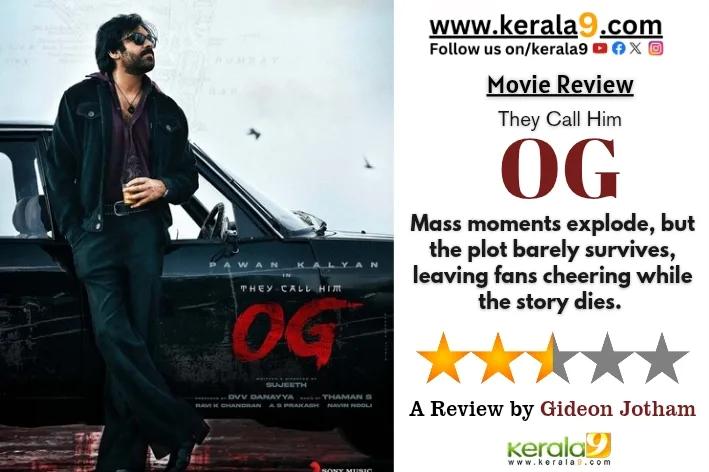
They Call Him OG is fundamentally based on a precarious foundation. Instead of creating something original, the story is thin, almost skeletal, and mainly relies on well-worn gangster clichés. It has weight, nostalgia, and the potential to create myths, so a feared gangster going missing for years and then coming back to take back his throne could have made for an engaging setup. However, the writing never delves further.
Instead of exploring the psychology of a man who walks in blood and shadows, the film takes the easiest path: revenge arcs, family in danger, betrayals that you see coming miles ahead. Every twist feels familiar because we’ve lived through these beats in countless other films. The audience isn’t surprised; they’re simply waiting for the next “mass” moment. The problem is not just predictability, but missed opportunity. The very idea of “OG – The Original Gangster” suggests a man who shaped the underworld, someone whose choices left ripples of consequence. But here, the story doesn’t bother to show us why he matters. What was his rise? What did he lose? What makes him feared or respected? Without those answers, the title feels ornamental grand words without roots.
There are glimpses where the drama could have soared his return, his clashes with Omi Bhau, his reunion with family but the writing stays on the surface. Emotional beats don’t land because they’re rushed or predictable. Instead of tightening the story into a gripping gangster saga, it sprawls out like a collection of fan-service episodes stitched together.
In the end, the story becomes less about OG the man and more about Pawan Kalyan the star. That’s why it feels weak not because the idea lacked spark, but because the execution chose spectacle over soul.
DIRECTION
The film carries the unmistakable vibe of Saaho grand visuals, larger-than-life posturing, and an overdose of stylised violence. But beyond the surface, it feels like a patchwork quilt stitched from a dozen Tamil gangster films, with borrowed moods, familiar tropes, and a relentless attempt to make everything look “mass.” Perhaps Sujeeth’s admiration for Tamil cinema pushed him into imitation, but imitation without originality is where the cracks show.
The blood, the bullets, the slow-motion swagger they all aim for cinematic high, yet the foundation of character and story is thin. The very idea of calling the film OG – The Original Gangster deserved depth, an exploration of what makes this man feared, respected, or even remembered. Instead, the title becomes just a label. The character is never built with the gravitas to justify the name; he is celebrated as a star more than fleshed out as a man.
Yes, this is a feast for Pawan Kalyan fans his aura dominates every frame. The director pours every ounce of attention into crafting elevation scenes for him, from grand entries to punch dialogues, but in doing so, the narrative itself becomes secondary. The story bends around the star, not the other way round.
The interval block is a perfect example. It should have been the thunderclap moment the point where “OG” truly earns his crown. Instead, it fizzles into a predictable elevation shot. You expect your pulse to quicken, but what arrives is familiar, stretched, and oddly mechanical. The essence of menace, of myth, is lost in the noise.
In the end, Sujeeth directs less like a storyteller and more like a fan building a shrine for his star but forgetting to build a world for his characters. The result is over-hyped cinema: glossy, noisy, and packed with spectacle, but hollow when you look for heart.
SCREENPLAY
The screenplay is where They Call Him OG truly stumbles. Instead of investing in layers, subplots, or engaging turns, it leans too heavily on mass introductions, hero elevation scenes, and fan-service moments. These may light up theatres for a while, but once the dust settles, the absence of real progression becomes painfully obvious.
A story like this needed sharp writing, unexpected beats, psychological tension, and a sense of inevitability that keeps the audience hooked. Instead, what we get is a straight line: introduction, conflict, betrayal, revenge. In order to make room for yet another stylized fight or punch dialogue, the in-between scenes that ought to have added texture are either hurried or neglected.
The idea of a gangster coming back after years away could have been explored in a variety of intriguing ways, such as how the underworld has evolved, how his past haunts him, or how the man finds it difficult to adjust. But the screenplay avoids these complexities, settling instead for predictable “rise and reclaim” arcs.
This makes the film engaging only in bursts. A scene here, a moment there but the overall rhythm is uneven. Just when you hope for the story to dig deeper, it cuts away to spectacle. Just when you expect a twist, it falls back on cliché. The result is a film that looks busy and loud but feels hollow in its journey.
Had the screenplay dared to slow down, build conflict with more nuance, and give its characters inner lives beyond revenge, OG could have been more than a fan event. It could have been a gripping gangster saga.
CINEMATOGRAPHY
If there’s one department where They Call Him OG consistently shines, it’s the cinematography. The visuals are stylish, glossy, and undeniably cinematic. The camera knows how to worship its star every slow-motion walk, every cigarette flick, every glare across the frame is designed to amplify OG’s aura. These frames, drenched in dramatic lighting and composed with precision, succeed in creating an atmosphere that feels grand and larger than life.
The action sequences especially benefit from the camerawork. Wide-angle shots make the fights feel operatic, while close-ups capture the raw intensity of blood and grit. The rain-drenched streets, smoke-filled warehouses, and neon-soaked nightscapes all look like they belong in a gangster myth rather than just another commercial entertainer.
Yet, for all its beauty, the cinematography sometimes feels like it is doing the heavy lifting for a story that isn’t there. The frames are arresting, but not always purposeful. Gloss frequently overrules grit scenes that ought to be raw and dangerous instead appear shiny and posed. That disconnect allows the film to be stylish, but keeps it from being immersive.
And yet you can’t help but feel that the cinematography is where OG gets its swagger. Even when the writing falls short, the visuals keep us involved, serving as a reminder that at least half of cinema is what we see before our eyes, not what it makes us feel in our guts.
EDITING
The editing is where OG stumbles the most in keeping its rhythm. Instead of tightening the narrative, the film often indulges in unwanted slow-motion shots scenes that stretch far longer than they should, draining energy rather than building it. What should have been sharp and impactful moments end up feeling repetitive, almost like the film is replaying the same emotion again and again until it loses all power.
This overuse of stylisation creates a lagging effect. The story slows down not because it’s deepening, but because it’s stuck in self-indulgence. The audience feels the drag what should be pulse-racing ends up testing patience. After a while, the slow-motion doesn’t elevate the hero, it numbs the viewer.
Even transitions between moods shifting from action to drama, or from mass moments to emotional beats lack smoothness. Instead of flowing like a river, the film moves in jerks and halts, often pulling the viewer out of immersion.
Editing is supposed to be invisible when it works well it should carry the audience along without them realising it. Here, it becomes too visible, reminding us constantly that the film is more interested in showing off than moving forward. The result is not tension but fatigue, a cinematic headache that could have easily been avoided with sharper, braver cuts.
MUSIC AND BACKGROUND SCORE
Songs: The songs in OG feel like pauses rather than progress. They arrive with style shot in glossy frames, choreographed with energy but rarely serve the story. Instead of deepening the characters or carrying the emotion forward, they act more like detours, reminding us of the commercial checklist the film wants to tick. While a couple of tunes may linger for their catchiness, they don’t leave behind the weight or memory of timeless gangster anthems. In a film of this scale, the songs should have been weapons of storytelling; here, they are just decorative ornaments.
Background Score (BGM): If the songs distract, the background score rescues. Thaman pours fire into the soundscape of OG the pounding beats, the swelling percussion, the sharp, edgy motifs all carry the kind of electricity that the screenplay often lacks. Whenever OG makes an entry or a fight breaks out, it’s the score that lifts the scene, injecting adrenaline into the audience. Yet, even here, there’s a sense of repetition. The themes are powerful, but they circle back so often that their impact begins to dull. Still, without Thaman’s score, much of the film’s mass appeal would crumble. It is not just background music it is the scaffolding that holds the spectacle together.
PERFORMANCE OF ACTORS:
Pawan Kalyan (OG / Ojas Gambheera): The film belongs to him, and it never lets us forget that. Pawan Kalyan carries OG on his shoulders with his undeniable aura his screen presence commands attention the moment he appears. His swagger, his stillness before the storm, and his ability to dominate even silent frames are what keep the film alive. In action and elevation scenes, he is magnetic; the theatre roars because of him. But when it comes to quieter, more emotional moments, the writing doesn’t give him enough to work with. We see the star in all his glory, but rarely the man beneath the myth. That’s where the performance feels underutilized, powerful, yet limited by the film’s obsession with his larger-than-life image.
Priyanka Arul Mohan (Heroine): Priyanka’s role is caught in the shadow of spectacle. She is graceful on screen, her innocence and charm offering a contrast to the world of guns and gangsters, but the film gives her little space to breathe. She is more a presence than a character, someone to soften OG’s roughness, rather than a woman with her own arc. Her performance is sincere, but it feels like she’s acting within walls that the screenplay never lets her climb.
Emraan Hashmi (Omi Bhau): As the antagonist, Emraan Hashmi is one of the few actors who manages to cut through the film’s star worship. His portrayal of Omi Bhau brings menace and unpredictability; he feels dangerous, which is exactly what the story needed. His dialogues and controlled aggression add weight to the rivalry. Yet, like Pawan, he too is restricted by the screenplay, which paints him more as a foil than as a layered villain. Still, he makes the most of it, and his presence gives the film a badly needed balance.
Supporting Cast: Actors like Prakash Raj and Arjun Das add occasional gravitas, their voices and intensity bringing sparks to their scenes. But beyond these few, the supporting characters are mostly functional friends, sidekicks, and family members who serve the story but don’t leave a lasting impression. They exist to orbit around OG, not to shine on their own.
ACTION SEQUENCES
The action in They Call Him OG is loud, relentless, and staged for maximum impact. From the very first fight, it’s clear that Sujeeth wanted the stunts to be the heartbeat of the film, the moments when the screen erupts with blood, fire, and bullets. In many ways, these sequences deliver stylized slow-motion shots, dramatic face-offs, and bone-crunching choreography that make the theatre crowd whistle and clap.
But the overdose is hard to ignore. Almost every confrontation is stretched out, loaded with exaggerated violence and cinematic pauses that dilute the intensity instead of sharpening it. What could have been tight, visceral moments often drag on, as though the film is more interested in showing off its choreography than in moving the story forward.
That said, a few sequences stand out: the rain-soaked fight scenes, the interval block showdown, and OG’s larger-than-life entrances are designed to thrill, and they do. These are the portions where the film feels alive, where the star power of Pawan Kalyan merges with the stylish camerawork to create pure theatre.
Yet, without emotional grounding, the action feels hollow after a point. We watch men fly, blood splash, and guns roar, but rarely do we feel the stakes. The violence is spectacle, not storytelling. In a gangster epic, the fights should carry the weight of personal vendetta, fear, or desperation. Here, they often feel like an action checklist being ticked off one by one.
In short: the stunts give the film its style, but not always its soul. They are glossy fireworks brilliant for the moment, but gone too quickly, leaving behind smoke rather than fire.
FINAL VERDICT & RATING:
They Call Him OG is all swagger and spectacle soaked in blood, bullets, and star power. While Pawan Kalyan’s aura and Thaman’s pounding score keep the theatre alive, the weak story, predictable screenplay, and indulgent pacing stop it from becoming the gangster epic it promised to be. Stylish but hollow, it’s a treat for die-hard fans, but a missed opportunity for everyone else.
Leh: A case has been registered against Congress Councillor Fundtsog Stanzin Sepag in connection with the recent Ladakh violence. The BJP accused him of leading the attack and released photos supporting the claim. The party alleged that the Congress orchestrated the unrest in Ladakh as part of a broader strategy similar to situations seen in Bangladesh, Nepal, and the Philippines. On Wednesday, protests demanding statehood for Ladakh turned violent, leaving four dead and over 80 injured. Demonstrators set fire to the BJP office in Leh and a CRPF vehicle, leading to clashes with police. The situation is now under control.
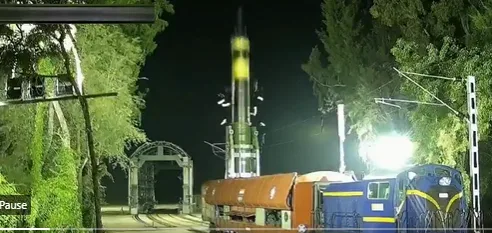
New Delhi: India has successfully conducted the test launch of the Agni Prime missile using a rail-based mobile launcher system for the first time. The missile, designed with a strike range of 2,000 km, can be moved easily along railway networks and launched quickly. Defense Minister Rajnath Singh said the successful test demonstrates India’s advancement in developing canisterized, rail-based launch systems. The trial was jointly conducted by DRDO, Strategic Forces Command, and the Indian Army.
New Delhi: The central government has imposed restrictions on silver jewellery imports until March 31, 2026, in response to rising prices. The move aims to prevent misuse of Free Trade Agreements (FTAs) and curb large-scale imports disguised as finished jewellery. Authorities said such practices adversely affect domestic manufacturers and threaten employment in the jewellery sector. The government emphasized its commitment to protecting small and medium businesses while safeguarding the livelihood of workers in the industry.
Kochi: The Kerala High Court has extended the ban on toll collection at Paliyekkara. The decision was taken while considering a petition regarding the resumption of toll collection. The district collector had submitted a report citing the collapse of Muringoor service road and the likelihood of similar incidents elsewhere. Based on this, the court ordered the toll ban to continue until repairs are completed. The case will be reviewed again on the 30th. The toll ban has been in effect for over a month, leading to severe traffic congestion in the region.
Kochi: Customs is probing Malayalam actor Amit Chakkalakal in connection with the Bhutan car smuggling case. Officials allege that Amit acted as a key middleman in importing foreign-made cars by evading taxes and selling them in India. He reportedly had close links with the Coimbatore-based vehicle mafia and supplied luxury vehicles to celebrities. Customs is also examining Amit’s past transactions and investigating officials of the Himachal Pradesh Motor Vehicles Department who allegedly colluded in the racket. Most of the smuggled vehicles were registered under the code HP 52. Another suspect, Mahin from Assam, believed to be a kingpin, is also under investigation.
Kochi: Heavy rain continues across Kerala. The India Meteorological Department (IMD) has issued a yellow alert for seven districts from Thiruvananthapuram to Idukki, warning of isolated heavy rainfall and strong winds. A low-pressure system lies over north Odisha, northwest Bay of Bengal, and adjoining Gangetic West Bengal. The system is likely to weaken within 12 hours. With widespread rain, the monsoon season is expected to conclude soon, officials said.
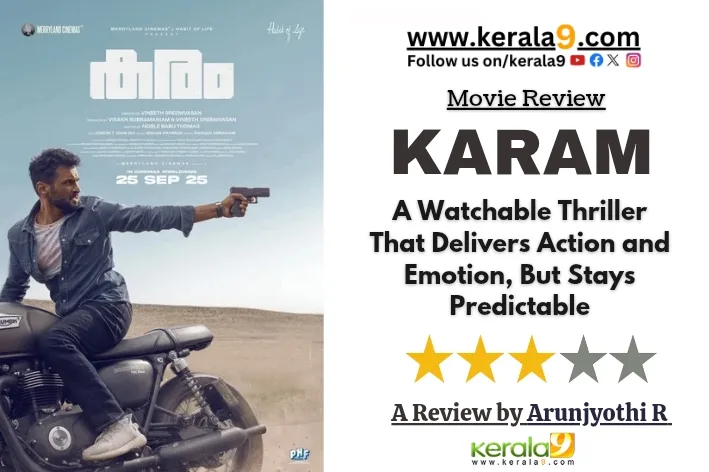
Karam Movie Review ONE WORD: A Watchable Thriller That Delivers Action and Emotion, But Stays Predictable
A Review by Arunjyothi R
LANGUAGE: Malayalam
DURATION: 02 Hours 08 Minutes
DIRECTOR: Vineeth Sreenivasan
GENRE: Action Thiller
•POSITIVES:
1: Direction
2: Action Sequences
3: Cinematography
4: Music and Background Score
5: Performance of actors
6: Production and Technical Quality
7: Editing and Colour Grading
•NEGATIVES:
1: Predictable Story
2: Screenplay
3: Resemblance of Thira
4: Routine Templates of an action thriller
5: Comedy situations felt forceful
STORY:
Karam follows former army officer Dev Mahendran, who is now living a happy life with his wife and child, while trying to move past a troubled relationship with his father and a series of personal tragedies. During a family trip to the city of Lenarco for his wife’s business meeting, Dev unexpectedly crosses paths with his ex-girlfriend, who is trapped in a human trafficking ring. Determined to rescue her, he is forced to confront dangerous criminals and risks not only his own life but also the safety of his family. The film explores how a seemingly simple family trip spirals into a high-stakes battle, showcasing Dev’s courage, resilience, and the lengths one will go to protect loved ones.
REVIEW & ANALYSIS OF THE FILM:
WHAT ARE THE POSITIVES:
1: One of the major positives of Karam is the direction of Vineeth Sreenivasan. He steps away from his familiar feel-good style and confidently experiments with a darker, more action-driven narrative. The making is stylish, technically sharp, and clearly a notch higher compared to his earlier attempt in Thira. In fact, certain portions of Karam do resemble the mood and tone of Thira, but here the execution feels more refined and advanced. The action sequences are staged neatly, and his grip on pacing ensures the film never drags. That said, Karam doesn’t really push you to the edge of your seat. It works well as a solid action thriller, but not as one of the genre’s finest. Still, the direction succeeds in making it engaging enough to enjoy on the big screen, offering a good theatre experience that justifies at least a one-time watch.
2: Karam maintains a balanced momentum throughout, ensuring that the viewing experience never turns dull. While the script does suffer from a sense of predictability, it is Vineeth Sreenivasan’s direction that manages to neutralize this drawback. His controlled narrative flow and stylish execution keep the audience invested, making the film move forward with proper rhythm. The film certainly has its standout moments, but rather than riding on sudden highs or dipping into lows, it travels on a steady, consistent line. This linear graph of storytelling works in its favor, as the continuous flow sustains audience engagement without ever giving a dragging feel. Even when you sense where the story might be headed, the treatment keeps you seated with interest, proving that Vineeth’s craftsmanship elevates an otherwise familiar screenplay.
3: The romantic scenes between Noble Babu Thomas and Audrey Miriam are few, but Vineeth Sreenivasan makes every moment count, showing how a skilled director can make the audience truly connect. Through subtle gestures, meaningful glances, and carefully crafted interactions, he makes us feel the blossoming of their love, the pain of separation, and the lengths one is willing to go for a loved one. Even in a high-stakes action thriller, these scenes stand out emotionally, adding depth to the characters and giving the story a heartfelt dimension. It’s remarkable how just a handful of well-executed moments can make the romance feel so real and engaging, highlighting Vineeth’s ability to weave emotion seamlessly into the narrative.
4: Another strong positive of Karam lies in its action sequences. Since the film is positioned as an action thriller, the fights had a big responsibility to carry the narrative forward, and they do so quite effectively. These aren’t the kind of over-the-top, brutal action blocks that rely on exaggerated stunts, but rather fights that feel grounded, believable, and in sync with the storyline. The choreography is neat, precise, and staged in a way that keeps the audience engaged without ever feeling forced. The momentum of action really kicks in just before the interval and from there continues to escalate till the climax. Each fight sequence adds to the pace and intensity, ensuring that the thriller mood remains intact. The hero’s journey to save his loved one from the clutches of a sex trafficking network is filled with stylish punches, chase moments, and well-timed stunt work. What works best is that the action is not only visually appealing but also emotionally connected to the character’s mission, giving it more weight than just being spectacle. By the time the film reaches its finale, the action has been carried consistently, leaving the audience satisfied with the thrilling quotient it promised.
5: For an action thriller to work, the visuals must enhance the thrill, and in Karam, Jomon T John’s cinematography does exactly that. His frames are stylish, precise, and consistently eye-catching, making the film a treat to watch on the big screen. The clever use of drone shots and wide-angle frames adds more depth and scale to the visuals, giving several sequences an expansive cinematic feel. From start to finish, the visual language perfectly matches the demands of a rescue-driven action thriller, ensuring that the audience is absorbed into the mood and ambience of the story. The second half offers some of the film’s most striking moments — the car chase sequence delivers the kind of adrenaline rush often compared to Hollywood, while the visuals of the fictional land Lenarco are crafted to look authentic and immersive. The rescuing fight sequence, especially the fire accident and gunshot scenes, is brilliantly shot, and the aerial shots amplify the tension while keeping the action visually clear and engaging. Overall, Jomon’s cinematography, with its stylish framing and inventive use of space, stands as one of the strongest pillars of Karam, giving the film a polished and thrilling edge.
6: Music and background score by Shaan Rahman emerge as one of the biggest strengths of Karam. Both the songs and the background compositions are crafted thoughtfully, perfectly aligning with the mood of each scene to enhance thrill, excitement, and emotion. Shaan Rahman’s signature musical style is evident throughout, and he adapts it cleverly to suit the film’s tone. The beats are catchy and immersive, particularly in the track Welcome to Lenarco, where the chorus and instrumentation make for a rich, theatre-filling experience. Another highlight is Uyarnnu Vaa, featuring Fejo’s rap, which adds a fresh and energetic layer to the soundtrack.
Beyond the songs, the background score plays a crucial role in elevating the action sequences, making fights, chases, and tense moments feel more gripping and intense. At the same time, emotional sequences are handled delicately with tunes that tug at the heartstrings without overpowering the scene. Shaan Rahman’s music consistently maintains the right balance between thrill and sentiment, enhancing the cinematic experience from start to finish. Overall, his contribution ensures that Karam is not just an action thriller but also a compelling audio-visual experience, making the film more immersive and engaging.
7: The performances of the actors form another significant positive of Karam. Noble Babu Thomas firmly establishes himself as a promising hero, delivering a performance that is both convincing and intense. Not only did he handle the action sequences with finesse, but as the scriptwriter, it is evident that he fully understands his character’s journey. His portrayal feels natural, whether in high-octane fights or emotional, heart-wrenching moments. The desperation to save his loved one, the struggles he endures, and his willingness to go to extreme lengths to resolve the crisis are all conveyed with authenticity and subtlety, reflecting Noble’s growing maturity as an actor. Audrey Miriam as Sana is equally impressive. Her character acts as a key pivot around which many events of the story unfold, and she delivers her scenes with natural ease and emotional depth, making the audience connect with her instantly. On the antagonist front, Ivan Vukomanović shines as a brutal, merciless gangster. His screen presence is menacing, and he embodies the ruthlessness required for the role with chilling perfection.
8: The production and technical quality of Karam is one of its standout aspects. The film is largely set in Georgia, and the choice of locations adds both authenticity and visual appeal to the narrative. The backdrop of the city and its surroundings enhances the storytelling, making the depiction of sex and human organ trafficking crimes feel more grounded and believable. Every location feels purposeful, contributing to the tension and urgency of the plot. The production quality is consistently high, with no compromises in set design, props, or overall mise-en-scène. Technical aspects such as lighting, sound design, and visual effects are handled meticulously, adding layers to the cinematic experience. The carefully chosen locations not only elevate the aesthetic appeal but also strengthen the narrative, making the film’s dark and intense themes more impactful. Overall, the combination of high production values and technical finesse ensures that Karam delivers a polished and immersive experience for the audience.
9: Editing by Ranjan Abraham is another notable strength of Karam. The cuts are precise and purposeful, particularly during the high-octane action sequences, where every punch, chase, and confrontation flows seamlessly. Transitions between scenes feel natural, maintaining the rhythm of the narrative without any jarring interruptions, which keeps the audience fully immersed in the story. The film’s duration is well-measured, ensuring that the plot moves forward consistently without unnecessary drag. Additionally, the colour grading plays a significant role in setting the film’s tone. The dark, greyish palette perfectly complements the intense and gritty storyline, enhancing the mood and amplifying the tension during critical moments. From the tense action scenes to the emotional beats, the combination of sharp editing and visually appealing grading strengthens the overall cinematic experience. Ranjan Abraham’s work ensures that Karam not only tells its story effectively but also looks and feels stylistically coherent throughout.
WHAT ARE THE NEGATIVES:
1: The first notable drawback of Karam is its storyline, which suffers from a high level of predictability. Once the narrative moves into the main plot, much of the story becomes easy to anticipate—from the unfolding of key events to the motivations behind characters’ actions, and even the arrival of helping hands. This predictability makes the film feel like a routine thriller at times, lacking the element of surprise that keeps audiences truly on edge. That said, the predictability doesn’t completely undermine the viewing experience. Vineeth Sreenivasan’s crisp direction and well-maintained pacing manage to keep the audience engaged, ensuring that the film doesn’t feel dull or stagnant. While it succeeds as a one-time watchable action thriller, the predictable storyline prevents it from reaching the level of a fully compelling, edge-of-the-seat experience.
2: While Vineeth Sreenivasan’s direction keeps the audience engaged, Karam still carries a strong resemblance to his earlier film, Thira. Many aspects—the film’s atmosphere, the unfolding of events, and even the general setting—evoke the same world that Thira created. The storyline and narrative style also mirror his previous approach, giving viewers a sense of familiarity that is hard to ignore. In essence, while Karam is technically more polished, with refined visuals, action sequences, and production quality, it often feels like an upgraded version of Thira rather than a wholly original venture. This similarity does not completely undermine the film, but it prevents it from feeling entirely fresh or innovative. Audiences may appreciate the improved technical finesse, yet the echoes of Thira linger, making parts of the narrative feel somewhat predictable and familiar.
3: The screenplay of Karam is competent and well-structured, but it lacks fresh or innovative concepts. Much like Vineeth Sreenivasan’s Thira, the narrative relies on familiar formulas, making key plot points and the story’s progression fairly predictable. From the way scenes unfold to the eventual resolution, seasoned viewers can often anticipate what is coming next. Additionally, certain sequences and the overall tone evoke the style of classic “Taken”-style detective and rescue action films, which gives the film a familiar global action-thriller flavor but also underscores its lack of originality. While the screenplay ensures that the story remains coherent and engaging, the absence of novel ideas or unexpected twists prevents it from standing out as a truly unique thriller experience.
4: In the second half of Karam, several situational comedy sequences are crammed in between the otherwise tense and thrilling scenes. Personally, I found it hard to connect with these moments, as they felt out of place and somewhat forced, disrupting the overall flow of the narrative. Babu Raj’s character is primarily used for these comic relief segments. While some audience members in the theatre did find them funny, for me, they came across as an unnecessary addition that didn’t land effectively. These poorly integrated comedic moments slightly undermine the intensity of the film, breaking the immersion that the thriller had built up until that point. Instead of enhancing the experience, they feel like filler content, reducing the impact of the high-stakes action and emotional sequences that define the rest of the film.
PERFORMANCE OF ACTORS:
Noble Babu Thomas firmly establishes himself as a promising lead in Karam. His performance is natural and convincing, whether it’s handling intense action sequences or delivering emotionally charged moments. Being the scriptwriter as well, he clearly understands his character’s journey, which shows in the way he portrays desperation, struggle, and determination. From the fight scenes to the emotional beats, Noble brings authenticity and depth to the role, making the hero’s quest to save his loved one feel genuine and engaging. He impresses not just with action but also with his dialogue delivery and emotional depth. His lines are delivered with clarity and conviction, making even simple dialogues feel impactful and natural. In the emotional scenes, especially those depicting his desperation to save his loved one, Noble strikes a perfect balance between intensity and subtlety. He conveys fear, determination, and heartbreak convincingly, allowing the audience to genuinely connect with his character’s journey.
Audrey Miriam, who plays the girl held hostage, delivers a deeply compelling performance. Her portrayal of fear, vulnerability, and resilience is executed perfectly, making the audience empathize with her situation. Despite being caught in a high-tension plot, her acting feels genuine and emotionally resonant. She carries the emotional weight of the story with ease, and her chemistry with Noble Babu Thomas adds a heartfelt dimension to the film. Through her expressions and reactions, she effectively communicates the stakes of the narrative, making her one of the standout performers of Karam.
Ivan Vukomanović delivers a chilling performance as the ruthless antagonist in Karam. His portrayal of a brutal, merciless gangster is intense and convincing, leaving a strong impression whenever he is on screen. He perfectly embodies the menace and unpredictability required for the role, making the hero’s struggle against him feel tense and high-stakes. Ivan’s screen presence adds depth to the conflict and significantly elevates the thriller aspect of the film, ensuring that the audience feels the danger and urgency throughout.
Reshma Sebastian, playing the wife, delivers a solid performance, and her scenes with Noble Babu Thomas, particularly in the second half, are engaging and add emotional depth to the narrative. Manoj K. Jayan, portraying the protagonist’s father, impresses with his intensity and stubborn demeanor, making his presence impactful. Kalabhavan Shajohn shines in his supporting role as the driver who steps in to help, bringing both gravitas and intensity to the character. Baburaj does a decent job in his humor-centric role, though personally, I found it less appealing and somewhat forced. Johny Antony and Swetha Menon, appearing in crucial supporting roles, deliver performances that do justice to their characters, contributing effectively to the overall story.
CONCLUSION:
Overall, Karam leaves a mixed impression. It’s not a groundbreaking thriller, nor is it a disappointing watch—the action, visuals, and performances hold their ground, but the predictable storyline and echoes of Thira prevent it from being truly memorable. For those looking for a stylish, engaging action film with solid performances and thrilling sequences, give it a try—it won’t disappoint. In the end, Karam is a one-time watchable entertainer—good, not great, but enjoyable enough to keep you invested till the end.
VERDICT: Watchable Action Thriller with Predictable Plot That Feels Like Thira
Ranchi: Security forces gunned down three Maoists belonging to the Jharkhand Jan Mukti Parishad (JJMP), a splinter group of CPI (Maoist), in an encounter. Several weapons were recovered from the site. One of the slain rebels, Chhotu Oraon, carried a bounty of ₹5 lakh on his head, officials confirmed.