
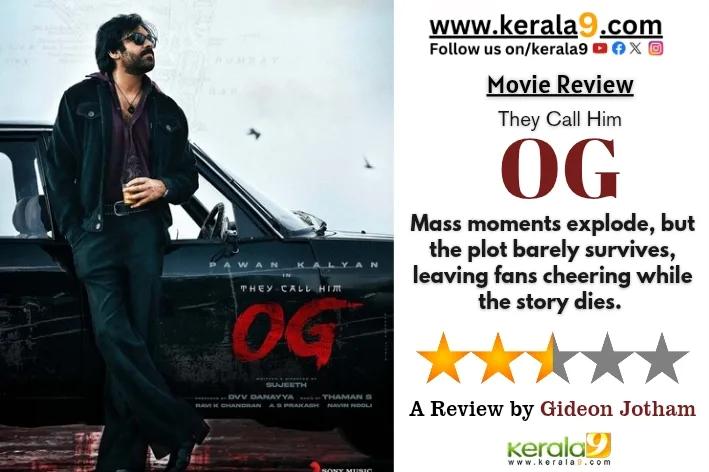
They Call Him OG Review: Mass moments explode, but the plot barely survives, leaving fans cheering while the story dies
Review by Gideon Jotham
Director: Sujeeth
Duration / Runtime: 2hr 34min
Language: Telugu
Genre: Action, Crime thriller.
Positives
- Pawan Kalyan’s screen presence
- Thaman’s score / background music
- Cinematography
- Art Direction
- Emraan Hashmi’s Performance
- Stunts
Negatives
- Lagging Story
- Average Direction
- Underdeveloped Screenplay
- Uneven Character Development
- Visual effects
- Dubbing and tone
STORY
They Call Him OG is fundamentally based on a precarious foundation. Instead of creating something original, the story is thin, almost skeletal, and mainly relies on well-worn gangster clichés. It has weight, nostalgia, and the potential to create myths, so a feared gangster going missing for years and then coming back to take back his throne could have made for an engaging setup. However, the writing never delves further.
Instead of exploring the psychology of a man who walks in blood and shadows, the film takes the easiest path: revenge arcs, family in danger, betrayals that you see coming miles ahead. Every twist feels familiar because we’ve lived through these beats in countless other films. The audience isn’t surprised; they’re simply waiting for the next “mass” moment. The problem is not just predictability, but missed opportunity. The very idea of “OG – The Original Gangster” suggests a man who shaped the underworld, someone whose choices left ripples of consequence. But here, the story doesn’t bother to show us why he matters. What was his rise? What did he lose? What makes him feared or respected? Without those answers, the title feels ornamental grand words without roots.
There are glimpses where the drama could have soared his return, his clashes with Omi Bhau, his reunion with family but the writing stays on the surface. Emotional beats don’t land because they’re rushed or predictable. Instead of tightening the story into a gripping gangster saga, it sprawls out like a collection of fan-service episodes stitched together.
In the end, the story becomes less about OG the man and more about Pawan Kalyan the star. That’s why it feels weak not because the idea lacked spark, but because the execution chose spectacle over soul.
DIRECTION
The film carries the unmistakable vibe of Saaho grand visuals, larger-than-life posturing, and an overdose of stylised violence. But beyond the surface, it feels like a patchwork quilt stitched from a dozen Tamil gangster films, with borrowed moods, familiar tropes, and a relentless attempt to make everything look “mass.” Perhaps Sujeeth’s admiration for Tamil cinema pushed him into imitation, but imitation without originality is where the cracks show.
The blood, the bullets, the slow-motion swagger they all aim for cinematic high, yet the foundation of character and story is thin. The very idea of calling the film OG – The Original Gangster deserved depth, an exploration of what makes this man feared, respected, or even remembered. Instead, the title becomes just a label. The character is never built with the gravitas to justify the name; he is celebrated as a star more than fleshed out as a man.
Yes, this is a feast for Pawan Kalyan fans his aura dominates every frame. The director pours every ounce of attention into crafting elevation scenes for him, from grand entries to punch dialogues, but in doing so, the narrative itself becomes secondary. The story bends around the star, not the other way round.
The interval block is a perfect example. It should have been the thunderclap moment the point where “OG” truly earns his crown. Instead, it fizzles into a predictable elevation shot. You expect your pulse to quicken, but what arrives is familiar, stretched, and oddly mechanical. The essence of menace, of myth, is lost in the noise.
In the end, Sujeeth directs less like a storyteller and more like a fan building a shrine for his star but forgetting to build a world for his characters. The result is over-hyped cinema: glossy, noisy, and packed with spectacle, but hollow when you look for heart.
SCREENPLAY
The screenplay is where They Call Him OG truly stumbles. Instead of investing in layers, subplots, or engaging turns, it leans too heavily on mass introductions, hero elevation scenes, and fan-service moments. These may light up theatres for a while, but once the dust settles, the absence of real progression becomes painfully obvious.
A story like this needed sharp writing, unexpected beats, psychological tension, and a sense of inevitability that keeps the audience hooked. Instead, what we get is a straight line: introduction, conflict, betrayal, revenge. In order to make room for yet another stylized fight or punch dialogue, the in-between scenes that ought to have added texture are either hurried or neglected.
The idea of a gangster coming back after years away could have been explored in a variety of intriguing ways, such as how the underworld has evolved, how his past haunts him, or how the man finds it difficult to adjust. But the screenplay avoids these complexities, settling instead for predictable “rise and reclaim” arcs.
This makes the film engaging only in bursts. A scene here, a moment there but the overall rhythm is uneven. Just when you hope for the story to dig deeper, it cuts away to spectacle. Just when you expect a twist, it falls back on cliché. The result is a film that looks busy and loud but feels hollow in its journey.
Had the screenplay dared to slow down, build conflict with more nuance, and give its characters inner lives beyond revenge, OG could have been more than a fan event. It could have been a gripping gangster saga.
CINEMATOGRAPHY
If there’s one department where They Call Him OG consistently shines, it’s the cinematography. The visuals are stylish, glossy, and undeniably cinematic. The camera knows how to worship its star every slow-motion walk, every cigarette flick, every glare across the frame is designed to amplify OG’s aura. These frames, drenched in dramatic lighting and composed with precision, succeed in creating an atmosphere that feels grand and larger than life.
The action sequences especially benefit from the camerawork. Wide-angle shots make the fights feel operatic, while close-ups capture the raw intensity of blood and grit. The rain-drenched streets, smoke-filled warehouses, and neon-soaked nightscapes all look like they belong in a gangster myth rather than just another commercial entertainer.
Yet, for all its beauty, the cinematography sometimes feels like it is doing the heavy lifting for a story that isn’t there. The frames are arresting, but not always purposeful. Gloss frequently overrules grit scenes that ought to be raw and dangerous instead appear shiny and posed. That disconnect allows the film to be stylish, but keeps it from being immersive.
And yet you can’t help but feel that the cinematography is where OG gets its swagger. Even when the writing falls short, the visuals keep us involved, serving as a reminder that at least half of cinema is what we see before our eyes, not what it makes us feel in our guts.
EDITING
The editing is where OG stumbles the most in keeping its rhythm. Instead of tightening the narrative, the film often indulges in unwanted slow-motion shots scenes that stretch far longer than they should, draining energy rather than building it. What should have been sharp and impactful moments end up feeling repetitive, almost like the film is replaying the same emotion again and again until it loses all power.
This overuse of stylisation creates a lagging effect. The story slows down not because it’s deepening, but because it’s stuck in self-indulgence. The audience feels the drag what should be pulse-racing ends up testing patience. After a while, the slow-motion doesn’t elevate the hero, it numbs the viewer.
Even transitions between moods shifting from action to drama, or from mass moments to emotional beats lack smoothness. Instead of flowing like a river, the film moves in jerks and halts, often pulling the viewer out of immersion.
Editing is supposed to be invisible when it works well it should carry the audience along without them realising it. Here, it becomes too visible, reminding us constantly that the film is more interested in showing off than moving forward. The result is not tension but fatigue, a cinematic headache that could have easily been avoided with sharper, braver cuts.
MUSIC AND BACKGROUND SCORE
Songs:
The songs in OG feel like pauses rather than progress. They arrive with style shot in glossy frames, choreographed with energy but rarely serve the story. Instead of deepening the characters or carrying the emotion forward, they act more like detours, reminding us of the commercial checklist the film wants to tick. While a couple of tunes may linger for their catchiness, they don’t leave behind the weight or memory of timeless gangster anthems. In a film of this scale, the songs should have been weapons of storytelling; here, they are just decorative ornaments.
Background Score (BGM):
If the songs distract, the background score rescues. Thaman pours fire into the soundscape of OG the pounding beats, the swelling percussion, the sharp, edgy motifs all carry the kind of electricity that the screenplay often lacks. Whenever OG makes an entry or a fight breaks out, it’s the score that lifts the scene, injecting adrenaline into the audience. Yet, even here, there’s a sense of repetition. The themes are powerful, but they circle back so often that their impact begins to dull. Still, without Thaman’s score, much of the film’s mass appeal would crumble. It is not just background music it is the scaffolding that holds the spectacle together.
PERFORMANCE OF ACTORS:
Pawan Kalyan (OG / Ojas Gambheera): The film belongs to him, and it never lets us forget that. Pawan Kalyan carries OG on his shoulders with his undeniable aura his screen presence commands attention the moment he appears. His swagger, his stillness before the storm, and his ability to dominate even silent frames are what keep the film alive. In action and elevation scenes, he is magnetic; the theatre roars because of him. But when it comes to quieter, more emotional moments, the writing doesn’t give him enough to work with. We see the star in all his glory, but rarely the man beneath the myth. That’s where the performance feels underutilized, powerful, yet limited by the film’s obsession with his larger-than-life image.
Priyanka Arul Mohan (Heroine): Priyanka’s role is caught in the shadow of spectacle. She is graceful on screen, her innocence and charm offering a contrast to the world of guns and gangsters, but the film gives her little space to breathe. She is more a presence than a character, someone to soften OG’s roughness, rather than a woman with her own arc. Her performance is sincere, but it feels like she’s acting within walls that the screenplay never lets her climb.
Emraan Hashmi (Omi Bhau): As the antagonist, Emraan Hashmi is one of the few actors who manages to cut through the film’s star worship. His portrayal of Omi Bhau brings menace and unpredictability; he feels dangerous, which is exactly what the story needed. His dialogues and controlled aggression add weight to the rivalry. Yet, like Pawan, he too is restricted by the screenplay, which paints him more as a foil than as a layered villain. Still, he makes the most of it, and his presence gives the film a badly needed balance.
Supporting Cast: Actors like Prakash Raj and Arjun Das add occasional gravitas, their voices and intensity bringing sparks to their scenes. But beyond these few, the supporting characters are mostly functional friends, sidekicks, and family members who serve the story but don’t leave a lasting impression. They exist to orbit around OG, not to shine on their own.
ACTION SEQUENCES
The action in They Call Him OG is loud, relentless, and staged for maximum impact. From the very first fight, it’s clear that Sujeeth wanted the stunts to be the heartbeat of the film, the moments when the screen erupts with blood, fire, and bullets. In many ways, these sequences deliver stylized slow-motion shots, dramatic face-offs, and bone-crunching choreography that make the theatre crowd whistle and clap.
But the overdose is hard to ignore. Almost every confrontation is stretched out, loaded with exaggerated violence and cinematic pauses that dilute the intensity instead of sharpening it. What could have been tight, visceral moments often drag on, as though the film is more interested in showing off its choreography than in moving the story forward.
That said, a few sequences stand out: the rain-soaked fight scenes, the interval block showdown, and OG’s larger-than-life entrances are designed to thrill, and they do. These are the portions where the film feels alive, where the star power of Pawan Kalyan merges with the stylish camerawork to create pure theatre.
Yet, without emotional grounding, the action feels hollow after a point. We watch men fly, blood splash, and guns roar, but rarely do we feel the stakes. The violence is spectacle, not storytelling. In a gangster epic, the fights should carry the weight of personal vendetta, fear, or desperation. Here, they often feel like an action checklist being ticked off one by one.
In short: the stunts give the film its style, but not always its soul. They are glossy fireworks brilliant for the moment, but gone too quickly, leaving behind smoke rather than fire.
FINAL VERDICT & RATING:
They Call Him OG is all swagger and spectacle soaked in blood, bullets, and star power. While Pawan Kalyan’s aura and Thaman’s pounding score keep the theatre alive, the weak story, predictable screenplay, and indulgent pacing stop it from becoming the gangster epic it promised to be. Stylish but hollow, it’s a treat for die-hard fans, but a missed opportunity for everyone else.
Rating: 2.25 / 5
Review By Gideon Jotham