Onam season brings a flurry of exciting Malayalam films to theaters, offering a mix of drama, action, comedy, and superhero thrills. As families gather to celebrate, these movies provide the perfect entertainment escape. Here’s a quick summary of reviews for some standout Onam releases, based on insights from our critics at Kerala9.com. For the full, in-depth analysis, click on the “Read More” links below.
Param Sundari
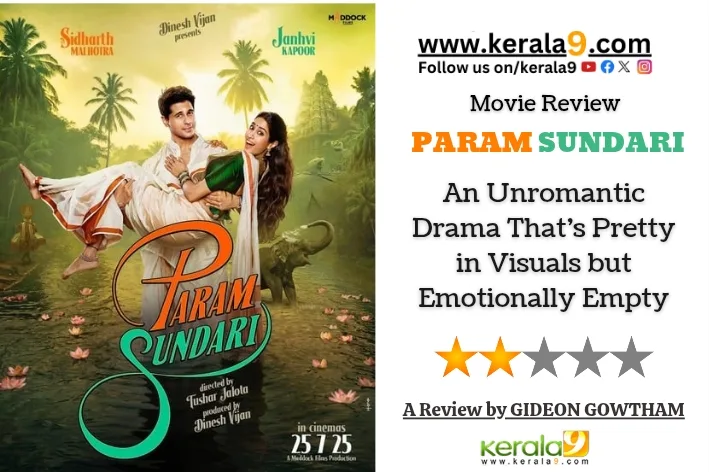
Review Title: An Unromantic Drama That’s Pretty in Visuals but Emotionally Empty By Gideon Jotham
This film boasts stunning visuals that capture the essence of romance, but it falls short in delivering genuine emotional depth, leaving audiences wanting more heartfelt connections.
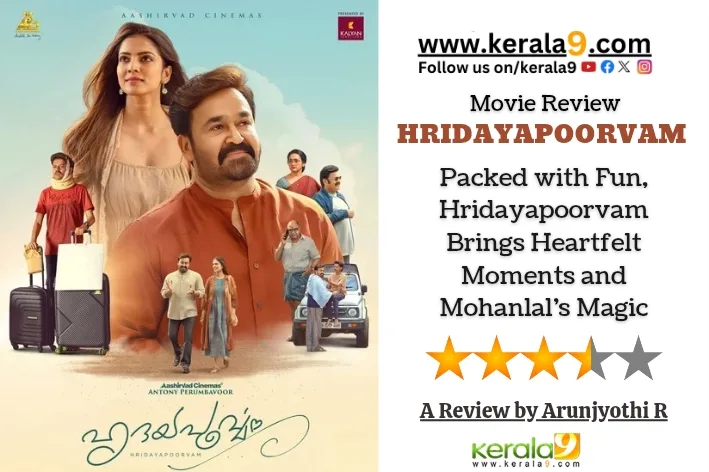
Review Title: Packed with Fun, Hridayapoorvam Brings Heartfelt Moments and Mohanlal’s Magic By Arunjyothi R
A delightful blend of humor and emotion, this movie shines with Mohanlal’s charismatic performance, offering feel-good moments that resonate long after the credits roll.
Stay tuned to Kerala9.com for more movie reviews, celebrity updates, and Onam special features. Which of these films are you planning to watch this festive season? Let us know in the comments!
ONE WORD: Dull and Boring Drama, Odum Kuthira Chaadum Kuthira Will Test Your Patience
A Review by ArunjyothiR
LANGUAGE: Malayalam
DURATION: 02 Hours 33 Minutes
DIRECTOR: Althaf Salim
GENRE: Comedy Drama
•POSITIVES:
1: Performance of Fahadh Faasil
2: Background Score
3: Some situational comedies
4: Performance of Lal
•NEGATIVES:
1: Weak Story
2: Poor Screenplay
3: Lagging at multiple points
4: Direction misses the spark
5: Comedies didn’t worked out
6: Boring second half
STORY:
Aby, an unwilling groom, reluctantly prepares for his wedding day when his bride-to-be, Nidhi, demands a grand entrance on horseback. What begins as a lighthearted gesture soon turns tragic—the horse panics, Aby is thrown off, and he slips into a coma-like state. As he slowly regains strength, life brings Aby face-to-face with a quiet, reserved woman whose presence changes the course of his recovery. Together, they embark on a tender journey of healing, rediscovering hope in places they least expect. Just as new bonds begin to form, Nidhi reappears—this time with a deeper understanding of Aby’s long-buried aspirations. Torn between the shadows of his past and the possibilities of a new beginning, Aby is led toward a hidden truth—one that holds the key to his peace and destiny.
REVIEW & ANALYSIS OF THE FILM:
WHAT ARE THE POSITIVES:
1: The only saving grace of this film is Fahadh Faasil. His natural expressions, sharp timing, and those little funny reactions on his face often bring some life into otherwise dull moments. Even when the script collapses under lame writing, he manages to pull the audience back with his effortless screen presence. Honestly, I kept checking my watch inside the theatre, wondering when this eccentric ride would end, but it was Fahadh’s performance that made me sit through till the finish. He carried the entire film on his shoulders from start to end, proving once again his calibre. Still, it feels disappointing to watch an actor of his range trapped in such poor storytelling — he truly deserves better scripts than this.
2: Another small positive lies in the background score. Though not extraordinary, it worked decently in keeping the film watchable. In a few rare scenes where the comedy actually clicked, the background score provided the right balance and added some energy. At moments when the screenplay fell flat, the music at least tried to hold the mood together, giving a little support to an otherwise shaky narrative.
3: Some of the comedy tracks in the first half worked to an extent. A few lighter moments managed to bring a smile and gave the impression that the film might shape up into a decent entertainer. These bits created a brief sense of relief and kept the audience engaged for a while, even though they were not laugh-out-loud funny. Unfortunately, this small spark of humor quickly faded as the film moved forward.
4: Though the character played by Lal is written in an eccentric and often over-the-top manner, with several of his actions being hard to digest, his sheer screen presence brings some amount of relief during this tiring watch. Even when the character slips into unbelievable territory, Lal’s energy and unpredictability keep the audience from completely losing interest. His combination scenes with Fahadh Faasil, in particular, manage to hold attention — not because they are exceptionally well-written, but because both actors complement each other’s timing and presence, making those portions at least watchable amidst the chaos.
WHAT DIDN’T WORK OUT:
1: Altaf Salim’s debut, Njandukalude Nattil Oridavela, was a breath of fresh air—a well-crafted, heartwarming family story with humor that genuinely landed. The film’s charm lay in its relatable characters, engaging narrative, and the seamless balance between comedy and emotion, which left audiences eagerly awaiting his next project. Naturally, when Odum Kuthira Chaadum Kuthira was announced with Fahadh Faasil in the lead, expectations were high.Unfortunately, Odum Kuthira Chaadum Kuthira fails to live up to its promise at almost every level. The final result is a tedious, exhausting watch—especially disappointing during the festive Onam season, when audiences crave engaging entertainment.
2: The biggest drawback of Odum Kuthira Chaadum Kuthira is Altaf Salim’s direction. While his vision and intent to bring something fresh, reminiscent of a Korean romantic comedy-drama, are evident but the execution falls flat. The story lacks momentum, and the direction struggles to maintain focus, leaving many scenes feeling aimless and disconnected. The script suffers from pacing issues and underdeveloped plotlines, while moments that could have delivered humor or depth instead fall flat. The comedic elements, which were a strong point in his debut, feel forced and uninspired here. Even Fahadh Faasil’s performance cannot salvage the film, unable to rise above the weak narrative and uneven direction.
3: The story is fundamentally weak, built on only a thin layer of plot stretched across an excessive number of events that fail to connect in any meaningful way. As I watched the film, I found myself constantly questioning what was actually happening and struggling to understand the universe in which this story was supposed to exist. There is a noticeable lack of sensibility and coherence throughout, making the narrative feel disjointed and confusing. The characters remain underdeveloped, and the situations fail to evoke any genuine emotion or engagement. By the end, the film comes across as a series of random, disconnected moments rather than a cohesive story, leaving the audience detached and struggling to care about what unfolds on screen.
4: The film opens on a promising note, with an interesting angle that immediately grabs attention. But as it dives into the main plot, the narrative quickly unravels. What could have been engaging turns tedious, making the viewing experience frustratingly slow. Fahadh Faasil’s character, following an accident, slips into a coma-like state, and from that point onwards, it feels as if the director is putting the audience into the same coma- like stage. The pacing falters, the energy dwindles, and by the second half, the film completely loses its grip, weighed down by a confused and incoherent screenplay. Scenes that should have added depth or humor instead feel hollow, and the emotional stakes never land, leaving the story feeling completely disconnected. A promising premise is squandered, and viewers are left counting down the minutes rather than staying invested in the unfolding drama.
5: The film primarily falls under the romantic drama genre, but both elements fail miserably to engage the audience. As mentioned earlier, the comedic moments feel completely unnatural, making the overall premise of the film seem artificial. The romantic angle suffers the same fate. The connection between Fahadh Faasil’s and Kalyani’s characters feels weak, and the situations meant to bring them together come across as forced and unconvincing. I could not feel any genuine romantic chemistry or emotional attachment to their journey. Even the second-half romantic subplot involving Revathi Pillai and Dhyan Sreenivasan, while slightly more watchable, didn’t leave much of an impact on me. From my perspective, the director’s attempt at a happy ending felt forced and awkward, and I kept finding myself checking the clock, wondering when the film would finally be over so I could go home.
6: The screenplay is also the weakest link in the film, struggling to hold together an excessive number of incidents that feel scattered and disconnected. Instead of flowing naturally, each new development appears abruptly, with little thought given to how it integrates with the previous scenes. Subplots that might have added depth or humor are either underdeveloped or entirely pointless, contributing to a sense of chaos rather than coherence. Moments that should carry emotional weight or comedic relief fall flat, and the characters’ journeys fail to resonate. The narrative is overcrowded yet empty, leaving the audience unable to connect with the story or its developments. By the second half, the film’s lack of structural focus becomes glaring, as the screenplay drags the momentum down and makes the entire viewing experience tedious and frustrating.
7: The comedy in the film falls flat almost entirely, with hardly a moment that genuinely evokes laughter. While a few bits in the first half manage to pass off as tolerable, the so-called comic portions in the second half are nothing short of painful, bordering on sheer stupidity. Character arcs are equally weak, especially the father role played by Lal. Though intended to be eccentric, his performance slips into overdramatization, with actions so exaggerated and bizarre that they make us question whether such behavior could ever exist in reality. The supporting characters don’t fare any better; their antics often give the impression that the entire ensemble is collectively insane. By the end, the film leaves viewers with a strange afterthought—are all the characters truly mad, or is it the audience that has gone mad for sitting through this chaos?
PERFORMANCE OF ACTORS:
If there is one reason this film doesn’t completely fall apart, it’s Fahadh Faasil. He slips into the role with ease, bringing a natural charm that keeps the audience engaged even when the story loses its grip. His quick-witted expressions, quirky reactions, and the way he switches moods on screen give the character an extra layer of appeal. Whether it is a casual smile or a sudden spark of mischief on his face, Fahadh knows how to hold attention. While the script often drags, his presence ensures there’s at least something worth watching. In many ways, he becomes the glue that holds together an otherwise scattered film.Lal steps into the film with his usual commanding presence, but the character he is given feels eccentric and, at times, overdrawn. Some of his actions are hard to digest, yet there’s no denying that he manages to bring a certain weight whenever he appears on screen. Even in the most dragging moments, his timing and body language prevent the scenes from turning completely flat. The portions he shares with Fahadh carry a mild spark, adding a touch of liveliness to an otherwise exhausting watch. While the role itself may not have been written well, Lal’s screen presence makes it bearable to sit through.
Kalyani Priyadarshan and Revathi Pillai, as the leading ladies, deliver fairly notable performances. Kalyani looks graceful on screen, and her playful mannerisms add a light charm to her character, though the comedic bits written for her do not land as effectively as intended. Despite that, her overall presence remains watchable. Revathi Pillai, on the other hand, stands out with her natural style of acting. She takes stronger control in the second half, which otherwise suffers from weak writing and dragging sequences. Her chemistry with Dhyan Sreenivasan in the romantic portions provides a much-needed relief during the dull stretch, while her brief interactions with Fahadh also come across as decent. Among the supporting cast, Vinay Forrt, Suresh Krishna, and Anuraj put in commendable efforts and maintain consistency, but even their solid performances are unable to lift the film above the weight of its underwhelming script.
CONCLUSION:
So overall, Odum Kuthira Chaadum Kuthira ends up being a tiring watch mainly because of its weak direction by Altaf Salim. The film never settles on a clear tone and often drifts without purpose, making the narrative messy and unengaging. Even with dependable actors like Fahadh Faasil and Lal trying their best, the screenplay gives them very little to work with. Revathi Pillai provides some natural charm, especially in the second half, but her efforts too get buried under the flat writing. The background score and a handful of light comedy moments offer mild relief, yet they cannot cover up the lack of strong storytelling.
Instead of delivering the quirky fun it promises, Odum Kuthira Chaadum Kuthira slips into a dull and half-baked mess. As an Onam release, it feels more like a test of patience, making you sit through stretched, boring moments — a bad choice for the festival season.
Param Sundari Review -An Unromantic Drama That’s Pretty in visuals but Emotionally Empty
Director : Tushar Jalota
Duration: 136 minutes
Language: Hindi
Genre : Romantic Comedy.
POSITIVES
1: Cinematography
2: Performance of some actors
NEGATIVES
1: Story
2: Performance of some actors (over acting)
3: No Emotional connection
4: Under developed arc
5: Dialogue
6: Comedy
STORY
The story revolves around a millionaire’s son who is portrayed as an ambitious yet immature entrepreneur. He has failed at multiple startups, burning through his father’s money, and is on the verge of losing his final chance. His father, tired of the failures, plans to sell off the company. This sets up the central conflict in desperation, the son pitches a new idea: an app that can scientifically find a person’s true soulmate.
On the surface, it feels like a fresh, modern concept. But the way it’s executed makes it predictable right from the start. His father, skeptical but willing to give him one last shot, sets a condition: prove the app works within 10 days by finding your own soulmate.
From here, the film moves into its romantic track. According to the app’s algorithm, his soulmate turns out to be Janvi Kapoor, a Malayali woman who manages a traditional residential home. She is written as simple, grounded, and deeply rooted in her culture, in direct contrast to the hero’s flashy, privileged life. This clash of personalities had great potential, but the film never really explores it beyond superficial banter and cliché interactions.
As the hero tries to win Janvi over, the audience is dragged through a mix of staged comedic situations and predictable romantic gestures. While Janvi slowly begins to soften towards him, her life comes with a catch she has a childhood friend to whom she has been emotionally bound since her early years. Their families have long dreamed of their marriage, making her loyalty to him almost inevitable. This creates a ticking clock for the hero: he has 10 days to not only prove his app works but also convince Janvi to choose him instead of her destined partner.
Just when it seems like the story might dig into this conflict, comes the twist: the hero discovers that the app developer, the very foundation of his project, is a fraud. The science behind his “soulmate finder” collapses, leaving the hero disillusioned. This is the film’s big emotional turning point, and it should have been the strongest moment of the narrative. But instead of exploring the gravity of this betrayal, the film moves past it too quickly.
The hero, wracked with guilt, confesses everything to Janvi that their entire relationship was sparked not by fate, not by love, but by an experiment tied to his startup. For a brief moment, the film feels raw and human. Janvi, deeply hurt, tells him to leave her life. It’s not dramatic or loud; it’s simply rejection, delivered with the weight of betrayal.
This could have been the point where the film redefined itself diving into redemption, forgiveness, or even the hero learning that love cannot be engineered. But instead, the story slides back into formula, leaving the audience with an ending that feels rushed and predictable. What should have been a poignant reflection on love and honesty becomes just another boy-meets-girl, boy-loses-girl, boy-gets-girl narrative.
Screenplay
Fundamentally, this movie follows the classic three-act model setup, confrontation, and denouement. On a prima facie level, this might seem acceptable; however, the problems exist in its delivery.
The first act introduces a privileged young man and his failed business endeavors. It sets up the premise but does not create a sense of urgency or a strong hook that would interest the audience in his story. The idea of a “10-day soulmate challenge” suggested by his father feels more like a forced plot device than a strong dramatic construct.
The second act, in which he meets Janvi and sets out to capture her heart, is the point at which the film should build tension and emotional investment. Sadly, instead of going deeper, we see shallow interactions. The comedy scenes are self-conscious about their purpose to be funny but don’t quite work. The humor is boisterous instead of witty, and instead of flowing naturally into the story, it is risible as awkward padding.
The conversation is another major weak point. The Malayalam spoken in the film is not authentic; even locals could be stumped into not being able to recognize it as their own language. This inconsistency ruins immersion and creates a separation, especially since the story is supposed to depict the culture of Kerala.
By the third act, the moment of discovery that the app creator is a con artist could have been the clincher. It could have propelled the story further, making the hero realize his inadequacies and actually work towards love. Unfortunately, the script rushes through this critical realization. The emotional consequences of the protagonist’s revelation and Janvi are realized but not explored fully. What should have been the emotional heart of the story simply becomes yet another plot device.
In summary, the screenplay appears to have been crafted to fulfill formulaic requirements rather than to foster authentic drama. There exists a lack of emotional complexity, an absence of organic character development, and no memorable moments that linger after the film concludes. While it adheres to a three-act structure, it overlooks the fundamental element that truly matters: capturing the audience’s emotional investment.
Direction
The direction can best be described as average. The film moves from one act to another without much flair, relying heavily on its glossy visuals rather than strong storytelling. There are moments where the staging and shot choices suggest promise, but they don’t translate into emotional weight or audience engagement.
What hurts more is the projection of Kerala and its people. Small details, like showing a cab driver casually drinking kallu (toddy), feel like cheap stereotypes rather than authentic cultural reflections. Worse, the film even pokes fun at Kerala’s 96% literacy rate one of the state’s proudest achievements in a way that comes across as mocking rather than humorous.
The language, too, becomes a victim. The Malayalam spoken on screen feels so distorted that even native speakers found it difficult to follow. For a film that leans on regional flavor, this is a major misstep; instead of celebrating the culture, it alienates the very audience it claims to represent.
Another disappointing element is the portrayal of female characters. Instead of being written with strength or individuality, they come across as underdeveloped and sometimes even disgracefully caricatured. The female leads are either bound by stereotypes or used as props to further the hero’s arc, leaving little room for their own voice.
Overall, the direction seems to prioritize style over substance, resulting in a film that looks polished on the outside but lacks sensitivity, depth, and respect for the cultural backdrop it portrays.
Cinematography
If there is one department where the film truly excels, it is the cinematography. Every frame looks carefully composed, and the visuals carry a polish that the story itself lacks. The camera work captures vibrant colors, smooth movements, and striking landscapes, making even the most ordinary moments look cinematic.
The lighting is handled with precision bright and lively during romantic sequences, subtle and atmospheric during emotional confrontations. The visual texture feels consistently rich, creating a mood that the screenplay often fails to support.
Each part of the film visually stands out, and in many ways, the cinematography works overtime to hold the audience’s attention. Even when the writing falters, the visuals offer something pleasing to look at, giving the film its only real sense of grandeur.
In short, the best part of the movie is its cinematography. It’s stylish, immersive, and easily the highlight of an otherwise underwhelming experience.
Performances
The acting in this film sits somewhere in the average zone. No one delivers a breakthrough performance, but at the same time, it isn’t outright unwatchable either.
The hero, despite lacking emotional depth in heavier scenes, does manage to bring a certain energy to the lighter portions. His charm works in parts, even if it doesn’t fully carry the story. The heroine, though underwritten, has a natural screen presence in a few moments, especially the emotional confrontation, she does manage to connect.
The supporting cast is a mixed bag: some characters are played too loud, leaning into overacting, while others quietly balance the tone. Now and then, a secondary role sparks a moment of authenticity that reminds you what the film could have been.
So while the performances don’t leave a lasting mark, there are scattered moments where the acting feels genuine and engaging. Somewhere in between, it’s good just not consistent enough to elevate the whole film.
Final Verdict
This is a film that had an interesting premise on paper technology meeting love, tradition clashing with modernity but it stumbles in execution. The direction is average, the screenplay predictable, and the performances land in the “just okay” zone. The biggest saving grace is the cinematography, which consistently delivers stunning visuals and keeps the film from sinking completely.
But weak storytelling, forced comedy, and cultural misrepresentation pull it down. Somewhere in parts it feels good, but as a whole, it never rises above mediocrity.
Rating:
Verdict: A visually polished film that fails to connect emotionally.
Kozhikode: The Thamarassery Ghat Road has been completely closed to traffic until further notice following repeated landslides, District Collector Snehal Kumar Singh announced.
Heavy rains have triggered boulders and mudslides onto the road, forcing a total traffic ban. Only ambulances and emergency vehicles are allowed passage with police permission.
Alternative routes via Lakkidi have been restricted for normal vehicles, while authorities have warned of possible congestion on Kuttiyadi ghat.
Revenue officials, police, fire and rescue teams are coordinating clearing operations. The District Disaster Management Authority has cautioned that there is a risk of further landslides at the Wayanad ghat viewpoint.
Under provisions of the Disaster Management Act, 2005, strict traffic restrictions have been imposed, exempting only essential services like ambulances, hospitals, milk, newspapers, and fuel supply.
Earlier today, more boulders fell onto the ghat road, forcing complete closure. Travelers were stranded for hours. Officials faced criticism for not reaching the site on time despite warnings.
Jammu: Torrential rains continue to wreak havoc in northern India, with flash floods and landslides claiming 41 lives in Jammu & Kashmir. Many others have been injured.
An emergency meeting chaired by Lieutenant Governor Manoj Sinha reviewed the situation. In Punjab, relief operations are underway, while the Chandigarh-Manali highway has been shut due to landslides.
For the past three days, heavy rains have caused widespread damage in several northern states. Rivers are overflowing, inundating low-lying areas. In Jammu’s Belicharan area, 35 houses collapsed. Dozens of families have been relocated from severely affected regions like Doda and Anantnag.
Schools remain shut and examinations have been postponed. The Indian Air Force has intensified rescue efforts in Punjab, evacuating 27 people from Gurdaspur. In Himachal Pradesh, landslides have damaged parts of the Manali National Highway near Kullu as the Beas river overflowed.
Due to continuous heavy rainfall, water levels in several reservoirs across the state have surged. Red alerts have been declared in nine dams.
KSEB dams: Kakki, Mattupetty, Kallarkutty, Sholayar, and Peringalkuthu
Irrigation department dams: Meenkara, Walayar, and Pothundi
Water is being released as a precaution from Mattupetty, Kallarkutty, Peringalkuthu, Meenkara, Walayar, and Pothundi dams. Residents near dam areas have been asked to remain vigilant.
At the Idukki dam, water storage has reached 74.37% of its capacity, with today’s level recorded at 2380.56 ft.
Thiruvananthapuram: Heavy rains continue to lash Kerala. The India Meteorological Department (IMD) has issued an orange alert for six districts on Thursday: Ernakulam, Thrissur, Kozhikode, Wayanad, Kannur, and Kasaragod.
A yellow alert has been issued for Malappuram, Palakkad, Idukki, Kottayam, and Alappuzha districts. On Friday, yellow alerts will be in place in Wayanad, Kannur, Kasaragod, Ernakulam, Thrissur, Palakkad, Malappuram, Idukki, and Kozhikode.
Chennai: Superstar Rajinikanth’s 171st film Coolie will retain its ‘A’ certificate, as the Madras High Court has dismissed the plea filed by the producers, Sun Pictures, seeking a revision.
The court, led by Justice T.V. Tamilselvi, noted that there was no basis for the producers’ complaint. The censor board had granted the film an ‘A’ certificate citing excessive violence. The board had also offered to grant a U/A certificate if certain violent scenes were cut, but the producers refused.
The producers argued that films like KGF and Beast contained more violence, yet did not receive an ‘A’ rating, and claimed that the certification would keep families away from theatres. However, the court did not accept the argument. Despite the certification controversy, Coolie continues to receive strong audience response, having already grossed ₹304 crore from India alone.
Hridayapoorvam Review :ONE WORD: Packed with Fun, Hridayapoorvam Brings Heartfelt Moments and Mohanlal’s Magic
A Review by Arunjyothi R
LANGUAGE: Malayalam
DURATION: 02 Hours 31 Minutes
DIRECTOR: Sathyan Anthikad
GENRE: Comedy Drama
•POSITIVES:
1: Direction
2: Screenplay and Dialogues
3: Performance of Mohanlal
4: Comedies
5: Combination scenes of Mohanlal and Sangeeth
5: Music and Background Score
6: Performance of Malavika Mohanan
7: Cinematography
8: Editing
•NEGATIVES:
1: Predictable Storyline
2: Duration could have been trimmed
STORY:
Hridayapoorvam follows Sandeep Balakrishnan (Mohanlal), a middle-aged bachelor in Kochi who is learning to live again after a heart transplant, with the help of his spirited caregiver Jerry (Sangeeth Prathap). His quiet life takes a turn when Haritha (Malavika Mohanan), the daughter of his heart donor Colonel Raveendranath, visits him and persuades him to attend her engagement in Pune. But the ceremony collapses unexpectedly when Haritha calls off the wedding, leading to chaos and leaving Sandeep injured and unable to return home.
Stranded in Pune, Sandeep and Jerry are taken in by Haritha and her mother, Devika (Sangita Madhavan Nair). In the days that follow, Sandeep becomes an emotional anchor for both women—reminding Haritha of her father’s presence and offering Devika the empathy she had long been denied in her marriage. In turn, Sandeep begins to rediscover warmth and intimacy he never thought he’d feel again. The story gently unfolds as an exploration of how loss, memory, and second chances can bring unlikely hearts together.
REVIEW & ANALYSIS OF THE FILM:
WHAT ARE THE POSITIVES:
1: The biggest strength of Hridayapoorvam lies in Mohanlal’s stellar performance. His effortless screen presence dominates the film, and his natural style of acting keeps the narrative engaging right till the end. One of his finest qualities here is his impeccable comic timing—he slips into humour with such ease that even ordinary lines turn into laugh-out-loud moments. These lighter touches never feel forced; instead, they flow organically, giving the audience a warm and enjoyable experience. As the story gradually shifts towards deeper emotions, Mohanlal carries the film with remarkable steadiness, never letting it lose its grip. The climax, in particular, showcases his ability to transition from humour to raw emotion seamlessly, leaving a lasting impact. This blend of comedy and sensitivity is what makes his performance special. Truly, this fun-filled yet deeply emotional Mohanlal is a treat to watch, and his presence alone lifts Hridayapoorvam above its flaws.
2: The second standout aspect of Hridayapoorvam is Sathyan Anthikad’s direction. What could have been a very straightforward story is executed with a steady hand, keeping the film free of major flaws. The humour is woven seamlessly into the narrative, never feeling out of place, and each comic situation flows naturally from the characters and setting. This is where Anthikad’s signature style truly shines—his ability to craft everyday scenarios with warmth, simplicity, and a touch of humour makes the film both delightful and cheering to watch.
3: The feel-good mood Sathyan Anthikad sustains throughout the runtime is another strength. Even as the story moves into more emotional territory, the lightheartedness and gentle comedies balance the depth of the plot, ensuring that the audience stays engaged. Anthikad manages to strike a rare balance between entertainment and emotional resonance, and by the end, his direction leaves behind a steady rhythm and consistency. It’s this grasp over tone that prevents the film from ever feeling sluggish or uneven, making Hridayapoorvam a classic example of his trademark storytelling.
4: Though the story of Hridayapoorvam is simple and at times predictable, the screenplay manages to keep things engaging. The writers deserve credit for shaping the narrative with situational humour that not only entertains but also drives the story forward. The comedic moments feel organic and never forced, giving the impression of natural, everyday occurrences rather than staged gags. This ease of writing allows the film to retain its feel-good essence while still moving steadily towards its core emotional beats. Another strength of the screenplay is how it balances humour with warmth and emotion. The lighthearted moments blend seamlessly with the more sentimental scenes, ensuring that the tone never feels inconsistent. Even the romantic angles are handled with restraint, complementing the humour without overcomplicating the narrative. From start to finish, the writing maintains its graph, leading to a satisfying climax that ties the threads together without unnecessary melodrama. It’s this careful blend of simplicity, comedy, and heart that makes the script work.
5: Another major highlight of Hridayapoorvam is the combination of Mohanlal and Sangeeth Prathap. Their scenes together are a constant source of fun, with humour flowing effortlessly and keeping the audience engaged throughout. What makes their comedy work so well is not just the timing but also the way both handle expressions and dialogue delivery—Mohanlal’s subtle reactions paired with Sangeeth’s energetic punchlines create a perfect rhythm that clicks every time. Their chemistry feels natural and unforced, making each interaction a delight. Beyond the laughs, the bond between their characters is portrayed with warmth and charm, adding emotional weight to their entertaining partnership.
6: One of the strongest positives of Hridayapoorvam is its abundance of comedy. From the very beginning to the final moments, the film is peppered with situational humour that keeps the audience engaged without ever slipping into monotony. There is hardly a dull stretch, as each sequence carries some light-hearted touch that makes the viewing experience consistently enjoyable. The comic exchanges between Mohanlal and Sangeeth Prathap, in particular, elevate the humour—Mohanlal with his subtle, effortless reactions and Sangeeth with his energetic, quirky style make for a hilarious combination that works beautifully on screen. What’s refreshing is that the humour never feels forced; it arises naturally from the situations and characters, giving the film an easy flow. This constant dose of fun, mixed with gentle emotional moments, creates the right balance of entertainment and warmth. As a festive Onam release, Hridayapoorvam feels tailor-made for families—it has the right blend of comedy, feel-good emotions, and relatability to leave viewers both entertained and satisfied. The overall package is one of charm and cheer, making it an ideal watch for audiences seeking laughter with a touch of heart.
7: The music and background score by Justin Varghese stand out as another strong positive of Hridayapoorvam. His compositions perfectly complement the film’s tone, making several moments more pleasing and memorable. The songs are thoughtfully placed, each carrying the right emotion to match the on-screen events. “Venmathi,” with its soothing melody and Sid Sriram’s soulful vocals, not only elevates the visuals but also lingers in the listener’s mind long after. On the other hand, “Vida Parayam” beautifully balances the feel-good mood with an emotional undercurrent, striking the right chord with the audience. Equally effective is the background score, which consistently supports the narrative. The playful tunes during comedy sequences enhance the humour without overwhelming it, while the softer, emotional strains gently underline the feel-good and heartfelt scenes. Justin Varghese’s work ensures that the film maintains its rhythm and emotional flow, proving how vital music is in sustaining the charm of Hridayapoorvam.
8: Malavika Mohanan’s performance is another strong pillar of Hridayapoorvam. Beyond her striking screen presence, she delivers a convincing portrayal of a daughter weighed down by emotional baggage. The vulnerability and depth she brings to her character create an instant connection with the audience, making her arc both relatable and heartfelt. Her scenes with Mohanlal are especially noteworthy—together, they generate a natural chemistry that blends moments of warmth, humour, and quiet emotion. These interactions not only add to the film’s feel-good charm but also help in driving the narrative forward with ease. Malavika proves that she is not just there for glamour, but also for substance, leaving a memorable mark on the film.
9: The cinematography of Hridayapoorvam stays simple and rooted in the core of the story. The frames and shots are clean, never distracting, and align well with the film’s family-oriented tone. Since much of the narrative unfolds in Pune, the visuals capture the city’s locations effectively, giving the film a natural backdrop without over-stylisation. What stands out most are the close-up shots, which beautifully highlight the performances of Mohanlal, Sangeeth Prathap, and Malavika Mohanan, allowing their expressions to carry the weight of the scenes. The climax in particular benefits from precise camerawork, with Mohanlal’s emotional speech framed and angled in a way that leaves a lasting impact. The cinematographer wisely avoids flashy experiments or unnecessary gimmicks, instead maintaining a grounded visual style that supports the story. For a simple, feel-good family drama, this restrained approach to cinematography works perfectly.
10: The editing by Rajagopal is neat and effective, with crisp cuts that keep the flow of the film intact. The transitions between scenes are handled smoothly, avoiding any jarring mismatches, and the editing in the climax action portions deserves special mention for maintaining both clarity and impact. The costumes too add to the film’s visual appeal—Malavika Mohanan looks elegant in every frame, while Mohanlal carries his looks with trademark charm and style. The final action sequence is choreographed with care, striking a balance between energy and realism. Here again, Mohanlal elevates the moment with his effortless screen presence, adding his own stylish touch that makes the climax sequence memorable. Together, the editing, costumes, and choreography contribute to making Hridayapoorvam visually pleasing while keeping the narrative engaging.
WHAT DIDN’T WORK OUT:
1: The first and most noticeable drawback of Hridayapoorvam is its overly simple storyline and the predictability that comes with it. Right from the beginning, it is quite easy to foresee how most of the events will unfold, and this lack of surprise weakens the narrative impact. For a film carrying such an emotional premise, one might expect more depth or a few unexpected turns, but the plot largely stays within a safe zone without taking any risks. However, what prevents this simplicity from turning into outright dullness are the lighter moments and situational humour built into the screenplay. The well-placed comedy and feel-good scenes breathe life into an otherwise straightforward story, keeping the audience engaged even when the direction of the plot is obvious. In that sense, while the writing doesn’t escape predictability, it manages to soften its effect by relying on humour, charm, and character interactions.
2: The second drawback of Hridayapoorvam lies in its duration. With a runtime of 151 minutes, the film feels slightly stretched, especially in the second half where a few scenes run longer than necessary. While the first half moves at a lively pace, some portions in the latter half could have been trimmed to maintain the same flow and energy throughout. This isn’t to say the film becomes boring, but the sense of drag does creep in here and there, making the narrative feel a bit heavier than it should. A tighter edit would have made the storytelling more compact and impactful, ensuring that the emotions and humour carried their weight without losing momentum.
PERFORMANCE OF ACTORS:
Mohanlal once again proves why he remains the heartbeat of family entertainers. His effortless charm, natural timing in light-hearted scenes, and measured grace in emotional moments elevate Hridayapoorvam throughout. Whether it is a witty one-liner or a tender exchange, he shifts gears seamlessly, giving the film its soul and making even simple sequences memorable. His ability to balance humor with subtle emotion ensures that the audience stays engaged and invested in the journey.
Sandeep delivers a refreshing performance, holding his ground confidently alongside stalwarts. His youthful energy and convincing expressions in comedy sequences add spark, while his controlled emotional beats make his character relatable. Malavika Mohanan, on the other hand, emerges as one of the strongest positives of the film. She looks stunning on screen but, more importantly, brings depth to her role. The emotional baggage her character carries translates effectively, making her moments resonate with sincerity. Her chemistry with Mohanlal works beautifully, especially in their lighter and feel-good scenes, giving the film both warmth and weight in equal measure.
Sangita Madhavan Nair, as Malavika Mohanan’s mother, delivers a heartfelt performance filled with love, warmth, and affection, making her bond with her daughter feel truly genuine. Her expressive acting, combined with a few light-hearted moments alongside Mohanlal, adds both depth and charm to the narrative. Nishan, in his negative-shaded role, plays it convincingly and brings the required intensity to his character. Meanwhile, veterans Siddique and Lalu Alex infuse the film with well-timed humor, excelling in their supportive roles. The biggest surprise, however, comes from Soumya Bhagyan Pillai, who shines in a fun-filled avatar, bringing freshness and effortless humor to the screen
CONCLUSION:
Overall, Hridayapoorvam works as a wholesome family entertainer that blends humor, emotions, and heartfelt moments. Mohanlal and Sandeep carry the comic portions with effortless timing, making several scenes genuinely laugh-out-loud, while Malavika Mohanan adds charm and grace to the narrative. Beyond the laughter, the film also strikes an emotional chord with its tender, feel good moments that remind us of the value of love and togetherness. With its balance of fun and feel-good sentiment, Hridayapoorvam succeeds in offering something for every kind of viewer, ultimately making it a delightful watch for families during the Onam festival.
Genre: Superhero Drama with strong cultural and mythological flavor
Director & Writer: Dominic Arun
Producer: Dulquer Salmaan under Wayfarer Films.
Positives
1: Direction
2: Story
3: Screenplay
4: Actors performance
5: Stunts
6: inematography
7: Editing
8: pecial effects and Visual effects
Negatives
1: Duration of the film
2: ncomplete characters(few)
3: Forcefully inserted sequence
Story
At its core, Lokah isn’t just another superhero origin tale it’s a meditation on loss, identity, and courage. The narrative uses the disappearance of Chandra’s father not as a mere plot device but as an emotional wound that defines her arc. Every step she takes, whether in fear, anger, or defiance, is tied to that bond. It’s not the wand or the powers that make her rise; it’s the lingering presence of a father she refuses to forget.
Chandra’s transformation from an ordinary daughter caught in tragedy to a reluctant protector feels deeply personal. Unlike many superhero films where the journey is driven by destiny alone, here the conflict is internal: Will she allow grief to consume her, or will she channel it into something larger than herself? That question shapes her choices and makes the spectacle meaningful.
Yes, the superhero blueprint is familiar the discovery of powers, the resistance to accept them, the reluctant embrace, and the eventual rise. But what differentiates Lokah is the way these stages are filtered through a Kerala-specific sensibility. The landscapes, the language, the cultural nuances, even the way family and community ties are written into the script they root the film in a context far removed from Western superhero templates. This grounding makes Chandra feel less like an imitation of Marvel or DC and more like a uniquely Malayali heroine whose struggles resonate beyond capes and costumes.
Screenplay
Dominic Arun approaches the screenplay with a clear sense of rhythm. The first half is deliberately paced, giving Chandra’s personal world enough breathing room before plunging her into larger-than-life conflicts. We witness her as a daughter first, as a human second, and only gradually as a superhero this careful layering makes the emotional beats land with impact.
The interval block is where Arun’s writing shines brightest. It isn’t just a technical “set-piece”; it feels like the natural culmination of Chandra’s inner struggle. The way the scene escalates from quiet grief into a thunderous moment of acceptance gives the audience that rare cinematic shiver not because of CGI or sound, but because the emotion has been earned.
Of course, the screenplay isn’t flawless. Certain segments lean heavily on exposition, especially when setting up the mechanics of Chandra’s powers or hinting at the mythology of the Lokah universe. These moments occasionally slow the flow, and the audience feels the script explaining rather than showing. Yet, even here, Arun ensures the groundwork is laid for what’s clearly envisioned as a multi-film universe. The small teases of larger villains, subtle cameos, and narrative seeds sown throughout make it evident that this is just “chapter one” of a grander saga.
The real achievement of the screenplay is balance between personal and epic, between grief and spectacle, between closure and open-ended promise. By the time the credits roll, the audience feels satisfied with Chandra’s arc yet hungry for the next installment. That’s exactly what a first chapter should do..
Direction
Dominic Arun’s direction is where Lokah – Chapter 1: Chandra finds its most distinctive voice. In an industry still hesitant to fully embrace the superhero genre, he dares to attempt something that feels both ambitious and deeply personal: crafting India’s first female-led superhero franchise that isn’t a one-off gimmick, but a foundation for a cinematic universe.
What makes Arun’s work stand out is his ability to balance two worlds that could have easily clashed the local and the global. The film moves seamlessly from narrow village lanes, filled with cultural textures and the intimacy of Kerala life, to expansive dystopian backdrops where the fate of humanity feels at stake. This contrast doesn’t feel jarring because Arun treats both spaces with equal sincerity. The local isn’t romanticized, and the global isn’t exaggerated; both are stitched into the same fabric of Chandra’s journey.
Importantly, Arun never loses sight of the human core. Many superhero films collapse under the weight of spectacle, turning their leads into symbols rather than people. Here, Chandra remains a daughter in mourning, a young woman stumbling through fear, before she becomes a savior. Arun’s camera lingers on her hesitations, her silences, and her moments of doubt reminding the audience that behind the powers lies a fragile human heart.
His world-building instincts also deserve mention. Instead of rushing to show everything, Arun plants small narrative hooks a glance at a villain, a brief cameo, a mysterious symbol teasing future chapters without overstuffing the present one. This shows a long-term vision, rare in Indian franchise-building attempts.
Yes, there are moments where the ambition slightly outruns the resources certain dystopian sequences strain against budget limits. But Arun’s direction compensates by ensuring that even the grandest set-pieces are emotionally anchored. The wand doesn’t just glow for spectacle; it glows as a reminder of loss, inheritance, and identity.
In short, Arun directs not just a superhero film, but a story about what it means to rise from grief and carry the burden of hope. That’s why Lokah feels less like an imitation of Hollywood and more like the birth of something uniquely Malayalam. Bun
Cinematography
Nimish Ravi’s visuals are a triumph. The color palette shifts earthy, warm tones in Chandra’s personal life versus cold, metallic shades in dystopian sequences tell their own story. Action sequences are fluid, with dynamic camera work that captures both intimacy and grandeur. Certain wide shots of ruined landscapes and the glowing wand stand out as poster-worthy.
Performance
Kalyani Priyadarshan
Kalyani brings charm and emotional balance to the narrative. While not overshadowing Chandra’s arc, her presence adds warmth and relatability especially in lighter moments. She acts as both friend and grounding force, giving the audience breathing space amidst heavy drama. Her screen presence lights up the scenes she’s in, making her role memorable even if not central.
Naslen K. Gafoor
Naslen is the film’s spark of youth and relatability. His comic timing and natural screen presence inject freshness into tense moments, offering relief without breaking tone. But more importantly, he plays his role not just for laughs when the story demands seriousness, he shifts gears effortlessly. Naslen’s chemistry with the rest of the cast, especially in friend-circle dynamics, makes the relationships feel lived-in rather than scripted.
Sandy Master
Sandy surprises with his raw physicality. His body language in action sequences feels organic, not choreographed, which is ironic given his dance background. He embodies the physical realism of Lokah, showing that even in a fantastical story, the human body has weight and impact
Editing
Chaman Chakko’s editing maintains rhythm, especially in the first half where emotion and mystery need space. The transition into action-heavy second half is slick, but a few sequences could have been trimmed for tighter pacing. The interval cut is razor sharp, ending on a perfectly timed high.
Stunts & Action
The stunt choreography in Lokah strikes a balance between realistic grounded combat and stylized superhero spectacle. Instead of relying only on wirework and CGI, the film leans into raw physicality you feel the weight of every punch, fall, and kick.
Hand-to-hand combat: The close-range fights, especially Chandra’s early encounters, are shot with an earthy, tactile quality. There’s a roughness that makes the action believable, showing that she’s still learning her powers.
Sandy Master’s contribution: His presence elevates the physical choreography. The way he moves agile yet gritty makes the stunt design look authentic rather than over-rehearsed. He adds rhythm to the action, which keeps sequences dynamic.
Set-piece moments: The interval stunt block stands out as a high point. It combines sharp choreography with emotional weight, making the action feel earned rather than gratuitous.
Blend with VFX: Instead of overloading the screen with CGI-heavy moves, the stunts are practically driven and then enhanced digitally. This keeps the fights rooted in realism while still delivering “larger-than-life” beats.
Cultural flavour: Unlike generic superhero films, the stunt design borrows from local martial arts traditions and Kerala’s physical culture, giving the action a unique identity.
VFX
For an Indian superhero film, the VFX is surprisingly polished. The wand effects, dystopian set extensions, and dark-force designs hold up well on the big screen. While not flawless in every frame, the ambition outweighs the occasional rough edges. Importantly, the effects support the story instead of overwhelming it.
Sound Design
The soundscape adds muscle to the film. From the subtle crackle when Chandra first touches the wand, to the layered chaos of battles, the design builds immersion. Silence, too, is used cleverly moments of grief are given quiet, letting emotion speak louder than sound.
CGI
The CGI blends with live action better than expected. The rendering of mystical energy around Chandra feels organic, not cartoonish. Large-scale destruction sequences look cinematic, though some crowd effects and background creatures reveal budget limits. Still, for Malayalam cinema, this is a leap forward.
Final Word
🌟 🌟 🌟 🌟
Lokah – Chapter 1: Chandra may not be flawless, but it’s bold, heartfelt, and groundbreaking. Kalyani Priyadarshan carries the film with vulnerability and strength, supported by technical departments that clearly aimed high. More than just a superhero origin, it’s a human story of grief and rising above it, wrapped in the spectacle of a cinematic universe in the making.