
Kochi: The Kerala High Court has extended the ban on toll collection at Paliyekkara. The decision was taken while considering a petition regarding the resumption of toll collection. The district collector had submitted a report citing the collapse of Muringoor service road and the likelihood of similar incidents elsewhere. Based on this, the court ordered the toll ban to continue until repairs are completed. The case will be reviewed again on the 30th. The toll ban has been in effect for over a month, leading to severe traffic congestion in the region.
Bhutan Car Smuggling Case: Actor Amit Chakkalakal Under Customs Scanner

Kochi: Customs is probing Malayalam actor Amit Chakkalakal in connection with the Bhutan car smuggling case. Officials allege that Amit acted as a key middleman in importing foreign-made cars by evading taxes and selling them in India. He reportedly had close links with the Coimbatore-based vehicle mafia and supplied luxury vehicles to celebrities. Customs is also examining Amit’s past transactions and investigating officials of the Himachal Pradesh Motor Vehicles Department who allegedly colluded in the racket. Most of the smuggled vehicles were registered under the code HP 52. Another suspect, Mahin from Assam, believed to be a kingpin, is also under investigation.
Heavy Rain in Kerala; Yellow Alert in 7 Districts
Kochi: Heavy rain continues across Kerala. The India Meteorological Department (IMD) has issued a yellow alert for seven districts from Thiruvananthapuram to Idukki, warning of isolated heavy rainfall and strong winds. A low-pressure system lies over north Odisha, northwest Bay of Bengal, and adjoining Gangetic West Bengal. The system is likely to weaken within 12 hours. With widespread rain, the monsoon season is expected to conclude soon, officials said.
Karam Review: A Watchable Thriller That Delivers Action and Emotion, But Stays Predictable
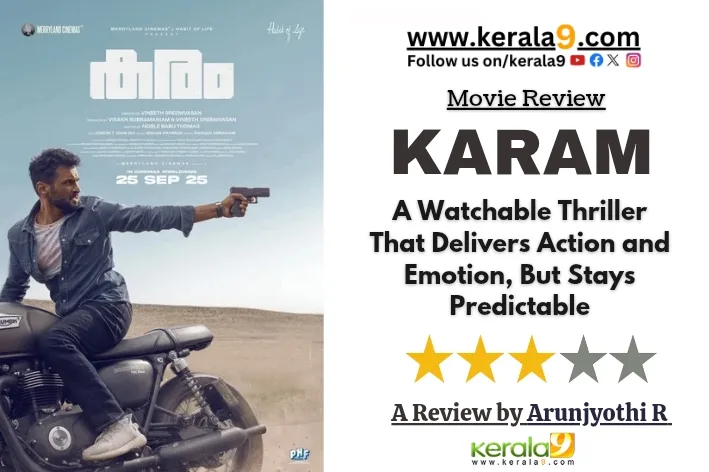
Karam Movie Review ONE WORD: A Watchable Thriller That Delivers Action and Emotion, But Stays Predictable
A Review by Arunjyothi R
LANGUAGE: Malayalam
DURATION: 02 Hours 08 Minutes
DIRECTOR: Vineeth Sreenivasan
GENRE: Action Thiller
•POSITIVES:
1: Direction
2: Action Sequences
3: Cinematography
4: Music and Background Score
5: Performance of actors
6: Production and Technical Quality
7: Editing and Colour Grading
•NEGATIVES:
1: Predictable Story
2: Screenplay
3: Resemblance of Thira
4: Routine Templates of an action thriller
5: Comedy situations felt forceful
STORY:
Karam follows former army officer Dev Mahendran, who is now living a happy life with his wife and child, while trying to move past a troubled relationship with his father and a series of personal tragedies. During a family trip to the city of Lenarco for his wife’s business meeting, Dev unexpectedly crosses paths with his ex-girlfriend, who is trapped in a human trafficking ring. Determined to rescue her, he is forced to confront dangerous criminals and risks not only his own life but also the safety of his family. The film explores how a seemingly simple family trip spirals into a high-stakes battle, showcasing Dev’s courage, resilience, and the lengths one will go to protect loved ones.
REVIEW & ANALYSIS OF THE FILM:
WHAT ARE THE POSITIVES:
1: One of the major positives of Karam is the direction of Vineeth Sreenivasan. He steps away from his familiar feel-good style and confidently experiments with a darker, more action-driven narrative. The making is stylish, technically sharp, and clearly a notch higher compared to his earlier attempt in Thira. In fact, certain portions of Karam do resemble the mood and tone of Thira, but here the execution feels more refined and advanced. The action sequences are staged neatly, and his grip on pacing ensures the film never drags. That said, Karam doesn’t really push you to the edge of your seat. It works well as a solid action thriller, but not as one of the genre’s finest. Still, the direction succeeds in making it engaging enough to enjoy on the big screen, offering a good theatre experience that justifies at least a one-time watch.
2: Karam maintains a balanced momentum throughout, ensuring that the viewing experience never turns dull. While the script does suffer from a sense of predictability, it is Vineeth Sreenivasan’s direction that manages to neutralize this drawback. His controlled narrative flow and stylish execution keep the audience invested, making the film move forward with proper rhythm. The film certainly has its standout moments, but rather than riding on sudden highs or dipping into lows, it travels on a steady, consistent line. This linear graph of storytelling works in its favor, as the continuous flow sustains audience engagement without ever giving a dragging feel. Even when you sense where the story might be headed, the treatment keeps you seated with interest, proving that Vineeth’s craftsmanship elevates an otherwise familiar screenplay.
3: The romantic scenes between Noble Babu Thomas and Audrey Miriam are few, but Vineeth Sreenivasan makes every moment count, showing how a skilled director can make the audience truly connect. Through subtle gestures, meaningful glances, and carefully crafted interactions, he makes us feel the blossoming of their love, the pain of separation, and the lengths one is willing to go for a loved one. Even in a high-stakes action thriller, these scenes stand out emotionally, adding depth to the characters and giving the story a heartfelt dimension. It’s remarkable how just a handful of well-executed moments can make the romance feel so real and engaging, highlighting Vineeth’s ability to weave emotion seamlessly into the narrative.
4: Another strong positive of Karam lies in its action sequences. Since the film is positioned as an action thriller, the fights had a big responsibility to carry the narrative forward, and they do so quite effectively. These aren’t the kind of over-the-top, brutal action blocks that rely on exaggerated stunts, but rather fights that feel grounded, believable, and in sync with the storyline. The choreography is neat, precise, and staged in a way that keeps the audience engaged without ever feeling forced. The momentum of action really kicks in just before the interval and from there continues to escalate till the climax. Each fight sequence adds to the pace and intensity, ensuring that the thriller mood remains intact. The hero’s journey to save his loved one from the clutches of a sex trafficking network is filled with stylish punches, chase moments, and well-timed stunt work. What works best is that the action is not only visually appealing but also emotionally connected to the character’s mission, giving it more weight than just being spectacle. By the time the film reaches its finale, the action has been carried consistently, leaving the audience satisfied with the thrilling quotient it promised.
5: For an action thriller to work, the visuals must enhance the thrill, and in Karam, Jomon T John’s cinematography does exactly that. His frames are stylish, precise, and consistently eye-catching, making the film a treat to watch on the big screen. The clever use of drone shots and wide-angle frames adds more depth and scale to the visuals, giving several sequences an expansive cinematic feel. From start to finish, the visual language perfectly matches the demands of a rescue-driven action thriller, ensuring that the audience is absorbed into the mood and ambience of the story. The second half offers some of the film’s most striking moments — the car chase sequence delivers the kind of adrenaline rush often compared to Hollywood, while the visuals of the fictional land Lenarco are crafted to look authentic and immersive. The rescuing fight sequence, especially the fire accident and gunshot scenes, is brilliantly shot, and the aerial shots amplify the tension while keeping the action visually clear and engaging. Overall, Jomon’s cinematography, with its stylish framing and inventive use of space, stands as one of the strongest pillars of Karam, giving the film a polished and thrilling edge.
6: Music and background score by Shaan Rahman emerge as one of the biggest strengths of Karam. Both the songs and the background compositions are crafted thoughtfully, perfectly aligning with the mood of each scene to enhance thrill, excitement, and emotion. Shaan Rahman’s signature musical style is evident throughout, and he adapts it cleverly to suit the film’s tone. The beats are catchy and immersive, particularly in the track Welcome to Lenarco, where the chorus and instrumentation make for a rich, theatre-filling experience. Another highlight is Uyarnnu Vaa, featuring Fejo’s rap, which adds a fresh and energetic layer to the soundtrack.
Beyond the songs, the background score plays a crucial role in elevating the action sequences, making fights, chases, and tense moments feel more gripping and intense. At the same time, emotional sequences are handled delicately with tunes that tug at the heartstrings without overpowering the scene. Shaan Rahman’s music consistently maintains the right balance between thrill and sentiment, enhancing the cinematic experience from start to finish. Overall, his contribution ensures that Karam is not just an action thriller but also a compelling audio-visual experience, making the film more immersive and engaging.
7: The performances of the actors form another significant positive of Karam. Noble Babu Thomas firmly establishes himself as a promising hero, delivering a performance that is both convincing and intense. Not only did he handle the action sequences with finesse, but as the scriptwriter, it is evident that he fully understands his character’s journey. His portrayal feels natural, whether in high-octane fights or emotional, heart-wrenching moments. The desperation to save his loved one, the struggles he endures, and his willingness to go to extreme lengths to resolve the crisis are all conveyed with authenticity and subtlety, reflecting Noble’s growing maturity as an actor. Audrey Miriam as Sana is equally impressive. Her character acts as a key pivot around which many events of the story unfold, and she delivers her scenes with natural ease and emotional depth, making the audience connect with her instantly. On the antagonist front, Ivan Vukomanović shines as a brutal, merciless gangster. His screen presence is menacing, and he embodies the ruthlessness required for the role with chilling perfection.
8: The production and technical quality of Karam is one of its standout aspects. The film is largely set in Georgia, and the choice of locations adds both authenticity and visual appeal to the narrative. The backdrop of the city and its surroundings enhances the storytelling, making the depiction of sex and human organ trafficking crimes feel more grounded and believable. Every location feels purposeful, contributing to the tension and urgency of the plot. The production quality is consistently high, with no compromises in set design, props, or overall mise-en-scène. Technical aspects such as lighting, sound design, and visual effects are handled meticulously, adding layers to the cinematic experience. The carefully chosen locations not only elevate the aesthetic appeal but also strengthen the narrative, making the film’s dark and intense themes more impactful. Overall, the combination of high production values and technical finesse ensures that Karam delivers a polished and immersive experience for the audience.
9: Editing by Ranjan Abraham is another notable strength of Karam. The cuts are precise and purposeful, particularly during the high-octane action sequences, where every punch, chase, and confrontation flows seamlessly. Transitions between scenes feel natural, maintaining the rhythm of the narrative without any jarring interruptions, which keeps the audience fully immersed in the story. The film’s duration is well-measured, ensuring that the plot moves forward consistently without unnecessary drag. Additionally, the colour grading plays a significant role in setting the film’s tone. The dark, greyish palette perfectly complements the intense and gritty storyline, enhancing the mood and amplifying the tension during critical moments. From the tense action scenes to the emotional beats, the combination of sharp editing and visually appealing grading strengthens the overall cinematic experience. Ranjan Abraham’s work ensures that Karam not only tells its story effectively but also looks and feels stylistically coherent throughout.
WHAT ARE THE NEGATIVES:
1: The first notable drawback of Karam is its storyline, which suffers from a high level of predictability. Once the narrative moves into the main plot, much of the story becomes easy to anticipate—from the unfolding of key events to the motivations behind characters’ actions, and even the arrival of helping hands. This predictability makes the film feel like a routine thriller at times, lacking the element of surprise that keeps audiences truly on edge. That said, the predictability doesn’t completely undermine the viewing experience. Vineeth Sreenivasan’s crisp direction and well-maintained pacing manage to keep the audience engaged, ensuring that the film doesn’t feel dull or stagnant. While it succeeds as a one-time watchable action thriller, the predictable storyline prevents it from reaching the level of a fully compelling, edge-of-the-seat experience.
2: While Vineeth Sreenivasan’s direction keeps the audience engaged, Karam still carries a strong resemblance to his earlier film, Thira. Many aspects—the film’s atmosphere, the unfolding of events, and even the general setting—evoke the same world that Thira created. The storyline and narrative style also mirror his previous approach, giving viewers a sense of familiarity that is hard to ignore. In essence, while Karam is technically more polished, with refined visuals, action sequences, and production quality, it often feels like an upgraded version of Thira rather than a wholly original venture. This similarity does not completely undermine the film, but it prevents it from feeling entirely fresh or innovative. Audiences may appreciate the improved technical finesse, yet the echoes of Thira linger, making parts of the narrative feel somewhat predictable and familiar.
3: The screenplay of Karam is competent and well-structured, but it lacks fresh or innovative concepts. Much like Vineeth Sreenivasan’s Thira, the narrative relies on familiar formulas, making key plot points and the story’s progression fairly predictable. From the way scenes unfold to the eventual resolution, seasoned viewers can often anticipate what is coming next. Additionally, certain sequences and the overall tone evoke the style of classic “Taken”-style detective and rescue action films, which gives the film a familiar global action-thriller flavor but also underscores its lack of originality. While the screenplay ensures that the story remains coherent and engaging, the absence of novel ideas or unexpected twists prevents it from standing out as a truly unique thriller experience.
4: In the second half of Karam, several situational comedy sequences are crammed in between the otherwise tense and thrilling scenes. Personally, I found it hard to connect with these moments, as they felt out of place and somewhat forced, disrupting the overall flow of the narrative. Babu Raj’s character is primarily used for these comic relief segments. While some audience members in the theatre did find them funny, for me, they came across as an unnecessary addition that didn’t land effectively. These poorly integrated comedic moments slightly undermine the intensity of the film, breaking the immersion that the thriller had built up until that point. Instead of enhancing the experience, they feel like filler content, reducing the impact of the high-stakes action and emotional sequences that define the rest of the film.
PERFORMANCE OF ACTORS:
Noble Babu Thomas firmly establishes himself as a promising lead in Karam. His performance is natural and convincing, whether it’s handling intense action sequences or delivering emotionally charged moments. Being the scriptwriter as well, he clearly understands his character’s journey, which shows in the way he portrays desperation, struggle, and determination. From the fight scenes to the emotional beats, Noble brings authenticity and depth to the role, making the hero’s quest to save his loved one feel genuine and engaging. He impresses not just with action but also with his dialogue delivery and emotional depth. His lines are delivered with clarity and conviction, making even simple dialogues feel impactful and natural. In the emotional scenes, especially those depicting his desperation to save his loved one, Noble strikes a perfect balance between intensity and subtlety. He conveys fear, determination, and heartbreak convincingly, allowing the audience to genuinely connect with his character’s journey.
Audrey Miriam, who plays the girl held hostage, delivers a deeply compelling performance. Her portrayal of fear, vulnerability, and resilience is executed perfectly, making the audience empathize with her situation. Despite being caught in a high-tension plot, her acting feels genuine and emotionally resonant. She carries the emotional weight of the story with ease, and her chemistry with Noble Babu Thomas adds a heartfelt dimension to the film. Through her expressions and reactions, she effectively communicates the stakes of the narrative, making her one of the standout performers of Karam.
Ivan Vukomanović delivers a chilling performance as the ruthless antagonist in Karam. His portrayal of a brutal, merciless gangster is intense and convincing, leaving a strong impression whenever he is on screen. He perfectly embodies the menace and unpredictability required for the role, making the hero’s struggle against him feel tense and high-stakes. Ivan’s screen presence adds depth to the conflict and significantly elevates the thriller aspect of the film, ensuring that the audience feels the danger and urgency throughout.
Reshma Sebastian, playing the wife, delivers a solid performance, and her scenes with Noble Babu Thomas, particularly in the second half, are engaging and add emotional depth to the narrative. Manoj K. Jayan, portraying the protagonist’s father, impresses with his intensity and stubborn demeanor, making his presence impactful. Kalabhavan Shajohn shines in his supporting role as the driver who steps in to help, bringing both gravitas and intensity to the character. Baburaj does a decent job in his humor-centric role, though personally, I found it less appealing and somewhat forced. Johny Antony and Swetha Menon, appearing in crucial supporting roles, deliver performances that do justice to their characters, contributing effectively to the overall story.
CONCLUSION:
Overall, Karam leaves a mixed impression. It’s not a groundbreaking thriller, nor is it a disappointing watch—the action, visuals, and performances hold their ground, but the predictable storyline and echoes of Thira prevent it from being truly memorable. For those looking for a stylish, engaging action film with solid performances and thrilling sequences, give it a try—it won’t disappoint. In the end, Karam is a one-time watchable entertainer—good, not great, but enjoyable enough to keep you invested till the end.
VERDICT: Watchable Action Thriller with Predictable Plot That Feels Like Thira
RATING: 3/5
A Review by Arunjyothi. R
Jharkhand Encounter: 3 Maoists Killed
Ranchi: Security forces gunned down three Maoists belonging to the Jharkhand Jan Mukti Parishad (JJMP), a splinter group of CPI (Maoist), in an encounter. Several weapons were recovered from the site. One of the slain rebels, Chhotu Oraon, carried a bounty of ₹5 lakh on his head, officials confirmed.
Ladakh Violence: 4 Killed, Curfew Imposed

Leh: Protests in Ladakh demanding statehood turned violent, leaving four dead and around 70 injured. Demonstrators torched the BJP office in Leh and a CRPF vehicle, prompting clashes with security forces. Authorities have imposed prohibitory orders. The agitation has been fueled by environmental activist Sonam Wangchuk’s hunger strike demanding statehood and inclusion of Ladakh under the Sixth Schedule of the Constitution.
Pahalgam Attack: Local Aider Arrested
Srinagar: A Kashmiri resident, Mohammad Kathariya, has been arrested for aiding Pakistani terrorists involved in the Pahalgam attack. The terrorists, killed during Operation Mahadev, were found in possession of AK-47 rifles and other weapons. Forensic analysis of the seized arms led investigators to Kathariya. Earlier, the NIA had arrested two others in a similar case.
Jewel Mary
























Jewel Mary is an Indian movie actress and television presenter, who mainly works in Malayalam movies and television. Jewel Mary Photos . Check out the latest pictures, pics, Jewel Mary new photos, movie stills, event photos, Jewel Mary photoshoot and images of Jewel Mary .
Vala Malayalam Movie Review: Poor Script and Weak Direction Leave Vala Struggling to Shine

VALA: THE STORY OF BANGLE
ONE WORD: Poor Script and Weak Direction Leave Vala Struggling to Shine.
A Review by Arunjyothi R
LANGUAGE: Malayalam
DURATION: 02 Hours 13 Minutes
DIRECTOR: Muhashin Nalakath
GENRE: Comedy Drama
•POSITIVES:
1: Story
2: Performance of Lukman and Dhyan Sreenivasan
3: Decent cinematography
4: Editing
5: Scenes of Vijayaraghavan
•NEGATIVES:
1: Direction
2: Screenplay
3: Unworked Comedies
4: Music and Background Score
5: Romantic scenes
7: Poor characterisation and subplots
8: Incompleteness was felt especially at the climax
STORY:
Sarala P. Nair (Raveena Ravi) treasures a golden vala (bangle), said to be her grandmother’s last gift. What starts as a token of sentiment soon spirals into an obsession. On their wedding night, her husband Purushothaman (Dhyan Sreenivasan) tries in vain to slip it off her wrist, sowing the seeds of greed and desire. Meanwhile, Vishalakshi (Sheethal Joseph), newly married to Bhanu Prakash (Lukman Avaran), longs for a replica of the same ornament. Unable to find one, Bhanu approaches Purushothaman for help. But when Purushothaman learns the bangle’s true worth—an antique valued in crores—he refuses, driving Bhanu to hatch plans of his own. As Purushothaman secretly schemes to sell it, an elderly woman, Paathumma (Shanthi Krishna), enters, claiming the vala rightfully belongs to her. What follows is a tense battle of desire, deception, and greed—where the bangle becomes far more than just a piece of gold.
REVIEW & ANALYSIS OF THE FILM:
WHAT ARE THE POSITIVES:
1: The first and most promising factor of this film lies in its storyline. At its core, the plot is engaging and holds the perfect foundation for a comedy drama wrapped within a thriller backdrop. The writers manage to set up an interesting premise, filled with opportunities for situational humor, quirky characters, and unexpected twists. With such material, the scope for creating laugh-out-loud moments alongside tense situations was undeniably strong. However, what could have blossomed into an entertaining ride ends up faltering in execution. The screenplay, instead of fleshing out the potential, feels half-baked and inconsistent. Scenes that could have elevated the narrative into clever comedies of error or gripping situational drama are left underdeveloped. The premise itself offers plenty to keep the audience hooked, but the lack of sharp writing and uneven pacing holds the film back from realizing its full potential.
2: Dhyan Sreenivasan and Lukman Avaran shoulder the film as its leads, and their performances hold the narrative together. The constant cat-and-mouse dynamic between the two adds the much-needed momentum, keeping the story moving even when the writing feels dull and uninteresting. Both actors manage to bring out the shades of greed, humor, and desperation in a way that fits the tone of the film. Adding weight to the cast is Vijayaraghavan, whose effortless screen presence and natural style of acting stand out as one of the film’s biggest strengths. His performance not only grounds the drama but also provides moments of relief and authenticity, ultimately becoming the saving grace of a film that too often drifts into boring territory.
3: The cinematography stands out as another positive factor in the film. While it may not boast of extraordinary or experimental visuals, the framing and tone suit the village setting effectively, giving the story a fitting backdrop. The camera work captures the rustic atmosphere without overdoing it, keeping the visuals grounded and relatable. A special mention must be given to the action sequences, particularly the karate fight scenes, which are shot with clarity and energy. These moments add a spark to the narrative and help keep the film from slipping into a fully tiresome feel.
4: Editing, on the other hand, works as a positive factor for the film. The runtime is kept in check, avoiding unnecessary stretch, and the flow feels crisp enough to carry the story forward. The transitions and cuts are functional and neat, doing their job without distraction. A notable plus is the handling of the karate action sequences, which are edited with clarity and precision—delivering impact without turning overly dramatic or exaggerated.
5: Vijayaraghavan emerges as one of the film’s major highlights. His performance is effortless and natural, lending credibility to every scene he appears in. The emotional moments are handled with subtlety and depth, making them genuinely impactful without feeling forced. Beyond the dramatic sequences, even his casual, everyday actions—like the scenes where he cooks biriyani—bring warmth and charm to the film, giving it a touch of authenticity. His screen presence not only anchors the story but also elevates the overall viewing experience, turning otherwise simple scenes into memorable moments.
WHAT ARE THE NEGATIVES:
1: The most glaring weakness of the film lies in its screenplay. Despite having a storyline with immense potential, the writing feels undercooked—like a half-baked cake that never quite rises. The narrative fails to leave an impact, with scenes often lacking the depth or cohesion needed to hold the audience’s attention. Instead of building tension and flow, the screenplay struggles to connect the dots, leaving the incidents feeling disjointed. By the time the film reaches its conclusion, there is a lingering sense of incompleteness, as if the story has not been fully realized.
2: What makes the screenplay more disappointing is that the premise itself offers plenty of scope for engaging twists, humor, and situational drama. Yet, the loose and uneven writing drains the energy out of the film, wasting an idea that could have been far more entertaining. Characterization is another weak spot. The villain, played by Govind Vasantha, is written with very little conviction, reducing what could have been a layered role into a forgettable one. The supporting characters too feel underdeveloped, with barely anything meaningful to contribute to the larger narrative. Instead of enriching the story, most of them fade into the background, further weakening the film’s overall impact.
3: The weakest link of the film is undeniably its direction. From the very start, the making feels shaky, with no sense of cinematic richness to pull the audience in. Instead of looking like a big-screen experience, the execution often resembles a short film stretched with a bigger budget. The momentum is missing, and without it, the viewing experience turns bland. The story itself is layered with emotions, yet the translation to screen strips away all the feeling. The romantic portions, which should have brought warmth and tenderness, fall flat with no spark or connection. Similarly, the characters’ struggles and conflicts lack depth, playing out in a way that leaves the audience unmoved.
4: One of the major drawbacks of the film is its poorly written subplots. While the flashback sequence had potential and a well-thought-out premise, it falters in execution, coming across as overdramatic and forced. Several secondary tracks, particularly the scenes involving Kollam Shafi, feel shoehorned into the narrative, included more to fill runtime or justify flashbacks rather than to enrich the story. These subplots fail to add depth or momentum, leaving the film cluttered without purpose. The characterization, especially of the villains, is equally weak. Govind Vasanth’s antagonist lacks nuance or menace, making his role forgettable and unconvincing. Most of the supporting characters are similarly underwritten, with minimal motivation or personality, reducing them to mere background figures. The combination of underdeveloped subplots and one-dimensional antagonists undermines the film’s tension and drama, leaving it struggling to hold the audience’s attention.
5: When the film finally shifts gears into thriller territory, the promised excitement never arrives, leaving only a sense of emptiness. Ironically, the only sequences that shine are the ones involving Vijayaraghavan. His natural charm elevates even simple moments—like cooking biriyani—into something heartfelt and memorable. These portions briefly remind the audience of what the film could have been if handled better. Sadly, by the time the climax arrives, the direction completely loses its grip, leaving an unfinished, unsatisfying ending that makes you wonder what the filmmaker was actually aiming for.
6: For a film pitched as a comedy drama, the least one would expect is a few genuine laughs—but sadly, the humor here falls flat. The jokes rarely land, and the forced attempts at comedy only underline the weak writing. Shoddy dialogues paired with a mediocre screenplay strip away the spark that could have made the situations funny.
What’s frustrating is that the story provides ample room for clever situational humor, yet the script feels too unpassionate and lazy to take advantage of it. Yes, there are moments that qualify as “comedy,” but they don’t flow naturally with the scenes; instead, they feel inserted, almost as if the audience is being spoon-fed reminders of where they’re supposed to laugh. At best, a handful of minor moments manage to come off as mildly amusing, while the rest drift into forgettable, lifeless territory.
7: The music and background score by Govind Vasantha turn out to be a mixed bag. On their own, the songs sound melodious and pleasant—something you could enjoy if you heard them outside the film. But when placed within the narrative, they fail to create the same impact. The visuals and the tracks don’t blend seamlessly, leaving the songs feeling detached from the emotions they’re supposed to enhance. The background score suffers from a similar issue. At several points, it feels overdone, almost as if the music is trying to dictate what the audience should feel rather than complementing the scene. There are moments where you’re left wondering—does this scene really need this kind of score? Instead of amplifying the emotions, the mismatch between scene and sound creates a jarring effect. While the BGM itself has quality, the lack of proper alignment with the narrative reduces its effectiveness, making it feel out of place more often than not.
8: The love between the characters was meant to be the emotional core of the film, but unfortunately, it ends up as one of its weakest links. The romantic track of Lukman and Sheethal, which should have carried both depth and emotional weight, feels flat and uninspired. Their scenes are positioned as crucial turning points that push the story forward, yet the lack of chemistry and conviction drains away any impact. The whole stretch where Sheethal longs for the bangle and Lukman goes to extreme lengths to please her had the potential to be touching—a tale of love tested by desire. But instead of stirring emotions, it comes across as hollow. His frantic struggles to fulfill her wish never move beyond surface-level drama, leaving the audience more detached than empathetic. What should have been a heartfelt conflict ends up feeling like a forced subplot with no real payoff. Ironically, it’s in the seasoned pairing of Vijayaraghavan and Shanthi Krishna that the film briefly finds a touch of authenticity in its depiction of love. Their moments, tender and grounded, succeed where the younger couple fails. But even these sparks aren’t enough to sustain interest, leaving the film’s romantic angle largely ineffective.
9: The climax is yet another major disappointment in the film. The action choreography is poorly executed, lacking energy or clarity, and the sequence ends in an incomplete and unsatisfying manner. While the hero seemingly defeats the villain, the aftermath is left ambiguous to the point of absurdity, leaving viewers confused about what actually happened.
Govind Vasanth’s role as another antagonist fares no better. His character is weakly written and inconsistently portrayed. Introduced with a gangster aura, his persona gradually drifts into unintentional comedy by the end. Vasanth himself struggles to fit the role—his physique, mannerisms, and dialogue delivery in Tamil fail to convey the menace required for a credible gangster. Overall, the climax and villain portrayals, instead of providing a thrilling payoff, leave the film feeling unfinished and poorly executed.
PERFORMANCE OF ACTORS:
The lead actors, Dhyan Sreenivasan and Lukman Avaran, carry much of the film on their shoulders, and their performances are fairly competent. Dhyan’s pairing with Raveena Ravi as Sarala adds some charm and intensity, while Lukman’s chemistry with Sheethal Joseph struggles to create the intended romantic impact. Their cat-and-mouse dynamics provide some energy to the narrative, and both lead actors manage to portray greed, desperation, and frustration with a degree of authenticity. Lukman, in particular, shines in the action sequences, showcasing impressive karate-style fight moves that add excitement and vigor to his character, standing out as one of the film’s few visually engaging moments. However, weak writing and underdeveloped romantic tracks limit their overall impact.
Among the supporting cast, several performances stand out despite the weak writing. Abu Salim delivers a fair performance, bringing emotional depth to his scenes and executing his fight sequences with power and presence. Arjun Radhakrishnan, though a talented actor, is wasted in his IPS officer role, as weak characterization prevents his role from adding any meaningful impact to the film. Gokulan impresses as the caring brother, yet the potential of his character and the emotional bond with his sibling remains underutilized due to poor writing. Similarly, Navas Vallikkunnu, in the role of a friend, has a character well-suited for situational humor, but the script fails to fully exploit his comic potential.
The true highlight among the supporting cast is Vijayaraghavan and Shanthi Krishna. Their romantic scenes bring a rare touch of warmth and authenticity, proving that love has no age limits. The subtle, heartfelt chemistry between them makes even simple moments—like family interactions or shared domestic tasks—feel poignant and genuine. These sequences inject emotion and depth that the younger romantic track fails to achieve, offering a refreshing reminder that mature love, when portrayed with sincerity, can resonate just as powerfully on screen.
CONCLUSION:
Overall, Vala: Story of Bangle had the ingredients for an engaging comedy-drama with thriller elements—a unique storyline, potential for situational humor, and a mix of action, romance, and emotion. However, the film falters in execution, with weak writing, underdeveloped characters, inconsistent direction, and poorly handled subplots that prevent it from fully realizing its potential. While the leads deliver competent performances and Vijayaraghavan and Shanthi Krishna bring warmth and charm, these moments are too few to salvage the film entirely. The music and background score, along with the comedy tracks, fail to leave a lasting impact, and the climax feels incomplete and unsatisfying.
Given its weak execution and lack of coherence, Vala: Story of Bangle is a film I cannot wholeheartedly recommend. That said, if viewers are willing to watch it purely for Lukman’s action sequences, Vijayaraghavan’s heartfelt moments, or for the novelty of the quirky bangle-driven plot, there may be some limited enjoyment. Overall, it’s a film with an interesting concept that unfortunately doesn’t deliver on its promise.
VERDICT: A Gripping Suspense Thriller
RATING: 2/5
A Review by Arunjyothi. R
Kiss Movie Review: Kiss aims for magic and emotion, but ends up lost in glossy visuals and a weak screenplay

KISS – Kiss aims for magic and emotion, but ends up lost in glossy visuals and a weak screenplay.
A Review by Gideon Jotham
Director: Sathish Krishnan
Duration / Runtime: 2Hr 24 minutes
Language: Tamil
Genre: Romantic Fantasy / Comedy
Positives
1: Fresh Concept
2: Lead Performance.
3: Supporting Characters
4: Music
Negatives
1: Storytelling Predictability
2: Screenplay
3: Direction
4: Cinematography
5: Stunts.
6: Fantasy Logic
7: Climax
Direction
It is the imprint of a director trying to make a point with his debut, Kiss by Satthish Krishnan. Even in the opening frame, one can see that he does not merely want to narrate a love story he wants to sell it as a youthful, stylish, and slightly magical experience. The ambition is demonstrated by the choice of the fantasy element of a kiss that tells the future. It is a daring effort to be unique among dozens of ordinary rom-coms that Tamil cinema has every year.
In the area Sathish is visual sensibility. He collaborates very closely with cinematographer Harish Kannan to produce bright, glossy and attractive frames that would be attractive to a young audience. The sections that include the dances, the romantic scenes, and even plain dialogues are used with the perspective of being colored. These are lively moments, the feeling of Sathish being interested that the audience remain as glued to the screen, despite the lapse in narrative.
Direction is not merely about the appearance of a movie it is also about its flow. And there cracks start to appear. Sathish at times finds it difficult to restrain his film. The transition between the light-hearted comedy to the strongly emotional conflict does not always seem natural. The scenes, which should have affected the heart, are sometimes in a hurry and the lighter scenes are extended longer than necessary. The rhythm is not even, which makes the film interesting in some ways and exhausting in other ways.
His style of telling stories is also another obvious thing. Sathish appears to be dilemna between being safe, and being an experimentalist. The fantasy concept is new, and the manner in which it will unfold is yet to be discovered. Rather than delve deeper into what the effect of Nelson visions can have on decision making and conflict resolution, the movie retreats into trite tropes of misinterpretations, last minute epiphanies and emotional drama. This way, the novelty of the idea would be watered down.
With that said, Sathish does manage to elicit performances out of his actors. Kavin is a star in his role as he is cute and emotionally vulnerable and Preethi Asrani is a graceful complement to him. Their chemistry is effective, and it is so due to the fact that the director allows them to breath on screen. Even minor actors such as VTV Ganesh have room to shine evidence that Sathish is aware of the need to balance the star power with the collective power of ensemble.
Being a first work, Kiss is a reflection of an artist in the discovery of his voice. Sathish Krishnan shows skill in the visuals, the appreciation of his cast, and the boldness to make an effort to do something different. He also shows the shortcomings of a first-time director who is afraid to go out of his comfort zone, who tends to rely on the same beats, and who loses control of narrative balance. In a way, Kiss can be seen as a movie that has the potential of the director but has not been fulfilled. Sathish can become a filmmaker with greater stinging narrative and more daring style that can make Tamil movies not only magical, but memorable.
Story
Kiss at its core is not simply a boy meets girl story but rather a story that tries to harmonise fantasy and the vagaries of love. The novel is about a simple young man Nelson who has a rare talent or curse, whenever he sees a kiss he gets glimpses of the future of the couple. It is this peculiar assumption that makes the film have its hook, making it immediately stand out of the mundane rom-coms.
The dramatic tone is added to it when Nelson falls in love with Sarah. Whenever he kisses her, he does not simply have a rosy picture like the other people do; he sees tragedy. Since that moment, the plot ceases to focus on young attraction and turns a bit deeper, to a question, is it possible to change fate, or is it predetermined? There is much dramatic potential associated with this idea, and the film exploits it in some aspects.
The story functions optimally in terms of setting and emotional investment. The battle that Nelson is going through is familiar he is not only fighting against love, he is fighting against time and fate. It is a blessing and a curse because the fantasy device presents a personal dilemma, which serves as the driving force. The relationship between Nelson and Sarah, the lighter scenes with family and friends makes it feel warmer, as it provides the story with certain basis into reality.
The story however fails in its execution as it moves along. The idea is new, yet the manner in which it is executed brings more of the classic elements of romance misunderstanding, dramatic conflicts, and the whole story climaxing in a manner that seems foreseeable. The story does not explore the ethical or pathos ramifications of the visions that Nelson sees. As an example, the movie might have visited the aspects of how this gift impacts his psychology, his relationships or even his faith in love. Rather, these questions are not addressed in detail.
The other disadvantage is that the story occasionally takes it too safe sometimes. The film does not challenge boundaries and venture into deeper or darker issues of fate versus choice but instead, it chooses a standard solution. This gives the conclusion some sort of satisfying closure that is not as powerful and memorable as the beginning suggested.
These in a nutshell make the tale of Kiss a combination of something new and something old. The main plot is creative and preconditions a strong romance, but the use of safe narrative decisions and lack of the chance makes it not turn to its full extent. What we are left with is a story that has its fair share of fun and pictures but one where the viewer would have wished that it had gone a bit deeper.
Screenplay
The strongest and weakest points of the film meet in the screenplay of Kiss. Sathish Krishnan is ambitious in concept, though not necessarily in execution, as he fails to find a way of turning that spark into a tightly wound story.
To the good, the screenplay starts well. When Nelson is introduced with his special gift of reading the future by kissing a woman, this has been treated with curiosity and humour. The depiction of his world, his relationships and his dilemma has been presented effectively through the early scenes and so the audience has sufficient factors to keep them wondering. The courtship scene with Sarah is not a serious affair, and the dialogues are humorous, and the montages are colourful and pleasant.
However, the screenplay begins to lose pace as the movie progresses. The medium parts lack the rhythm some of the scenes feel out of place that they are taking too long to accomplish, and others have a hasty emotional scene to cover. Fantasy, romance, and comedy are not balanced, which causes tonal variations that are not smooth but unpleasant.
The next problem is that significant plot twists are predictable. With a high concept fantasy premise on which the story is made, the screenplay does not exhaust the options. The visions of Nelson might have been exploited to provide tension, dilemmas and even unexpected turns, however, the movie constantly tends to rely on the time-tested romantic tropes. This renders sections of the story safe even in situations where the set-up was supposed to be fresh.
The dialogues are mixed bags as well. Here they shine with lightness or delicacy, there they are awkward, overloaded, indicating the feelings rather than letting them speak of themselves. More tender and vulnerable scenes should have been used by the screenplay instead of dramatic confrontations to bring out the emotional depth of the relationship between Nelson and Sarah.
Nonetheless, the screenplay is also able to hold together courtesy of the performances. Kavin and Preethi Asrani add flair to otherwise stiff areas, and the supporting characters add elements of humor, which aid in keeping the interest. At the cost of a foregone conclusion, the climax is at least performed with the emotional conviction and gives a glimpse of what the writing might have accomplished were the writer less cautious.
Basically, the screenplay of kiss is a half promise. It has a creative idea behind it and creates bursts of fun, yet it lacks the sustainability and complexity. It would have made a good idea an especially memorable romance with tighter writing, sharper conflicts, and bolder choices.
Cinematography
The cinematography of the film is a two sided sword by Harish Kannan in Kiss. On the one hand, the images are radiant, vivid, and glossy, precisely the type of image that elements of a young audience like. The scenes are color-coded with warm colors, smooth lighting, and flawless backgrounds that have rendered the film aesthetically pleasing. This works especially well with songs and montages, which make the film look like it were music videos and so would suit its rom-com feel.
Nevertheless, the cinematography is many times empty-handed when approached closer. Most of the frames, though beautiful, do not always work to the emotional heart of the story. As an illustration, a scene of lovemaking or fighting between Nelson and Sarah is revealed with the same glossy finish that the lighter romance scenes, and watering down the seriousness of the feelings. The absence of any tonal difference in the images denotes that the audience is not always able to sense the change in the characters experiences in their journey.
Another dimension of the lighting that is uneven is lighting. Outdoor scenes are lit brightly, whereas indoor scenes and those with a high level of emotion tend to be flat or too bright and deprive them of three-dimensional effects and atmosphere. A narrative about fate, tragedy, and emotional conflicts would have been better framed with more subtle shades of shadows, opposition, or close-up shots that would make us experience the inner world of the characters. Rather, the movie resorts to pristine, stereotypical, commercialistic images, which focus on the superficiality of beauty, rather than the depth in storytelling.
The movement of the camera is also not steady. Certain passages particularly in songs are fluent and accompanied by sweeping shots and inventive angles. However, when it comes to a dramatic situation, the camera work is stagnant and dull, like it is merely recording the actors and not adding any tension or emotional charge to them.
In simple terms, it is the cinematography of the film, Kiss that manages to capture the colourful world and fails to capture the cinematic world. The images are visually nice, although not necessarily meaningful. Each cinematography could be more imaginative considering the film was constructed based on a high-concept fantasy notion because the lens could be used to differentiate reality, fantasy, and emotional conflict. The opportunity is still unexploited.
Editing
Editing in Kiss feels like one of the weaker technical links. While the film carries an inherently light and youthful premise, the pacing doesn’t always reflect that. Several scenes especially emotional confrontations and dialogues meant to carry weight are allowed to run far longer than necessary. Instead of heightening tension or deepening emotion, the extra seconds make them feel repetitive.
On the flip side, when the film shifts between moods from playful romance to fantasy elements or from light comedy to tragedy the cuts often feel rushed or abrupt. These tonal jumps deserved smoother transitions that could have guided the audience seamlessly through the shifts. Instead, the editing sometimes pulls us out of the mood rather than drawing us deeper in.
Song placements, too, could have been tighter. A couple of numbers arrive suddenly, halting the narrative flow instead of blending organically into it. For a story that already struggles with consistency in tone, editing was the one tool that could have bridged the gaps. Unfortunately, it plays safe, resulting in a film that looks neatly packaged but doesn’t always carry the sharp rhythm it needed.
Music
The music of Kiss by Dhina is constructed in a juvenile way. The music is simple to the ears, fast-paced, and presented in such a manner that highlights the beauty of the lead couple. Songs such as the romantic duet songs embody the childish play between Kavin and Preethi and aesthetically, they are presented appealingly. This renders the songs enjoyable on their own accord.
However, the songs do not necessarily have weight when they are compared to the storytelling requirements of the film. Certain ones are forced into the screenplay, and look more like musical interludes than extensions of the story. This detachment implies that although viewers may hum the melodies when they are not at the movie theatre, when they are in the movie they may stop the narrative as opposed to moving the story.
With that said, the writing date of the compositions does give it a commercial gloss. The songs are useful to viewers who are there to have a light rom-com experience. However, the soundtrack can be considered more of an ornament than an essential part of the story to those who seek music that blends well with the highs and lows of the story.
Background Score (BGM)
The background music is the most effective when the movie remains in the light-hearted realm. Harmless extensions and humoric moments are supported by the vibrant and light-hearted sounds that correspond to the careless character of the movie. These scenes are simply smooth, courtesy of the music.
The difficulty lies in the fact that the story requires emotional substance or fantasy inspired intensity. The BGM in such sequences tends to revert to known and generic formations. The score has the tendency to be predictably understated, as opposed to establishing an ambiance that would add excitement to the drama or improve the magic. This leads to serviceable but unmemorable scenes.
A movie such as Kiss where the setting traverses contrasting moods romance, fantasy, and tragedy could not have been accomplished without a background score, which can be described as a bridge, which made these tones come together creating a unified experience. Sadly enough, the BGM does not go that far. It does not interfere with the scenes and bring them to a superior level, but it seldom elevates them to a superior level. The emotional weight is not developed as the musical motifs are not memorable or rich in theme.
Performances
Kavin as Nelson:
Kavin puts Kiss on his shoulders almost completely. Nelson, a charismatic man, possesses the ease of nature to render the romantic passages to be believable. His boy-next-door attractiveness does not fail in lighter scenes and his comic timing is spontaneous. But in case the part requires more serious emotions, particularly in the tragic parts, his acting at times seems superficial. As he gets the intent, the intensity is not always received with the depth the scenes ought to. Nevertheless, the screen appearance and energy of Kavin make the film interesting even in case of writing failure.
Preethi as Sarah:
Preethi gives the performance that is likeable but unsynchronized. She dazzles in the love scenes, with elegant innocence she makes Sarah that she combines well with the playful Kavin. The fact that she is chemistry with him is also one of the highlights of the film, adding flair to their relationship on screen. However, in the dramatic confrontations, her expressions occasionally have a narrow scope and the emotionality is not completely achieved. Preethi has potential, yet the character was underserved with a more detailed development of her character.
Supporting Cast:
Friends and comedy sidekicks add comedy, which however is usually cliched. They make the story light and at one time interrupt the story.
The roles of family members and older characters are satisfactory and form the basis of some of the melodramatic stretches. But none of these acts are very memorable ones they are rather present to get the story through than to make an impression.
Stunts
The stunt work in Kiss is rather a supplement than a natural aspect of the story. The action scenes are performed in a commercial manner, using exaggerated movements and dramatic build-ups that are used to bring cheers in cinema halls. Although they deliver spurts of energy, they are not always needed by a movie that in other aspects occupies the territory of romance and fantasy.
Stylistically, the stunts are glossy including slow-motion shots, stylised punches, and uncouth reactions, which may appeal to mass-audience sections. They have no ground outside the spectacle, however. These emotional undertones associated with these scenes are not believable, and thus the fights lack weight. They frequently do little more than add tension or further the storyline, and instead of benefiting the film, they usually serve as distractions prolonging the film.
The performance is also unnatural. There are some sequences that are properly choreographed with clean framing and some are so clumsy and the editing seems to be jerky, losing its effect. It does not seem to be safety- or realism-at-all-costs; the stunts are much more dramatised.
In general, however, the stunt work in Kiss contributes to a certain degree of commercialism, but does not flow well with the story. The action in a movie touching upon love, fate, and fantasy is as tangible as a checklist point rather than a part of the narrative.
Conclusion
Kiss is a movie that attempts to wear so many hats simultaneously a romance movie about youth, a fantasy experiment and a heartfelt drama. Surface wise, it has ample to recommend it: the light-hearted lovability of Kavin, the bracing effect of Preethi, visual color and some catchy background music which appeal to the youthful audience. One can find that there are times when the movie is sincerely amusing light-duty banter, tender romantic asides, and good-natured laugher.
However, where the film tries to go deeper into the tragedy and fantasy its failure is more evident. The direction fails to strike a balance between tones, the screenplay is torn between excessive drag and too rapid swings, the technical departments of the movie in cinematography, editing and background score seldom go farther than the superficial gloss. The stunts, despite being flashy, are also too out of place in a narrative that needed to be more emotionally and fantastically driven.
In its core, Kiss could have been a distinctive mixture of the romance of youth and the fantasy of narration. Rather, it rests on its laurel as a safe and shiny entertainer that does not explore its potential to the fullest. It is done in parts and phases, but all in all, you are left with the feeling of what might have been.
Final Rating: 2.5 / 5
A Review by Gideon Jotham