Munambam residents have received major relief as the Kerala High Court has permitted the Revenue Department to accept land tax until a final judgment is delivered in the ongoing case. The single bench granted approval for the department to collect land tax.
The order was issued on a petition filed by landholders seeking a directive to the Revenue authorities to accept land tax. The petition stated that the authorities had refused to accept tax, citing the Wakf Board’s claim over the land. Hearing the preliminary arguments, the single bench led by Justice C. Jayachandran directed that landholders be allowed to remit tax and the Revenue Department be allowed to accept it, pending further orders.
Another petition filed by the Kerala Wakf Protection Forum, challenging a 2022 order issued by the Kochi Tahsildar, is also before the High Court. Permission to collect land tax will remain in effect until final orders are passed in these petitions.
Earlier, a Division Bench had ruled that the Munambam land in question does not belong to the Wakf Board. Following this, the state government requested the High Court to expedite the hearings and sought permission—through an affidavit—to allow the acceptance of land tax in Munambam.
Residents view the interim order as a significant step toward resolving the long-pending land dispute in the region.
Eko Review in ONE WORD: Eko Redefines the Malayalam Mystery Thriller — A Must-Watch Cinematic Brilliance You Should Never Miss.
A Review by Arunjyothi R
LANGUAGE: MALAYALAM
DURATION: 125 Minutes
DIRECTOR: Dinjith Ayyathan
GENRE: Mystery Thriller
•POSITIVES:
1: Direction
2: Story
3: Screenplay & Dialogues
4: Performance of actors
5: Cinematography
6: Sound Design
7: Background Score
8: Editing
9: Locations
10: Mystery Mood
•NEGATIVES:
1: Nothing to mention
STORY:
Set in the remote wilderness of Kaattukunnu — a lonely mountain stretch veiled in fog along the Kerala–Karnataka border — Eko slowly pulls you into its unsettling world. At the centre of this eerie tale is an ageing woman known locally as “Mlaathi Chedathi” (Bianna Momin), and her loyal companion Peeyos (Sandeep Pradeep). The two spend their days cut off from civilisation, surrounded only by restless winds and whispering forests.
But peace rarely lasts in these hills. Mlaathi’s estranged husband, Kuriyachan, a notorious handler of fierce dogs and a criminal on the run, is being tracked down by relentless officers. As the manhunt tightens, Mlaathi and Peeyos stumble upon buried secrets — revelations so disturbing that the mountains themselves seem to tremble under their weight. What begins as a quiet life in isolation slowly turns into a gripping mystery, where every shadow feels suspicious and every truth carries a sting.
REVIEW & ANALYSIS OF THE FILM:
Eko emerges like a whisper from the deep woods — a Malayalam thriller that thrives not on spectacle, but on the eerie breath of its landscape and the unspoken emotions of its characters. Dinjith Ayyathan steers the film with an assured yet invisible hand, while Babu Ramesh crafts a closing chapter to his animal-themed saga that feels more immersive, more haunting, and more emotionally charged than anything before it.
From the first shot itself, the film plunges you into the rugged solitude of Kaattukunnu — a mountain belt wrapped in mist and unease. This isn’t just a shooting location; it is the pulse of the film, shaping moods and whispering clues through every shadow. The valleys breathe uncertainty, the quiet houses hold secrets, and the fog acts like a veil hiding truths the characters fear to confront. Very few thrillers manage to make their geography this alive.
What makes the experience so gripping is the film’s refusal to guide you neatly. Instead of leading you through a predictable trail, Eko scatters signals, half-revealed motives, and disconnected timelines that only begin to weave together as you sink deeper. This storytelling choice makes the audience a participant — always watching, always guessing, always doubting. The film builds its mystery slowly, but with intention. Every pause, every glance, every shift of wind seems to carry weight. Dinjith and Bahul shape their scenes with patience, allowing the mountain’s silence to speak louder than dialogue. What first appears meandering soon reveals itself to be a subtle lure, pulling you further into Kaattukunnu’s labyrinth.
At the heart of the narrative lies an unexpected lens — the dogs. They are not background noise, nor sentiment triggers; they are emotional conduits, clues, and sometimes keepers of truth. Their presence becomes a bridge between instinct and human complication, reflecting themes of dominance, loyalty, and silent understanding. Few films have captured the intelligence and intuition of animals with such depth.
Bahul Ramesh’s dual contribution behind the camera and on paper elevates Eko’s texture. His visuals feel like fragments of a half-remembered dream — dimly lit rooms, damp forest trails, light slicing through fog. The visual grammar enriches the script, creating a seamless bond between narrative tension and visual poetry. Sooraj E. S. shapes the film’s flow with a deft editorial rhythm. Though the story leaps across times and perspectives, the transitions feel almost subconscious. The pacing mirrors the fog: soft, drifting, but hiding something sharp underneath. Even the slower portions feel loaded with anticipation.
The soundscape plays a colossal role in building the film’s tension. Forest murmurs, faint movements in the distance, and the echo of animal calls blend into an acoustic cloak that wraps around the viewer. It creates the unsettling sensation that something is always watching from beyond the frame.
Muieeb’s background score enters not as music, but as an emotion. It arrives quietly, staying just long enough to deepen the feeling of dread or wonder, never imposing itself. The soundtrack becomes a companion, shadowing the narrative without overshadowing it.
As the chase for Kuriachan tightens, the film begins to resemble a puzzle-box novel — each revelation measured, each omission deliberate. The writing trusts the intelligence of its audience, expecting them to stitch together clues without handholding. This faith in the viewer is what gives the film its lingering impact. The story also opens doors into moral and psychological questions. It nudges you to consider where affection turns into possession, where safety mutates into confinement, and how humans complicate what animals express with simple purity. These themes surface quietly, without sermonising, making them even more resonant.
Dinjith’s direction shines most in what he chooses not to show. The unsaid becomes powerful here. Silence carries meaning. Shadows feel like hints. The director embraces restraint, letting the audience feel the tension instead of being instructed on it. This makes the mystery far more atmospheric. The post-interval segment tightens the screws. Ambiguity starts peeling away. Links snap into place. What felt like scattered strands start forming a single, compelling thread. The second half moves with urgency and emotional clarity, transforming quiet uncertainty into gripping momentum.
When the film reaches its concluding stretch, it lands with genuine emotional force. The finale is not just satisfying — it recontextualises everything before it. The haze lifts, the motives sharpen, and the emotional truth hits with surprising weight. The quiet build-up feels entirely worth it.
Sandeep Pradeep anchors the film with an understated, internalised performance. He conveys conflict without theatrics, blending naturally into the mood of the story. The supporting cast — from Nairan to Vineeth, Ashokan to Binu Pappu — each adds a distinct shade, subtly feeding the air of uncertainty surrounding Kuriachan. Craft-wise, Eko is a unified vision. Every department — sound, edit, performances, cinematography, writing, music — collaborates like an ensemble of storytellers working toward the same uneasy mood. The result is a film that feels carved rather than constructed.
In the end, Eko stands as a testament to how quietly told stories can be the most unsettling. It proves that thrillers need not rattle you with noise; they can seep into your mind through atmosphere, silence, and suggestion. With its hypnotic visuals, lingering themes, and masterful control of mystery, Eko becomes an experience — one that stays with you long after the mist fades.
CONCLUSION:
In the end, Eko triumphs as a masterfully written and meticulously crafted mystery thriller, powered by Bahul Ramesh’s sharp script that balances intrigue, emotion, and philosophical depth with remarkable precision. The film sustains an unbroken sense of mystery, wrapping you in a slow-burning tension that evolves into a haunting afterthought long after you leave the theatre. Dinjith Ayyathan’s outstanding direction elevates every frame — his command over silence, atmosphere, and pacing turns the narrative into an immersive cinematic experience rather than just a story on screen. Sandeep Pradeep’s performance stands out with quiet brilliance, anchoring the film with restraint and emotional honesty that perfectly complements the film’s tone. With its chilling mood, thrilling revelations, and unforgettable visuals, Eko is not just a movie but a full-fledged sensory journey. I would highly recommend experiencing it on the big screen — this is a must-watch, never-miss theatrical film that deserves to be felt, heard, and absorbed in all its cinematic glory.
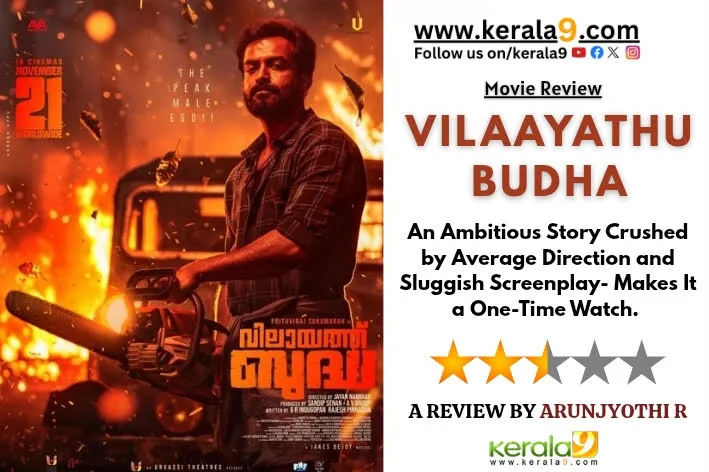
Vilayath Budha Review ONE WORD: An Ambitious Story Crushed by Average Direction and Sluggish Screenplay- Makes It a One-Time Watch.
A Review by Arunjyothi R
LANGUAGE: MALAYALAM
DURATION: 02 Hours 56 Minutes
DIRECTOR: Jayan Nambiar
GENRE: Action Thriller
•POSITIVES:
1: Story
2: Prithviraj Sukumaran
3: Performance of actors
4: Music and Background Score
5: Cinematography
•NEGATIVES:
1: Direction
2: Screenplay
3: Duration of the film
4: Editing
5: Lagging at many points
6: Weak emotional arch
7: VFX
STORY:
Set in the rugged landscapes of Marayur, Vilaayath Budha unfolds through the life of Double Mohanan, a man whose reputation is split between fear and admiration. Known for his deep involvement in the illicit trade of sandalwood, Mohanan moves through the village like a shadow—dangerous to many, yet a symbol of daring ambition to others. At the same time, his heart is drawn to Chaitanya, a strong-willed woman who runs her jaggery enterprise with fierce independence and fearlessness.
Not far from Mohanan’s world stands Bhaskaran Master, a former teacher who has nurtured an exceptionally rare fragrant sandalwood tree in his courtyard. This tree is not just a plant for him—it’s tied to an old wound that he guards with pride and silence. When Mohanan comes across this precious tree, he sees his next big opportunity. But for him, the chase is not just about money; it’s also a chance to settle an old score with the very man who once guided his school days.
What follows is a gripping duel of pride, vengeance, and survival. The tension between Mohanan and his former mentor intensifies as their motives collide, raising the question: can Mohanan overpower the past and claim what he desires, or will the weight of old grudges crush his plans?
REVIEW & ANALYSIS OF THE FILM:
Vilaayath Budha begins with a foundation that instantly sparks curiosity. The premise holds enough dramatic weight to promise a captivating emotional journey, even if the storyline isn’t groundbreaking. What makes the film initially appealing is its attempt to explore the complex human emotions hidden beneath a seemingly straightforward conflict. The intention is visible, and at times, the emotional textures do resonate, but the execution never fully shapes them into something memorable.
The film is inspired by a widely appreciated novel, known for its tense, atmospheric storytelling. The original work offers a gripping blend of suspense, character depth, and moral ambiguity. While the adaptation manages to brush against a few of these strengths, it struggles to carry them through to the finish. The final act, especially, feels like a steep downfall. The movie introduces several interesting personalities, yet their arcs remain underutilized. This is a classic case of a strong narrative foundation being let down by an inconsistent cinematic translation.
One of the biggest hurdles here is the transformation of the novel into a functional screenplay. Many literary adaptations stumble at this stage, and Vilaayath Budha unfortunately joins that list. The pacing is unusually lethargic, the storytelling lacks energy, and the interest the opening scenes build gradually dissolves. What starts as a promising setup collapses midway, almost like a structure that appears sturdy but crumbles due to weak support underneath. The dullness of the narrative rhythm further prevents the story from reaching its potential impact.
The script had all the required ingredients to evolve into a gripping thriller, but the writing never sharpens itself enough to achieve that. Instead of digging deeper into character motivations or emotional complexities, the film repeatedly falls back on predictable genre staples. There’s an unmistakable absence of intensity in the storytelling. Despite having the right atmosphere and premise, the film limits itself to formulaic choices, leaving little room for innovation or emotional depth.
The movie’s first half is passable, though not engaging enough to pull the audience fully into its world. But the second half slows down drastically, stretching scenes far beyond necessity. Several moments that were designed to be emotionally strong feel muted and hollow. A tighter, more disciplined runtime would have significantly improved the experience. Even the dialogue writing seems uninspired, making several scenes feel flat and disconnected from the seriousness the film demands.
One of the most crucial issues arises in the climax. The final stretch, intended to deliver the emotional and dramatic high point of the story, falls shockingly short. The twist, instead of surprising or stirring the audience, comes across as unpolished and even amateurish. Character emotions are expressed without conviction, and the scenes meant to hold weight are staged without depth. This lack of precision drains the climax of all emotion and suspense.
The screenplay tries to preserve the layered texture of the novel but fails to translate that complexity effectively. The narrative becomes unnecessarily heavy due to an over-reliance on literary-style exposition. Some emotional beats are rushed, some are overstretched, and several promising secondary characters receive minimal development. The imbalance in pacing and character focus further pulls the film away from achieving its intended intensity.
The central emotional conflict—the core rivalry and ego-driven tension between the two men—never rises to its full potential. Prithviraj has previously headlined films that brilliantly showcased such confrontations, but here, the staging lacks bite. The direction does not deliver the gravitas or raw energy required for such a theme. The filmmaking feels oddly detached, with scenes stitched together in a way that often feels forced. If a visionary filmmaker like Sachy had helmed this project, the thematic intensity might have been elevated beyond measure. Instead, the film lacks authenticity in its transitions, its dramatic staging, and its emotional peaks.
However, the shortcomings are substantial. The direction lacks clarity, the screenplay feels half-baked, the film drags far longer than necessary, and the editing—despite having clean transitions—fails to maintain rhythm. VFX work looks unrefined, and several action sequences appear exaggerated and overly cinematic. Emotional arcs remain weak, and many crucial scenes fail to land with the intended force. Numerous moments feel disconnected, making the film’s journey uneven and tiring.
Yet, amidst these shortcomings, there are bright spots. The storyline itself remains undeniably compelling. Prithviraj Sukumaran’s performance becomes the primary driving force, keeping the audience anchored through even the tiring portions. His dialogue delivery is sharp, emotional scenes are handled with finesse, and his romantic and action sequences show controlled commitment. The soundtrack by Jakes Bejoy brings warmth and atmosphere, although one or two songs feel misplaced. The background score, however, successfully sustains tension and gives life to many scenes that would otherwise fall flat. The cinematography is another major asset, offering stunning forest shots, atmospheric night sequences, and expressive close-ups that capture the mood beautifully.
Shammi Thilakan turns out to be one of the film’s strongest assets, carrying his role with remarkable precision and emotional weight. His performance subtly echoes the legacy of his legendary father, bringing a natural intensity and sharpness to every line he delivers. Whenever he shares the frame with Prithviraj, the chemistry elevates the scene, making those moments some of the most engaging in the film despite its shortcomings. Priyamvada Krishnan, too, delivers a confident performance. Having already made an impact with her debut in Thottappan, she once again proves her ability to stand firm beside seasoned actors. Her character, bold and uninhibited, complements Mohanan’s recklessness perfectly, adding both spark and unpredictability to their dynamic.
CONCLUSION:
Overall, Vilaayath Budha is a film built on a solid foundation but weakened by its own execution. The story, the performances, and the technical craft show flashes of what the film could have been, yet the inconsistent direction, sluggish pacing, and underdeveloped emotional beats hold it back from reaching its full potential. Prithviraj, Shammi Thilakan, and Priyamvada Krishnan give the narrative the spark it desperately needs, but even their committed performances cannot completely rescue the film from its structural shortcomings. Vilaayath Budha remains a watchable attempt with notable merits, but it ultimately falls short of delivering the gripping, emotionally charged drama that its premise promises.
India’s first bullet train is set to begin operating in August 2027, according to an announcement by Railways Minister Ashwini Vaishnaw. The inaugural run will take place on the 100-kilometre stretch between Surat and Vapi, which forms part of the Mumbai–Ahmedabad High-Speed Rail Corridor. The trains, designed to travel at a speed of 320 kilometres per hour, will enable passengers to reach Mumbai from Surat in just about two hours, with twelve planned stops along the way. The entire corridor is expected to become fully functional by 2029, and during peak travel hours, trains are expected to operate at intervals of around ten minutes. Japan’s advanced E10 Series Shinkansen models are likely to be deployed for the service, and the government has indicated that fares will be kept at levels accessible to the middle class. A significant highlight of the project is the undersea tunnel that forms part of the route, allowing bullet trains to travel in both directions at the same time.
Kochi: The Kerala High Court has quashed the Vigilance Court’s decision that had canceled the clean chit given to ADGP M. R. Ajith Kumar in a disproportionate assets case.
The HC observed that the Vigilance Court acted without properly examining the Vigilance report.
The complainants may file a fresh petition after obtaining prior permission, the court noted.
Justice A. Bhadhrudeen delivered the judgment. Earlier, the Vigilance Court had ordered a re-investigation in the case, prompting Ajith Kumar to approach the High Court.
The National Investigation Agency (NIA) has confirmed that the accused in the Delhi blast case had foreign connections.
The investigation revealed that Dr. Musammil received 42 bomb-making videos from overseas contact Hansulla through various apps. Musammil reportedly forwarded the videos to another accused, Umar.
Other foreign-based individuals—Nisar, Ukas, and Mohammed Shahid Faisal—are also under scrutiny. Faisal, originally from Bengaluru, is believed to have moved first to Pakistan and later to the Syria–Turkey border.
The probe is being expanded to include explosions and attempted attacks in Tamil Nadu and Karnataka since 2020, with possible links to Jaish networks in Pakistan-occupied Kashmir.
Four arrested doctors will be questioned in detail today.
Thiruvananthapuram: The SIT investigating the Sabarimala gold theft case is likely to question former Devaswom Minister Kadakampally Surendran.
This move comes after the arrest of former TDB president A. Padmakumar.
Padmakumar reportedly stated that Unnikrishnan Potti had submitted an application for gold plates through the government, which eventually reached the Devaswom Board. The SIT is probing possible government involvement.
Officials from the Devaswom Board—former commissioner N. Vasu, executive officer Sudheesh Kumar, and administrative officer Murari Babu—have reportedly given statements pointing to Padmakumar’s role. The SIT also found evidence of Padmakumar’s close ties with accused Unnikrishnan Potti.
Kadakampally Surendran, however, has maintained that no Devaswom Board files ever came to him and that the Board alone takes decisions.
Pathanamthitta: The Special Investigation Team (SIT) continued its search at the residence of former Travancore Devaswom Board (TDB) president A. Padmakumar, who is currently in remand in connection with the Sabarimala gold theft case.
The inspection has been underway for more than two hours at his residence in Aranmula.
According to the remand report, Padmakumar allegedly intervened to help the prime accused, Unnikrishnan Potti. The SIT had earlier found that Padmakumar had altered Devaswom Board minutes by mentioning copper sheets instead of gold sheets, aiding the accused in transferring temple gold plates.
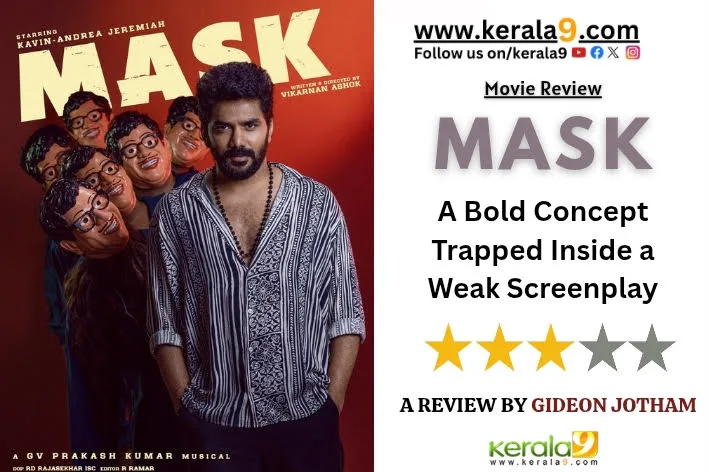
Mask Review: A Bold Concept Trapped Inside a Weak Screenplay
Review by Gideon Jotham
Film : Mask
Director: Vikarnan Ashok
Language : Tamil
Duration : 2hr 7mins
Positives
Cinematography
Story
Editing
Performance of actors
Screenplay.
Artworks
Vfx
Negatives
Direction
Interval
Second half
Emotional connection
Screenplay
Slow paced plots
Under developed character arc
Special note: only the lead role and their character arc have been concentrated, other characters loses its grip and feels empty.
STORY
The film opens with a high-tension supermarket heist, narrated in a stylish, fast-paced manner. Right from the first sequence, the audience is thrown into chaos alarms blaring, people panicking, masked men moving with precision. Amid this tension, the film introduces both the protagonist and the antagonist, setting up their personalities, motives, and the unseen connection that binds them to the heist.
As the story unfolds, we understand that neither of them entered this mess willingly. Circumstances, desperate choices, and hidden agendas pull them deeper into the conflict. The protagonist finds himself trapped in a web of consequences created by his own actions mistakes he can’t undo, secrets he can’t escape from.
The emotional and narrative core revolves around a single question:
How is he going to protect his family while the walls close in?
The conflict intensifies as his past decisions collide with the antagonist’s ambitions, dragging them into a chain of events where survival becomes both a physical and moral battle.
However, the film misses significant opportunities.
The political angle, which could have added layered depth, remains only half-explored. The character arcs, especially of the supporting cast, lack the detailing needed to elevate the stakes. With stronger focus on political motivations and richer emotional development, the story could have delivered a far more powerful impact.
Direction
Vikranan Ashok deserves credit for taking a bold swing. He attempts to merge a high-stakes heist thriller with a subtle political undercurrent, all wrapped in a glossy, action-driven cinematic package. It’s an ambitious blend style meets message, adrenaline meets ideology.
The title “Mask” is genuinely fitting. It doesn’t just reference the literal masks worn during the heist; it symbolises the invisible masks every character wears lies, hidden motives, moral compromises, and the dual identities people carry in society. The thematic potential is strong, and the title captures that metaphor beautifully.
But ambition alone cannot carry a film.
While the attempt is brave, the fictional world he presents often stretches beyond believability. The political elements feel too superficial, the emotional beats don’t land with enough weight, and the overall tone jumps between realistic and exaggerated without settling into a consistent identity.
Vikranan clearly had the vision, but the screenwriting lacks sharpness. With tighter detailing, stronger character motivations, and more disciplined narrative control, the film could have been far more gripping. A crisper script with clearer stakes and deeper emotional layering would have transformed this brave attempt into a truly impactful film.
Screenplay
The film stands on a fundamentally strong story, but the execution collapses because of a weak, undercooked screenplay. The narrative follows a non-linear structure, a tricky format that requires precision, emotional clarity, and controlled pacing. Unfortunately, the screenplay fails to use the structure as a storytelling strength. Instead of enhancing the tension, it dilutes it.
Key details that should have been the backbone of the emotional and political layers are either missing, rushed, or underdeveloped. This results in scenes that feel disconnected, stakes that never fully escalate, and characters who don’t get the depth required for the audience to care.
Because of the scattered writing, the film repeatedly loses its tightness. The momentum rises in bursts but drops before delivering the punch. The emotional and narrative payoff the “impact moment” the story keeps building toward simply never arrives. What could have been a gripping, layered thriller becomes a fragmented experience with unfulfilled potential.
Cinematography
The cinematography in Mask stands out as one of the film’s strongest assets, almost functioning as a lifeline whenever the screenplay loses grip. The visual language is confident, stylish, and purposeful, proving that the DoP clearly understood the mood the story was trying to create, even when the writing didn’t fully support it.
Visual Tone & Atmosphere
The film leans into a cool, gritty palette during the heist portions muted blues, harsh whites, and dim shadows creating a tense, claustrophobic atmosphere that immediately sets the urgency. In contrast, the personal and emotional scenes shift to warmer tones, helping the audience breathe and understand the protagonist’s inner conflicts.
Kavin
Kavin delivers one of the most grounded and convincing performances in the film. His character is the only one that truly gets a complete arc, and he carries that responsibility with solid intensity. Whether it’s panic, guilt, frustration, or emotional breakdown, Kavin shifts through these layers with believable clarity.
He maintains a controlled screen presence never overacting, never underplaying. His expressions communicate more than the dialogues at times, especially in moments where the script fails to support the emotional stakes. In many scenes, it’s his performance alone that keeps the audience invested.
Simply put, he holds the film together. His impact is crisp, enjoyable, and easily one of the strongest positives of the entire movie.
Andrea Jeremiah
Andrea Jeremiah is a force of subtlety and strength in this film. Every frame she appears in has weight; her expressions are sharp, controlled, and effortlessly expressive. She brings a quiet intensity that elevates even the most underwritten scenes.
However, her character is severely underutilized.
The script gives her the space to create intrigue, but never allows her arc to bloom fully. Just when her character begins to get interesting, the writing steps back. It feels like her role was designed for more emotional depth, more narrative influence, and more dramatic weight but the film simply doesn’t give her that room.
In short, Andrea kills it, but the film doesn’t give her the stage she deserved. Her incomplete arc leaves a noticeable void.
Final Verdict
Mask is a film that fires with ambition but lands with inconsistency. It has the ingredients for a gripping thriller, a strong story base, stylish cinematography, solid performances, and a thematic title loaded with metaphor. But the weak screenplay, uneven direction, and underdeveloped character arcs dilute the experience.
The film constantly hints at something bigger: a political commentary, a psychological exploration, a moral conflict but never fully commits to any of them. What should have been a tight, high-impact thriller becomes a film with flashes of brilliance scattered inside an incomplete execution.
Kavin and Andrea do the heavy lifting, the visuals add polish, and the premise has genuine potential. But a thriller is only as strong as its writing, and here the writing simply doesn’t punch hard enough.