NEW DELHI: In a major move to enhance passenger safety, India’s aviation regulator, the Directorate General of Civil Aviation (DGCA), has imposed a strict ban on the use and charging of power banks during flights. The new safety advisory aims to mitigate fire risks associated with lithium-ion batteries in the cabin.
Key Highlights of the New Rules:
No In-Flight Usage: Passengers are strictly prohibited from using power banks to charge mobile phones, tablets, or any other electronic devices while the aircraft is in the air.
Charging Ban: Charging power banks using the aircraft’s in-seat power supply or USB ports is now completely forbidden.
Carry-on Only: Power banks and spare lithium batteries must be carried exclusively in hand luggage. Carrying them in checked-in baggage remains strictly prohibited as it poses a significant fire hazard in the cargo hold.
Storage Restrictions: The DGCA has advised against storing power banks in overhead bins. Passengers are encouraged to keep them in their personal bags under the seat or within reach to ensure immediate detection in case of overheating.
Why the Sudden Ban?
The decision follows several global and domestic incidents where lithium batteries entered a state of “thermal runaway,” leading to smoke and fire mid-flight. Most recently, an incident on an IndiGo flight sparked concerns, prompting the regulator to align Indian aviation rules with international carriers like Emirates and Singapore Airlines.
Aviation experts note that fires in overhead bins or cargo holds are harder to detect and extinguish quickly. By keeping devices accessible and unused, the crew can respond immediately if a device begins to emit heat or smoke.
Safety Advisory for Passengers: The DGCA has directed airlines to make mandatory announcements regarding these rules. Travelers are requested to inform the cabin crew immediately if they notice any unusual odor, smoke, or excessive heating from their devices or power banks.
CARACAS/WASHINGTON — In a stunning military operation, US President Donald Trump has confirmed that Venezuelan President Nicolás Maduro and his wife, Cilia Flores, have been captured and flown out of the country. This follows a “large-scale strike” launched by US forces against strategic targets in Venezuela in the early hours of Saturday morning.
Key Highlights from Sky News & Reports:
The Strikes: At approximately 2:00 AM local time, at least seven major explosions were heard across the capital, Caracas. Low-flying aircraft were spotted, and columns of smoke were seen rising over the city.
Trump’s Announcement: Taking to Truth Social, President Trump stated: “The United States of America has successfully carried out a large scale strike against Venezuela and its leader, President Nicolas Maduro, who has been, along with his wife, captured and flown out of the Country.”
Infrastructure Damage: Reports indicate that the southern areas of Caracas are currently without electricity, and several military facilities have been targeted.
Context: The operation follows months of pressure from the Trump administration, including maritime strikes on vessels allegedly involved in drug trafficking in the Caribbean and Pacific.
THIRUVANANTHAPURAM: In a landmark verdict that has sent ripples through Kerala’s political landscape, the Nedumangad Judicial First Class Magistrate Court has found former Minister and sitting MLA Antony Raju guilty in the notorious evidence tampering case. The judgment brings a conclusion to a legal saga that spanned over three and a half decades.
The Conviction
The court held Antony Raju, along with the first accused K.S. Jose (a former court staff member), guilty under several grave sections of the Indian Penal Code (IPC). The proven charges include:
IPC 120B: Criminal Conspiracy.
IPC 409: Criminal breach of trust by a public servant (a serious offense that can carry a sentence up to life imprisonment).
IPC 193: Punishment for false evidence (fabrication of evidence).
IPC 201: Causing disappearance of evidence of offense.
IPC 34: Acts done by several persons in furtherance of common intention.
However, the court acquitted him of the charge under Section 420 (Cheating), stating that the prosecution failed to establish the specific grounds for that particular section.
The Case Background
The case dates back to 1990, when an Australian national, Andrew Salvatore Cervelli, was arrested at Thiruvananthapuram airport for smuggling contraband (charas). The primary evidence was a pair of underwear in which the drugs were allegedly hidden.+1
Antony Raju, who was then a junior lawyer representing the accused, was charged with conspiring with a court clerk to retrieve the underwear from court custody and alter its size. By making the garment too small to fit the accused, the defense successfully argued in the High Court that the evidence was planted, leading to the Australian national’s acquittal in 1991.+1
Sentencing and Political Impact
Since the court found the accused guilty under Section 409, which carries a potential sentence exceeding seven years, the Magistrate Court does not have the jurisdiction to pronounce the final sentence. Consequently, the case has been referred to the Sessions Court for the formal pronouncement of the sentence.
The verdict poses a significant threat to Antony Raju’s political career. Under the Representation of the People Act, any legislator sentenced to two years or more in prison faces immediate disqualification from the Legislative Assembly.
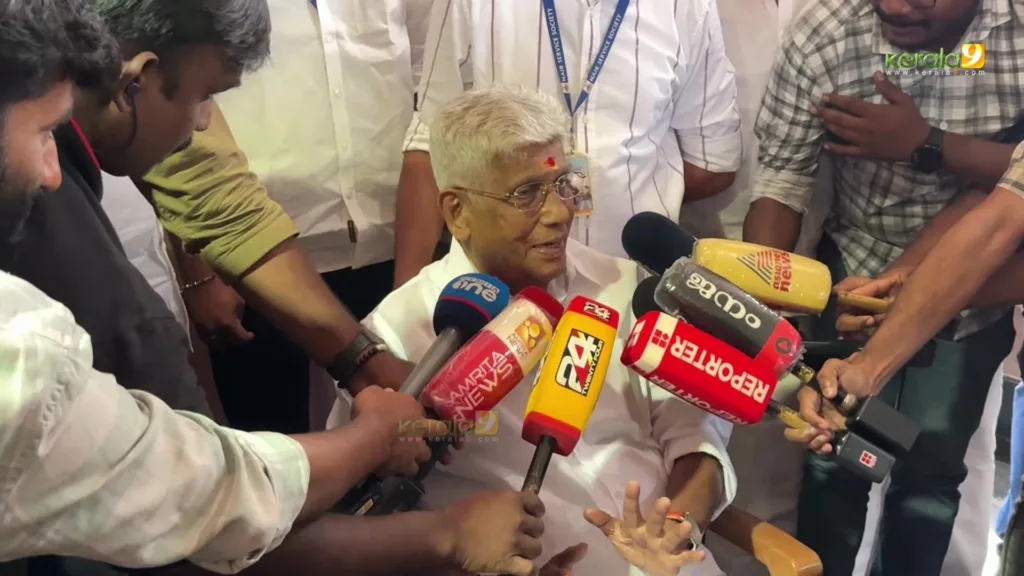
Changanassery: The Nair Service Society (NSS) has said it does not hate any political party. NSS General Secretary G. Sukumaran Nair stated that the organization will keep an “equal distance” from all parties in the upcoming Kerala Assembly elections.
He was speaking to reporters during the Mannam Jayanthi celebrations at the NSS headquarters in Perunna.
Staying Neutral: Mr. Nair said that since the NSS is not a political party, it has no reason to be angry with any group.
The “Equidistance” Policy: For the next election, the NSS will maintain its traditional policy of not supporting any one side.
Sabarimala Issue: He explained that the NSS only took a specific side (called the ‘Sharidooram’ or ‘Right Distance’ policy) during the Sabarimala protest. In all other matters, they remain neutral.
Gold Controversy: When asked about the Sabarimala gold theft case, he said he had already said enough about it and did not want to discuss it further.
The Mannam Jayanthi festival is currently being celebrated at the NSS headquarters with many people and leaders attending to pay their respects.
Kochi: Shanthakumari Amma, the mother of legendary Malayalam actor Mohanlal, passed away on Tuesday, December 30, 2025. She was 90 years old. She breathed her last at the actor’s residence, ‘Vishwamanthi,’ in Elamakkara, Kochi.
According to reports, she had been undergoing treatment for age-related ailments and neurological issues, including the after-effects of a stroke, for several years. She was under constant medical supervision at home during her final days.
A Life of Quiet Strength
A native of Elanthoor in Pathanamthitta district, Shanthakumari was the wife of the late Viswanathan Nair, who served as a Law Secretary for the Government of Kerala. After her husband’s tenure in Thiruvananthapuram, the family eventually moved to Kochi.
Shanthakumari Amma was known to be the pillar of strength for Mohanlal throughout his illustrious four-decade career. Despite her son’s global stardom, she led a quiet and simple life. Mohanlal has often spoken emotionally in interviews about his deep bond with his mother, frequently sharing how her prayers and presence guided him through life’s challenges.
The Final Moments
Mohanlal, who had been balancing his filming schedules to spend as much time as possible with his mother, was reportedly at home in Kochi when the end came. The actor had recently shared a touching moment with her after receiving the prestigious Dadasaheb Phalke Award, dedicating his success to her.
She is survived by her son Mohanlal and daughter-in-law Suchitra. Her elder son, Pyarelal, passed away in 2000, and her husband, Viswanathan Nair, passed away in 2007.
Funeral Details
The mortal remains are currently kept at the Elamakkara residence for family and close friends to pay their respects. The funeral is expected to take place on Wednesday, December 31, 2025, in Kochi.
The State Election Commissioner A. Shahjahan has announced that elections to Standing Committees in all local self-government institutions, where President and Vice-President elections have been completed, will be held from January 5 to January 7, 2026.
Following the election of members, chairpersons will be elected at the earliest by the respective returning officers.
Village and Block Panchayats will have four Standing Committees: Finance, Development, Welfare, and Health & Education. District Panchayats will have five committees, while Municipalities will have six and Corporations eight Standing Committees covering various sectors including finance, development, public works, health, education, urban planning, and tax appeals.
Returning officers of the respective institutions will conduct elections in Village and Block Panchayats. In District Panchayats and Corporations, the Additional District Magistrate (ADM) will serve as the returning officer. The Commission has also appointed returning officers for Municipalities.
Thiruvananthapuram: Licensing for pet dogs will be made mandatory and strictly enforced, with a limit of two dogs per household. The move aims to prevent the abandonment of pet dogs on the streets.
The State Animal Welfare Board has decided to recommend amendments to Panchayat and Municipal laws to enforce this condition. Although licensing is currently mandatory, it is not strictly followed. The government is considering amending existing laws.
Under the proposed rules, timely vaccination and sterilisation of dogs will be mandatory. Only dogs implanted with microchips will be eligible for licences. Microchipping will help authorities trace owners who abandon dogs. The chip will contain details such as the dog’s name, breed, and owner’s address, linked to local body databases. A fee will be charged for microchipping.
Those wishing to keep more than two dogs must obtain a breeder’s licence. The move is also aimed at preventing breeders from abandoning dogs when they fail to sell them after breeding.
New Delhi: Former Jammu and Kashmir Chief Minister Mehbooba Mufti has been placed under house arrest. The action was taken after she announced her decision to participate in student-led protests against the reservation policy in Jammu and Kashmir.
Along with Mehbooba Mufti, her daughter Iltija Mufti, Srinagar MP Ruhullah Mehdi, PDP leader Waheed Para and others have also been placed under house arrest. The incident comes ahead of a protest planned by students on Sunday against the Omar Abdullah-led government.
Alappuzha: Following the confirmation of bird flu in Alappuzha district, the sale of chicken-based food items has been banned in hotels. The action was taken by the Food Safety and Standards Authority of India (FSSAI).
Officials asked customers who had arrived at hotels to leave, which led to protests by hotel owners. The hotel owners alleged that the action was taken without prior notice.
In view of the increasing bird flu cases, a decision has been taken to keep hotels closed until December 30. Currently, bird flu has been confirmed only in ducks in Alappuzha. Around 20,000 birds have already been culled in the district as part of containment measures.
From Kadalundi in Kozhikode comes Asif Beeran, a carefree youngster who has no interest in academics. His dream is music, especially rap. He performs with his own group and goes by the stage name Azbee, along with his crew Monjans.
Everything changes during a wedding performance, where Asif notices a girl named Maria. As usual, he is instantly drawn to her. What follows is not just a simple love story, but a deep conflict, as their feelings grow in the middle of strong social barriers — mainly because they belong to different religions.
Direction
Director Rafeek Veera approaches HAAL with a clear artistic intention: emotional control. His storytelling relies heavily on mood, silence, and atmosphere rather than dramatic confrontations. The film is shaped by visual stillness, unspoken feelings, and musical cues, making it more experiential than event-driven. Veera seems deeply interested in the internal worlds of his characters, allowing their emotions to surface through pauses, glances, and lingering frames.
However, this restrained approach becomes both the film’s strength and its limitation. While the romantic chemistry between the lead pair is well-maintained in the first half, the second half struggles to retain the same emotional grip. As the narrative shifts from romance to socio-religious conflict, the film begins to feel crowded with incidents. Political undertones, communal tensions, and ideological clashes are introduced, but not always with the depth required to make them impactful.
The emotional consequences of key conflicts are underdeveloped, which weakens audience investment. The climax, despite its intentions, settles into a familiar template, and the sudden involvement of political elements feels slightly disconnected from the emotional journey built earlier. Still, Veera deserves credit for integrating music thoughtfully into the narrative. Songs emerge naturally from character emotions, rarely feeling like interruptions, and the performances are guided with sensitivity, particularly from the lead actors.
Screenplay
The screenplay of HAAL is emotionally sincere but structurally predictable. It does not aim for twists or dramatic escalation, instead choosing to immerse the viewer in mood, rhythm, and emotional proximity. This approach will appeal to audiences who enjoy slow, introspective storytelling but may test the patience of viewers seeking narrative momentum.
Music plays a crucial role in the writing. Songs are woven into the screenplay as emotional extensions of the characters rather than commercial inserts. The relationship between Asif and Maria grows through shared silences, music, and moments rather than dramatic declarations. This organic progression works well initially.
However, the screenplay struggles once the conflict intensifies. While the idea of forbidden love is timeless, the writing does not bring sufficient freshness to the theme.
The socio-political and religious angles introduced later feel more descriptive than dramatic, and the emotional struggle of the characters lacks escalation. Silence, though effective in parts, occasionally stalls the narrative, leading to repetition and predictability. From start to finish, the trajectory of the story remains largely foreseeable, limiting its emotional payoff.
Technical Aspects
Technically, HAAL maintains consistency and restraint. The cinematography is one of the film’s strong points, capturing emotional distance through framing and visual composition. Close-ups reveal inner turmoil, while wide shots subtly reflect social barriers and isolation. The visual language supports the film’s emotional tone without drawing unnecessary attention to itself.
Editing remains smooth for the most part, preserving the film’s rhythm. However, the second half could have benefited from tighter cuts, as certain scenes linger longer than needed. Art direction, costumes, and makeup remain grounded and realistic, helping the film stay rooted in its world without artificial gloss.
Music
Music is the emotional backbone of HAAL. Rather than functioning as a commercial tool, it becomes an extension of the characters’ emotional states. The song ‘Hijir’ stands out for its haunting melody and poetic pain, with its chorus beautifully capturing longing and loss. The rap number performed by Shane Nigam adds a contemporary edge, effectively reflecting political tension and social unrest.
The background score is used sparingly and with intention. Instead of overwhelming scenes, it rises only when emotions demand it. Particularly in the first half, the background music elevates romantic moments, enhancing their intimacy. Overall, the music complements the film’s subtle tone and strengthens its emotional texture.
Performance of the Actors
Shane Nigam delivers a controlled and introspective performance. He relies more on body language and expressions than dialogue, allowing emotions to simmer beneath the surface. His portrayal suits the film’s restrained tone, making Asif feel real and emotionally grounded. Sakshi Vaidya complements him well, offering a calm and composed performance. Her expressions feel natural, and she conveys emotional shifts without exaggeration. While her role does not demand dramatic transformation, she brings sincerity to the character. The supporting cast effectively represents societal and familial pressure, though a few characters could have benefited from deeper writing to enhance their impact.
Final Verdict
HAAL is a slow-burning musical romance that prioritizes mood, emotion, and realism over dramatic spectacle. Its strengths lie in its sincere performances, soulful music, and visually grounded storytelling. However, its predictable narrative, uneven pacing, and underdeveloped conflicts prevent it from reaching its full potential.
This is a film best suited for viewers who appreciate realistic romance, musical storytelling, and emotionally restrained cinema. Those willing to engage patiently with its rhythm may find HAAL quietly rewarding. However, audiences seeking high drama or fast-paced entertainment may find it emotionally distant. Ultimately, HAAL stands as a well-intentioned film that caters more to a niche audience than the masses.