Kochi: The Ernakulam Principal Sessions Court has ordered the return of actor Dileep’s passport following his acquittal in the actress assault case.
The court accepted Dileep’s argument that his passport should be returned as he is no longer an accused. His counsel informed the court that Dileep needs to travel abroad for the promotion of his upcoming film.
The passport had been seized earlier after he was named as an accused in the case.
Dhaka: India has closed two visa application centres in Bangladesh—located in Rajshahi and Khulna—citing security concerns.
The decision comes amid recent threats against the Indian High Commission in Dhaka and provocative anti-India statements by Bangladeshi political leaders. India had earlier summoned Bangladesh High Commissioner senior diplomat Mohammed Riyaz Hamidullah to convey its strong protest.
Recently, Bangladesh National Citizens Party leader Hasnat Abdullah had issued a threat referring to India’s northeastern states as the “Seven Sisters,” prompting strong condemnation from India.
Kottayam: Director Major Ravi has suffered a setback in the long-running legal dispute over the screenplay of the Mohanlal-starrer Karmayodha. The Kottayam Commercial Court ruled that the script belongs to screenwriter Reji Mathew of Puthuppally.
The court ordered Major Ravi to pay ₹30 lakh as compensation and also granted copyright ownership of the film to Reji Mathew.
The verdict comes after a 13-year legal battle. The film was released in 2012. Reji Mathew had alleged that his story, screenplay, and dialogues were used without his consent.
He had approached the court one month before the film’s release seeking a stay. The court allowed the release after a deposit of ₹5 lakh, noting that there was a dispute over authorship. However, the film was released crediting Shaji and Sumeesh as writers.
Subsequently, Reji Mathew approached the court again seeking ₹40 lakh compensation, citing violation of court orders. The court has now ruled in his favour.
Vidya Balan Photos. Check out the latest pictures, pics, Vidya Balan new photos, movie stills, event photos, Vidya Balan photoshoot and images of Vidya Balan.Vidya Balan is an Indian movie actress mainly in the Bollywood industry.
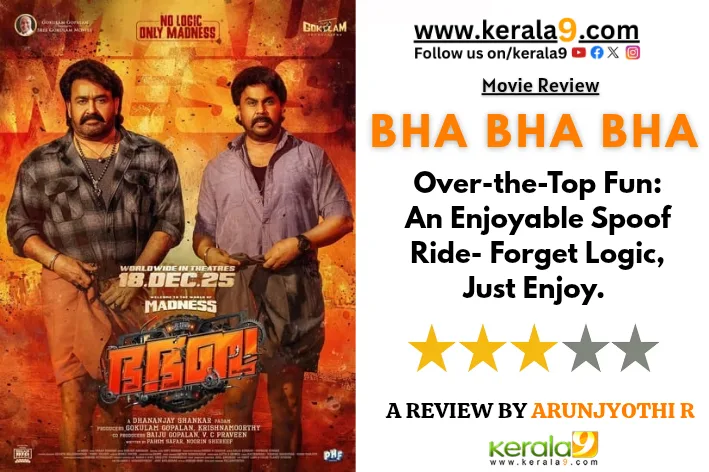
Bha Bha Bha Review ONE WORD: Over-the-Top Fun: An Enjoyable Spoof Ride—Forget Logic, Just Enjoy.
A Review by Arunjyothi R
LANGUAGE: MALAYALAM
DURATION: 02 Hours 32 Minutes
DIRECTOR: Dhananjay Shankar
GENRE: Comedy Action Thriller
•POSITIVES:
1: Making Style
2: Comedies
3: Performance of Dileep and Mohanlal
4: Songs and Background Score
5: Over the top scenes
7: Spoof way of approach
8: Editing
•NEGATIVES:
1: No logics
2: Screenplay could have been better
3: Fully predictable.
STORY:
A stranger pretending to be a party worker does the unthinkable—he kidnaps the Kerala Chief Minister and turns the situation into a public trial. Instead of hiding, he takes the CM across the state and forces him to face the real problems of ordinary people. His strange and risky ways make it hard to tell whether he is a villain or a hero. Adding to the confusion are his reckless helpers, whose actions throw the entire system into chaos. At the same time, the Chief Minister’s son, a hot-headed NIA officer, begins a fierce hunt—not only to save his father, but also to punish the man who publicly embarrassed his family. What follows is a political roller-coaster filled with satire, disorder, and power struggles.
REVIEW & ANALYSIS OF THE FILM:
This is a film that makes its intentions clear from the very first frame—it is a spoof, and logic has no entry pass here. The narrative runs purely on madness, exaggeration, and unapologetic chaos. Once you accept that, the film becomes an entertaining ride. Despite its lengthy runtime of two hours and thirty-two minutes, it never feels dragged or sluggish, thanks to the sheer number of events packed into the plot. One absurd situation follows another, each unfolding in its own quirky way, deliberately ignoring realism. The makers even announce this approach upfront, making it clear that “no logic, only madness” is the rule of the game. Questioning logic in such a film feels misplaced, because the genre itself thrives on breaking rules rather than following them. From start to finish, the movie stays committed to this tone—loaded with twists, turns, and overblown heroic moments that border on the ridiculous in the best possible way. The constant flow of incidents keeps the energy high, turning the film into a full-blown rollercoaster of spoof-driven entertainment. If approached with the right mindset and accepted for what it is, the film delivers a loud, chaotic, and thoroughly engaging big-screen experience.
For a film to truly click, the audience needs to connect with its characters—and this is where the writing by Fahim Safar and Noorin Shereef takes a very different route. Instead of aiming for realism, the film fully embraces its spoof nature, loading the characters with exaggerated traits and unapologetic absurdity. At times, the over-the-top portrayals may make you momentarily question whether you’re watching a conventional Malayalam film at all. But that very excess works in the film’s favour—keeping the narrative lively, preventing boredom, and ensuring there’s never a dull moment or confusion about what’s unfolding. By leaning into madness rather than restraint, the writing manages to turn potential flaws into entertainment, making the experience quirky, engaging, and comfortably above average for a spoof.
This film is clearly not designed to please everyone. For some viewers, the relentless chaos and free-flowing nonsense may feel overwhelming, even absurd. But for others, that very madness is what makes the film enjoyable and worth celebrating. It boldly commits to its style without trying to balance or dilute it for universal approval. From a technical standpoint, the making quality stands out. The film is well-mounted, and its fast-paced structure—packed with nonstop events and a playful tone—keeps the momentum alive throughout. The director consciously opts for an over-the-top filmmaking style, fully embracing exaggeration and spectacle. In doing so, he smartly taps into Dileep’s star power. Known for his impeccable comic timing and ease with eccentric roles, Dileep once again proves why he remains a dependable performer in this space. His portrayal is lively, energetic, and consistently entertaining, and the director succeeds in presenting the character in a way that feels vibrant rather than repetitive.
A special mention must go to the extended cameo of Mohanlal. His entry is timed perfectly, and the sheer weight of his screen presence instantly elevates the theatre experience. The audience energy visibly spikes the moment he appears, turning the atmosphere electric. The interval block deserves praise for its sheer audacity—so wildly chaotic that you’re left wondering what just happened, yet thoroughly entertained. It lands as a solid crowd-pleasing moment. The climax follows the same template, going all out with exaggerated action sequences, gunshots, and larger-than-life moments. The overblown execution makes it both thrilling and humorous, staying true to the film’s spoof nature. Overall, the movie thrives on excess and madness, and while it may divide opinions, it confidently delivers a loud, energetic, and unapologetically fun cinematic experience for those willing to embrace its madness.
At a certain point, the film makes a noticeable shift in tone, moving from unrestrained madness into a more emotional and sentimental space. This transition significantly alters the overall feel of the narrative. Here, writers Fahim Safar and Noorin Shereef take a more detailed and grounded approach, carefully unpacking the emotional core of the story. The motivations of the hero are clearly laid out—why he seeks revenge, what pushed him to go rogue, and what his true intentions are. This backstory is woven smartly into the screenplay, adding depth to a character who until then thrived largely on exaggeration. What works particularly well in this stretch is the way the film balances emotion with explanation. The logical reasoning provided for the hero’s vengeance feels satisfying and convincing, lending weight to the chaos that surrounds it. This emotional anchor strengthens the overall impact of the film, proving that even a spoof can benefit from a well-defined purpose. At the same time, the writers never abandon the fun-filled tone; humour continues to flow naturally, ensuring that the film remains entertaining even during its more serious moments.
Pulling off over-the-top sequences without losing audience engagement requires a solid writing foundation, and the script largely succeeds in that regard. The structure is packed with elements that keep the viewer invested—be it comedy, emotion, or spectacle—making even the most exaggerated moments easy to sit through and enjoy. Another major highlight is the clever use of references from several hit films featuring Dileep and Mohanlal. These callbacks are placed thoughtfully, appearing at just the right moments to trigger nostalgia and applause rather than feeling forced. The inclusion of the popular character Advocate Mukundan Unni is a particularly crowd-pleasing touch, drawing cheers and adding to the celebratory mood. These self-aware references enhance the spoof factor and make the viewing experience all the more enjoyable, especially for fans familiar with the actors’ iconic roles.
While Bha Bha Bha is a highly entertaining spoof, it does come with a few noticeable shortcomings. The film completely abandons logic, which, though intentional for its madcap style, may feel jarring for viewers looking for a coherent storyline. The screenplay, though filled with humour, action, and emotional moments, could have been more tightly structured to elevate the overall narrative and give the chaos a stronger foundation. Additionally, many of the plot developments are fully predictable, making it easy to anticipate the twists and turns even amid the over-the-top spectacle. These aspects slightly limit the film’s impact, but they do not overshadow its energetic performances and mass appeal.
The musical landscape of the film turns out to be another major strength. Gopi Sundar’s background score plays a crucial role in lifting the film’s larger-than-life moments, especially in a spoof that thrives on excess and mass appeal. To make over-the-top scenes work, the music needs to strike the right balance between energy and exaggeration—and Gopi Sundar delivers exactly that. The film is packed with powerful, high-spirited themes that amplify the madness on screen, injecting a strong mass-mood vibe into key sequences. Whether it’s the hero’s dramatic entries, chaotic confrontations, or action-heavy stretches, the background score consistently adds punch and momentum, ensuring the energy never dips. The score also smartly adapts to tonal shifts in the narrative. During emotional moments, the music softens, allowing the sentiment to breathe without feeling melodramatic. In contrast, the action and spoof-heavy sequences are driven by loud, pulsating tracks that heighten the theatrical experience—particularly effective in a packed theatre setting where audience reactions feed off the sound design. Adding to the musical appeal are two songs composed by Shaan Rahman. One leans into emotion, complementing the film’s sentimental stretch, while the other is a celebratory dance number featuring Dileep and Mohanlal—a combination that naturally excites fans. Both tracks are well-tuned and blend smoothly into the narrative without disrupting the flow. The song Azhinjattam stands out for its raw energy and foot-tapping rhythm, perfectly matching the film’s madness, though the lyrics could have been sharper to elevate its impact further.
Dileep delivers an energetic and thoroughly entertaining performance, carrying the film effortlessly with his trademark comic timing and screen presence. The role gives him ample space to explore humour, action, and emotion, and he handles each aspect with ease. The over-the-top moments, which could have easily slipped into excess, are executed with perfect control, turning them into crowd-pleasing highlights. His comedy sequences stand out for their unique style and spontaneity, reminding audiences why he has long been celebrated for his natural flair in humour. At the same time, the emotional portions of the film bring out his strong acting abilities, adding depth to a character rooted in madness and exaggeration. The action scenes, too, are well-handled, contributing to the film’s mass appeal without overshadowing its spoof nature. Really, this is his comeback. Mohanlal’s extended cameo is nothing short of a cinematic treat. His entry alone elevates the film’s energy, with his gigantic screen presence instantly commanding attention. The action sequences featuring him are executed with style and confidence, backed by sharp dialogue delivery that amplifies the mass moments. His chemistry with Dileep is a major highlight, making their combination scenes lively and immensely enjoyable. One of the most celebrated moments is his iconic mundu madakki kuthi sequence, which drew loud cheers and applause from the audience. Even in a limited screen time, Mohanlal leaves a lasting impact, turning his appearance into a full-fledged event that adds significant value to the film’s overall entertainment quotient.
The supporting cast adds considerable strength to the film, complementing the lead performances with effective humour and solid screen presence. Actors like Sandy, Balu, Ashokan, and Saranya Ponvannan share a comfortable rapport with Dileep, and their combination scenes are crafted to generate both laughter and occasional thrills. Each of them is given enough space to make an impact, and they perform their roles with conviction, ensuring that the chaos on screen remains entertaining rather than cluttered. Their timing and reactions play a key role in sustaining the film’s spoof-driven energy, and they do complete justice to the characters written for them. Vineeth Sreenivasan appears in a crucial role and leaves a strong impression with his full-fledged, charming performance. He brings a certain calm authority and wit to the narrative, nailing his part with assured acting and crisp, effective dialogue delivery. Dhyan Sreenivasan, on the other hand, pops up in a cameo that leans heavily into comedy. His scenes are laced with humorous references to his real-life persona, which adds an extra layer of fun for the audience. These self-aware moments work well within the spoof framework, drawing laughs and keeping the tone light, making the ensemble cast an important contributor to the film’s overall entertainment value.
The technical side of the film also scores well, with Armo’s cinematography and Ranjan Abraham’s editing emerging as clear positives. The framing and shot compositions are visually pleasing, and the camera work effectively enhances the film’s mass and heroic moments. The action sequences, in particular, are well-shot, with dynamic angles and movements that amplify the larger-than-life impact the film aims for. The visuals in the Azhinjattam song stand out for their vibrancy and colour, adding to the film’s energetic appeal and making the sequence visually memorable. Ranjan Abraham’s editing ensures that the film maintains a steady pace despite its long runtime. The cuts are clean, scene transitions are smooth, and the narrative never feels unnecessarily stretched. The action blocks benefit from sharp editing, which heightens the heroic tone and keeps the momentum intact. That said, the lighting could have been more refined in certain portions—especially in a few action scenes that rely heavily on red lighting. While the intention is clear, the execution doesn’t always work in the film’s favour and slightly affects visual clarity. Still, overall, the cinematography and editing significantly contribute to the film’s engaging, mass-oriented presentation.
CONCLUSION:
Bha Bha Bha is a full-on, entertaining ride that unapologetically embraces its spoof nature. From start to finish, the film is packed with over-the-top moments, chaotic fun, heroic madness, and clever comedy, all tied together with a surprisingly solid emotional core. Dileep shines in his role, balancing humour, action, and emotion with ease, while Mohanlal’s extended cameo adds a larger-than-life presence that elevates the entire experience. The supporting cast, including Sandy, Balu, Ashokan, Saranya Ponvannan, Vineeth Sreenivasan, and Dhyan Sreenivasan, bring energy, humour, and charm, enhancing the overall entertainment. Technically, the film impresses with vibrant cinematography by Armo, tight editing by Ranjan Abraham, and a pulsating background score by Gopi Sundar, complemented by catchy songs from Shaan Rahman. While logic takes a backseat—which is entirely intentional—the film thrives on its madcap humour, mass appeal, and spirited performances. If you enjoy spoofs with a mix of comedy, action, emotion, and sheer spectacle, Bha Bha Bha is definitely worth watching on the big screen. I would highly recommend it.
Thiruvananthapuram:The long-standing dispute between the Kerala government and Governor Rajendra Arlekar over university Vice-Chancellor appointments has been resolved through a consensus. The breakthrough came after a meeting between Chief Minister Pinarayi Vijayan and the Governor.
As part of the agreement, Dr. Sisa Thomas will be appointed Vice-Chancellor of APJ Abdul Kalam Technological University (KTU). It was also agreed that Dr. Saji Gopinath will be appointed Vice-Chancellor of the Kerala Digital University.
A search committee had prepared panels of eligible candidates and submitted them to the Chief Minister. The Chief Minister prioritised the names and forwarded the lists to the Governor for approval. In the list submitted by the Chief Minister, Dr. Saji Gopinath topped the panel for the Digital University, while C. Satheesh Kumar was placed first for the Technological University.
Dr. Sisa Thomas and Dr. Priya Chandran featured in both panels and were reportedly preferred by the Governor. Citing the fact that they were the only common candidates in both lists, the Governor informed the Supreme Court that he had proposed Dr. Sisa Thomas for the Technological University and Dr. Priya Chandran for the Digital University.
Earlier efforts to resolve the standoff, including talks held at Raj Bhavan by ministers P. Rajeev and R. Bindu with the Governor, had failed. The latest agreement between the Chief Minister and the Governor has now brought an end to the impasse over the Vice-Chancellor appointments.
Kochi: As counting of votes for the local body elections began in Kerala, the first victory went to the LDF. The LDF candidate won in Ward 1 of Adoor in Pathanamthitta district. The first result in the state was declared within eighteen minutes of the commencement of counting. LDF candidate Biju Samuel emerged victorious from Adoor Ward 1.
In Shoranur Municipality, the BJP secured victories in three wards. Out of the four wards counted, the BJP won in three. In Koothuparamba Municipality, LDF candidate A.P. Shyamjith won in Ward 1, while the LDF also secured victory in Ward 2, with Sabina emerging as the winner.
Vote counting is progressing at 244 centres across the 14 districts of the state. Counting of postal ballots for district panchayat elections is being carried out at the collectorates under the supervision of district collectors. In the initial phase of counting, the LDF showed an early lead.
Akanda 2 : A sequel that believes noise is powerful and forgets that cinema needs a pulse.
Film : Akanda 2
Director: Boyapati Srinu
Language: Telugu
Genre : Action Thriller
A Review by Gideon Jotham
Positives
Scale
Confidence
Visual polish
Negatives
Screenplay
Direction
Music
Editing
Performances
Story
Akhanda 2 picks up the thread of divine vigilantism and stretches it until it frays. The story follows Akhanda once again stepping in as a spiritual enforcer, taking on forces of corruption that are painted in broad, almost comic-book strokes. The setup promises scale and intensity but the narrative never deepens beyond its surface-level righteousness.
At its core, the story is painfully predictable. Every turn is telegraphed well in advance: the evil is introduced loud and ugly, the hero arrives slow and godlike, and justice is delivered through monologues rather than meaningful consequences. There’s no real suspense because the film never allows doubt Akhanda is invincible from frame one, which kills any dramatic tension.
What hurts most is the lack of human conflict. The story is more interested in proclaiming power than exploring purpose. Supporting characters exist only to be threatened, rescued, or silenced. Emotional stakes are replaced with spiritual slogans, and repetition takes the place of progression.
Instead of expanding Akhanda’s world or questioning his path, the story plays it safe rehashing familiar beats with a bigger budget and longer runtime. By the time the film reaches its climax, the narrative feels exhausted, not earned
Direction
Boyapati Srinu directs Akhanda 2 as if volume alone equals vision. Every scene is designed to announce itself slow-motion entries, thunderous background scores, and dialogues delivered like divine proclamations. What’s missing is control. Direction here is not about shaping a narrative, but about repeatedly reminding the audience who the hero is.
There’s no modulation in tone. Emotional scenes are shot like action set-pieces, action scenes are stretched into rituals, and silence arguably the most powerful tool in cinema is completely absent. Boyapati doesn’t trust the audience to feel; he insists on instructing them, loudly and repeatedly.
The biggest flaw lies in overindulgence. Moments that could have landed with impact are dragged until they lose meaning. Elevation becomes routine, and routine becomes fatigue. Instead of building awe, the film numbs the viewer with excess.
Most disappointing is the missed opportunity to evolve. A sequel demands growth of character, of worldview, of cinematic language. But Boyapati sticks rigidly to his comfort zone, recycling the same visual grammar and dramatic beats from the first film, just turned up a notch.
Screenplay
The screenplay of Akhanda 2 is where the film truly collapses under its own weight. What should have been the backbone of the narrative instead becomes a loose collection of elevation blocks, stitched together by speeches and background score.
Scenes don’t flow they pile up. Conflict is introduced, paused for a sermon, inflated with slow motion, and then resolved without consequence. There’s no rhythm, no urgency, and absolutely no sense of escalation. The film mistakes length for depth and repetition for conviction.
Character motivations are spelled out so bluntly that the audience is never invited to think or feel. Every emotion is underlined, circled, and highlighted with background music, leaving no room for subtext. When everything is loud, nothing lands.
The screenplay also fails structurally. The first half drags its feet, the second half runs in place, and the climax arrives not as a payoff but as a formality. Subplots appear with promise but are abandoned once they’ve served their purpose of glorifying the protagonist.
Worst of all, Akhanda himself faces no internal conflict. A hero without doubt is a statue, not a character. By refusing to challenge its own lead, the screenplay drains the film of tension and dramatic payoff.
Music & Background Score
The music in Akhanda 2 doesn’t support the film it assaults it.
From the opening frame, the background score behaves like it’s in a competition with the actors, the dialogue, and basic human hearing. Every emotion, every walk, every stare is drowned in thundering beats that scream importance instead of earning it. There’s no restraint, no variation just an endless loop of “this is mass, please clap.”
What’s worse, the score is used as a crutch. Weak scenes are padded with louder music, thin writing is buried under chants, and moments that should breathe are force-fed noise. Instead of elevating impact, the music exposes the lack of it.
The songs fare no better. They interrupt rather than integrate, halting whatever little momentum the film manages to build. None add character insight or narrative value; they exist purely out of obligation and feel like it.
By the second half, the background score becomes exhausting, not empowering. When silence could have created gravity, the film chooses decibels. Repeatedly. Relentlessly.
Performances
In Akhanda 2, performances don’t rise above the writing they drown in it.
Nandamuri Balakrishna
Balakrishna doesn’t perform Akhanda; he repeats him. The body language, the pauses, the stare-into-the-horizon act everything feels carried over from the first film, with nothing new added except extra slow motion. There’s power, yes, but no surprise. When a character is written as invincible and played as untouchable, the performance turns static. Reverence replaces range. What once felt commanding now feels mechanical.
Antagonist
The villain is reduced to a loud caricature evil by default, exaggerated by design. The actor does exactly what the role demands: shout, threaten, smirk. But that’s the problem. There’s no menace, no psychology, no presence. A villain without depth only exists to be defeated, not remembered.
Overall
No one is allowed to act naturally because the film doesn’t want performances it wants poses. Every emotion is performative, every reaction amplified, every dialogue delivered like a proclamation. Subtlety is absent, nuance is discouraged, and realism is actively avoided.
Cinematography & Editing
The cinematography in Akhanda 2 looks expensive, polished and completely empty. Every frame is designed for elevation, not expression. Low angles, dramatic lighting, dust-filled backdrops, and god-rays are used so obsessively that they lose all meaning. When every shot screams “iconic,” nothing actually is.
There’s no visual storytelling here, only visual decoration. The camera worships the protagonist but forgets the world around him. Locations blur together, action geography is unclear, and emotional moments are framed like poster shots rather than lived-in scenes. Style replaces substance at every turn.
Editing fares even worse. The film desperately needed a ruthless editor and got the opposite. Scenes linger far beyond necessity, reaction shots repeat endlessly, and slow motion is abused to the point of parody. Momentum dies not once, but repeatedly.
Transitions are clumsy, pacing is uneven, and the film seems allergic to urgency. Instead of tightening tension, the edit stretches everything walks, stares, speeches until the audience checks out. By the time the climax arrives, fatigue has already won.
Most damningly, cinematography and editing work against each other. One inflates, the other refuses to cut. The result is a film that looks grand but feels interminable.
Final Verdict
Akhanda 2 is a sequel that mistakes volume for vision and repetition for reverence. It doubles down on everything that worked superficially in the first film while ignoring what cinema actually needs story progression, character depth, and emotional credibility. What unfolds is not a film, but a prolonged act of self-admiration.
Despite its scale, budget, and star power, the film feels creatively stagnant. There is no risk, no evolution, and no curiosity to explore Akhanda beyond his invincibility. The result is a loud, bloated spectacle that demands devotion but offers little engagement in return.
Thiruvananthapuram: The United Democratic Front (UDF) has achieved a major upset victory in the by-election for the Muttada ward of the Thiruvananthapuram Corporation. This marks the first time the UDF has won the ward in 25 years, wresting the sitting seat from the Left Democratic Front (LDF).
The victorious UDF candidate, Vaishna Suresh, reacted to her stunning win, stating that it was a “victory for democracy” and a triumph given by the people. She added that the people recognized her hard work and dedication, and gave her immense support. Despite issues related to the voters’ list, she maintained that she was confident that truth would prevail. Suresh expressed her happiness and gratitude to the people for the win.
Vote Count: Vaishna Suresh won the election by securing 363 votes. LDF candidate Amshu Vamadevan received 231 votes, while the BJP candidate, Ajith Kumar, managed to secure 106 votes.
The Supreme Court has stayed a Kerala High Court verdict that declared Munambam land as not belonging to the Wakf Board. The interim stay was issued while admitting a Special Leave Petition filed by the Kerala Wakf Protection Forum. The bench headed by Justice Manoj Misra ordered that the existing status of the land be maintained until January 27.
However, the Supreme Court did not stay the High Court’s earlier approval for the state government to appoint an investigation commission to examine the Munambam land issues. The commission may continue its work.
The state government opposed the petition in court. Notices have been issued to all concerned parties, who must respond within six weeks. The matter will be heard in detail on January 27.