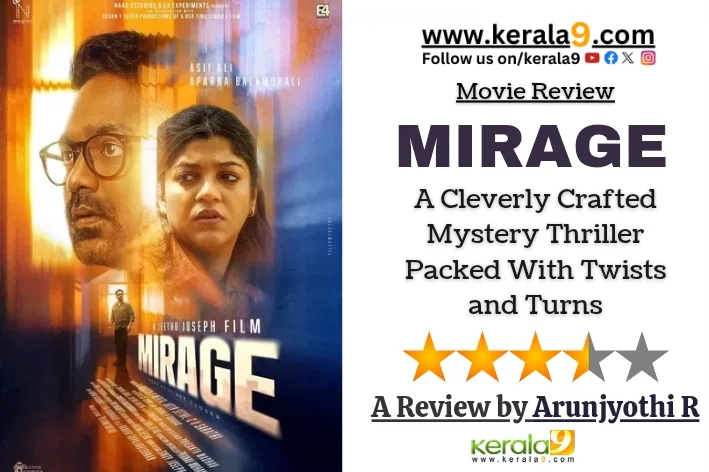
Mirage Malayalam Movie Review – ONE WORD: A Cleverly Crafted Mystery Thriller Packed With Twists and Turns
A Review by Arunjyothi R
LANGUAGE: Malayalam
DURATION: 02 Hours 32 Minutes
DIRECTOR: Jeethu Joseph
GENRE: Suspense Mystery Thriller
•POSITIVES:
1: Direction
2: Story
3: Screenplay
4: Twist and Suspenses
5: Performance of actors
6: Cinematography
7: Editing
•NEGATIVES:
1: Background Score
2: Little Slow Pacing
3: Some scenes are predictable
STORY:
Abhirami (Aparna Balamurali) moves to Coimbatore for her job and falls in love with her coworker Kiran (Hakim), planning a life together. But when Kiran mysteriously disappears in a train accident, Abhirami’s world is thrown into chaos. Determined to uncover the truth, she joins forces with online investigative journalist Aswin (Asif Ali). As their search deepens, they stumble upon dark secrets that pull them into a twisted mystery far more dangerous than they ever imagined.
REVIEW & ANALYSIS OF THE FILM:
WHAT ARE THE POSITIVES:
1: The first and foremost positive element of Mirage is its direction, steered with precision by Jeethu Joseph. He once again demonstrates his command over the suspense thriller genre, crafting a narrative that is both clear and tightly engaging. Each scene is paced with intent, ensuring that the tension never drops and the audience remains invested throughout. What makes the direction stand out is Joseph’s ability to balance straightforward storytelling with layered mystery. Without drifting into excess, Mirage sustains a concise structure while still delivering depth and intrigue. It’s yet another example of his filmmaking finesse, offering viewers a gripping experience that feels worth every bit of their time and money.
2: What truly stands out is the way Joseph holds the film together as a complete package. Instead of overwhelming the audience with complexity, he skillfully balances the layers, giving each revelation its place and purpose. The result is a film that sustains its mystery without compromise, offering an atmosphere that is consistently gripping and filled with intrigue. Mirage thrives because of this careful orchestration, reminding us once again of Joseph’s mastery in building suspense with clarity and precision.
3: Another strong aspect of Mirage is the way it is layered with multiple dimensions, presenting a chain of events and developments that, in lesser hands, might have easily caused confusion. With so many narrative turns, the danger of losing clarity or falling flat was always present. Yet, Jeethu Joseph’s assured filmmaking never lets the story deviate. His direction sustains a seamless rhythm, where each moment connects smoothly to the next, shaping a tightly knit and engaging narrative.
4: Mirage thrives on the atmosphere it builds—a carefully crafted mood where both the script and Jeethu Joseph’s direction play an equal role. Right from the opening scene, the film whispers that something bigger is waiting to explode, and that sense of unease lingers until the very last frame. What makes this work so well is the way the tension feels organic. Instead of relying on loud shocks, Mirage draws viewers in with a slow burn of suspense, layering thrills and mystery in just the right doses. Every moment fuels curiosity, keeping the audience guessing who’s pulling the strings and why. It’s this immersive, edge-of-the-seat mood that makes the film not just engaging but genuinely fascinating.
5: The story emerges as another winning highlight of Mirage. Built on a web of characters and numerous events, the plot never loses its grip, thanks to the strong connective tissue that binds every incident together. Each scene feels like a carefully placed piece in a larger puzzle, gradually aligning to reveal the bigger picture. Instead of relying on a single twist, the narrative keeps the audience on edge with its rhythm. Some turns may feel familiar, but the brisk pacing and the clever way each incident folds into the next create an irresistible forward pull. The writing doesn’t allow space for distraction—it constantly feeds curiosity, leading viewers deeper into the mystery. By the time the climax arrives, everything feels neatly tied together, leaving the impression of a story that is both sharp in execution and satisfying in its payoff.
6: The screenplay of Mirage serves as its true backbone, standing out as one of the film’s finest strengths. Carefully crafted with the right balance of mystery, thrill, and suspense, it keeps the narrative consistently sharp and engaging. The brisk writing style, coupled with sudden shifts from one incident to another, ensures that the momentum never dips, pulling the audience deeper into the unfolding drama. What makes the screenplay remarkable is the precision in its design—the seamless linking of scenes, the way plot twists are anchored to the central characters, and how suspense is always tied to their motives. The writers clearly knew how to hold the viewer’s attention, leaving almost no room to look away. Packed with plenty of twists and well-timed surprises, the screenplay gradually raises the stakes, and by the time it reaches the climax, it delivers those “wow” moments that define a memorable thriller.
7: The performances stand out as another major strength of Mirage. The casting is spot-on, with every actor delivering their best to elevate the film. In the lead, Aparna Balamurali, Asif Ali, Hakim, and Hannah give commanding performances that not only dominate the screen but also perfectly complement the film’s mystery-driven tone. Their portrayals carry the right intensity, keeping the suspense alive through subtle expressions and controlled emotions. Among the highlights, the chemistry between Asif Ali and Aparna Balamurali adds significant depth, making their combination scenes a major plus. Hakim, on the other hand, brings an additional edge with his performance, strengthening the thriller’s atmosphere and ensuring the tension remains consistent. Together, the cast becomes an essential pillar that sustains the intrigue and impact of Mirage.
8: Cinematography emerges as another standout positive in Mirage, enriching the film’s overall mood and intensity. The visuals align seamlessly with the script, with several striking frames amplifying the mystery-driven atmosphere. From action sequences captured through dynamic angles to close-up shots that highlight the actors’ nuanced performances, the camerawork constantly adds depth to the storytelling. One of the most notable achievements lies in the climax chase, where the visuals heighten the tension and pull the audience right into the moment. By sustaining a consistent visual appeal throughout, the cinematography not only complements the narrative but also reinforces the suspense and thriller vibes that define Mirage.
9: The editing of Mirage deserves appreciation for its smoothness and precision. The transitions are clean, with no mismatches that could distract from the flow of the narrative. The cuts are sharp and purposeful, while the sudden shifts between events are handled effectively, keeping the pace brisk and the tension alive. This crisp editing style not only enhances the storytelling but also ensures that the suspenseful momentum of the film remains intact throughout.
WHAT DIDN’T WORK OUT:
1: If there’s a weak link in Mirage, it’s in the way the first half unfolds. The film takes its own time to build the foundation, and though the detailing helps set the mood, the pacing feels a little sluggish, especially for a thriller that thrives on urgency. Viewers may sense the narrative stretching before the tension fully kicks in. The interval twist, meanwhile, arrives as the much-needed spark but loses some of its punch because it feels predictable. Yet, credit goes to the execution—the reveal may not shock, but it still carries enough weight to keep the audience curious about what’s waiting in the second half.
2: Another drawback of Mirage lies in its background score. While the music is competent and does support the narrative, it lacks the punch needed for a thriller of this scale. A film built so heavily on tension and suspense demands a score that heightens every twist and magnifies the atmosphere, but here the tunes often settle for being functional rather than impactful. With a more inventive or intense musical treatment, the viewing experience could have reached a far greater level of immersion. This shortfall is felt most strongly in the chase sequences and the climax twist reveal. Though these moments are executed with precision in terms of direction and cinematography, the background score doesn’t quite rise to the occasion. At times, it even carries shades of Drishyam-style familiarity, which dilutes the freshness of the scenes. A more original composition or a distinct musical approach could have elevated these key moments, making the thrills sharper and the suspense far more gripping.
PERFORMANCE OF ACTORS:
The performances form one of the strongest pillars of Mirage, with the casting proving to be spot-on. Aparna Balamurali, Asif Ali, Hakim, and Hannah take charge of the lead roles, delivering performances that command attention and add weight to the narrative. Aparna, in particular, shines with her subtle and layered portrayal of emotion—capturing struggles, desperation, and the intensity of emotional flashbacks with remarkable authenticity. Her expressions carry a quiet depth, making the audience feel every turmoil her character experiences, while her chemistry with Asif Ali in key scenes adds further emotional resonance. Asif Ali, especially in the climax, delivers a surprising and dominating performance, leaving a strong impact that elevates the final act. Hakim brings a striking presence that strengthens the thriller’s tension, while the leads’ performances are consistently engaging and convincing.
The supporting cast—Arjun, Deepak, Sampath, and Saravanan—also elevate the film, each adding layers to the story without overshadowing the leads. Their portrayals feel genuine, and even in smaller moments, they contribute meaningfully to the suspense and mystery. Together with the leads, the entire ensemble maintains the tension and emotional depth of the film, making Mirage a gripping experience where every performance plays a part in keeping the audience invested.
CONCLUSION:
So overall, Mirage is a gripping thriller that keeps you on the edge of your seat from start to finish. With Jeethu Joseph at the helm, the film masterfully weaves twists, suspense, and unexpected turns into a layered narrative that constantly keeps the audience guessing. Aparna Balamurali and Asif Ali deliver powerful performances, with moments of emotional depth and a climax that surprises and dominates. While the first half takes its time to set up the story and the background score could have packed more punch, the relentless tension, clever plot twists, and immersive atmosphere make Mirage a must-watch for thriller and suspense lovers—an intense, twist-filled ride that will leave your heart racing until the very last frame.
VERDICT: A Gripping Suspense Thriller
RATING: 3.5/5
A Review by Arunjyothi. R