
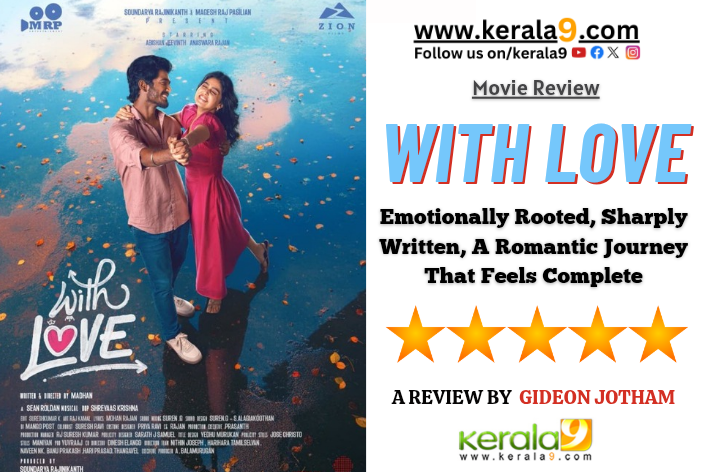
With Love Movie Review: Emotionally Rooted, Sharply Written, A Romantic Journey That Feels Complete
Film Name: With Love
Director: Madhan
Duration: 2hr 21mins
Language: Tamil
Genre: Romcom
A Review by Gideon Jotham
Positives:
1: Story
2: Screenplay
3: Performance of actors
4: Direction
5: Humour
6: Cinematography
7: Music and Background Score
8: Character arc
9: Sound design
10: Emotional connection
Negatives:
Prediectablity (doesn’t matters)
Story
The story begins with an arranged-marriage meeting. Sathya goes to meet Monisha in a normal, formal setting, expecting the usual questions and small talk. During their conversation, they realise something unexpected they were schoolmates. He was a senior, she was a junior.
As they talk more, they start sharing their school-time love stories. Both of them had innocent feelings for someone back then, but neither had the courage to express it. Those loves remained unsaid and unfinished. The conversations bring back a strong school-time vibe pure, simple, and emotional.
Monisha then suggests something unusual. Instead of directly deciding on marriage, she asks Sathya to travel with her. She wants to revisit those unsaid feelings, to understand whether what they felt was really love. They treat the journey like a date talking, travelling, remembering, and slowly opening up. The story follows this journey and shows where it finally leads them.
The story itself is not new. It follows a familiar romantic template. But what makes it work is the emotional honesty. Many people can relate to having an unfinished love from their past and wondering “what if”.
The film does not depend on dramatic twists or big conflicts. It depends entirely on conversations and emotional connection. If the characters feel real, the film works. If not, it becomes predictable.
The strength of the film is its simplicity and relatability. The weakness is that it takes a safe path. The ending matters a lot because the story is not about whether they get married, but about whether the journey truly changes them.
Overall, it is a gentle romantic film that connects through memory, missed chances, and emotional truth. It may not feel new, but it feels familiar and that is why it works.
Direction
The film is directed by Madhan, and his direction is the backbone of the film. The story itself follows a familiar romantic structure, but Madhan’s control over execution makes it engaging and emotionally effective.
One of the strongest aspects of the direction is pacing. The film moves at a calm, steady rhythm, but never feels slow. Madhan understands that this story depends on conversations and emotional discovery, so he allows scenes to breathe. He avoids rushing key moments and resists the temptation to add artificial drama. This balance keeps the audience invested without testing their patience.
Another major strength is character handling. Sathya and Monisha are carefully shaped characters, not just romantic leads. The director clearly defines where they start emotionally and where they end. Their changes happen through interaction, reflection, and silence not through loud confrontations. This gradual evolution makes their journey believable.
The character sketches are tight and consistent throughout the film. Each scene adds a layer either revealing a past wound, a hesitation, or a growing emotional clarity. There are no random scenes inserted just for mood or visuals. Everything serves character and narrative purpose.
Madhan’s direction also shows strong restraint. He avoids melodrama, avoids overuse of background score, and avoids spoon-feeding emotions. Instead, he trusts the actors and the screenplay to do the work. This restraint is what gives the film its grounded, realistic feel.
Most importantly, the direction stays focused. Even during the travel portions, the film never loses sight of its emotional core. The journey is not treated as sightseeing; it is treated as a space where emotional truths surface. This clarity of intent is what makes the screenplay and direction feel tightly bound together.
Overall, Madhan’s direction elevates a simple, familiar story into a deeply engaging experience. It may not aim to surprise the audience with novelty, but it succeeds by being honest, controlled, and emotionally precise.
Screenplay
The screenplay is the film’s strongest pillar. Even though the core idea is familiar, the writing keeps the narrative tight, focused, and emotionally engaging. There are no unnecessary subplots, no distractions, and no scenes that exist just to fill runtime.
The biggest strength of the screenplay is its scene construction. Most scenes are conversation-driven, but they never feel repetitive. Each dialogue exchange either:
- reveals something new about the past, or
- pushes the relationship slightly forward, or
- exposes an internal conflict within the characters.
Because of this, the film never feels stagnant even though it avoids dramatic twists.
The screenplay handles the arranged-marriage setup smartly. It starts formally and slowly shifts into personal territory without feeling abrupt. This transition is crucial, and the writing makes it believable. The rediscovery of their school connection is not treated as a dramatic reveal, but as a natural emotional trigger.
Another strong point is the way the screenplay treats unsaid love. Instead of romanticising it blindly, the writing allows doubt, awkwardness, and emotional hesitation. The journey becomes a narrative device where suppressed emotions surface organically. Travel is not used as a visual escape, but as emotional space.
The character arcs are clearly written. Sathya and Monisha don’t suddenly change; they evolve through conversation, silence, and shared memory. Their emotional progression feels earned because the screenplay respects time and emotional realism.
What the screenplay smartly avoids is melodrama. There are no forced conflicts, no dramatic misunderstandings, and no exaggerated emotional breakdowns. This restraint gives the film its grounded tone. However, this is also a risk because without strong performances, the screenplay would feel flat. The writing demands subtle acting and precise direction.
Overall, the screenplay succeeds because it knows its limits. It does not try to reinvent romance. Instead, it focuses on emotional truth, clean structure, and character-driven storytelling. The tight writing ensures that a simple story remains engaging till the end.
Performances
The performances play a major role in holding the film together, especially because the screenplay depends heavily on conversations and emotional subtlety.
Abishan Jeevinth makes his debut as a lead actor in this film, and his performance is both impressive and relatable. He does not try to “perform” in a loud or dramatic way. Instead, he keeps his acting natural and grounded. His expressions, body language, and silences feel honest, which makes the character easy to connect with. Many viewers can see parts of themselves in Sathya, and that is where Abishan succeeds the most. For a debut lead performance, he shows strong control and emotional maturity.
Anaswara Rajan once again proves why she is considered a natural performer. She carries her character with ease and confidence throughout the film. Her reactions feel spontaneous, her attitude feels real, and her emotional shifts are handled smoothly. She brings warmth and charm to Monisha without making the character feel artificial. Beyond performance, her screen presence adds life to the film she becomes the emotional anchor and the “cutie pie” factor without reducing the character to just that.
The chemistry between the two actors feels organic. Their interactions are comfortable and believable, which is essential for a film driven by dialogue and shared memories. Neither actor overpowers the other; instead, they complement each other well.
Music & Songs
The music and songs play a subtle but important role in the film. Instead of dominating the narrative, the music stays in the background and supports the emotions already present in the scenes. This restraint works well for a story that depends more on conversations and inner feelings than dramatic moments.
The songs are placed carefully and do not interrupt the flow of the film. They blend naturally into the narrative, often reflecting memory, nostalgia, and emotional hesitation rather than pushing the audience to feel something forcefully. This makes the listening experience pleasant and emotionally aligned with the story.
The background score is used with control. Silence is given importance, and the music enters only when required. This helps maintain the film’s realistic tone and avoids melodrama. Emotional scenes are allowed to stand on their own, with music acting as support rather than a crutch.
What works best is how the music complements the journey portions of the film. It enhances the mood of travel and reflection without turning the film into a montage-driven romance. The overall soundscape feels soft, familiar, and emotionally honest.
However, the music does not aim to be instantly catchy or chart-topping. Its strength lies in mood and emotional continuity rather than standalone impact. This may not appeal to audiences looking for loud or memorable commercial numbers, but it suits the film’s tone well.
Overall, the music and songs stay true to the film’s emotional core simple, restrained, and effective adding depth without taking attention away from the story or performances.
Cinematography & Editing
The cinematography supports the film’s emotional tone rather than trying to stand out on its own. The visuals are kept natural and grounded, matching the realistic nature of the story. There is no unnecessary stylisation or overuse of dramatic lighting. Instead, the camera stays close to the characters, allowing the audience to connect with their emotions.
Frames are composed to emphasise intimacy. Many shots rely on close-ups and medium shots, especially during conversations, which helps capture small expressions and silent reactions. This approach works well because the film depends heavily on subtle emotional shifts rather than big dramatic moments.
The travel portions are shot with simplicity. Locations are used to create mood, not spectacle. The visuals never feel like postcard shots; they feel lived-in and real. This keeps the focus on the characters instead of distracting the audience with visual excess.
Editing plays a crucial role in maintaining the film’s rhythm. The cuts are clean and invisible, allowing scenes to flow naturally. Conversations are not chopped aggressively, and pauses are retained where needed. This patience in editing strengthens the emotional impact and keeps the film immersive.
The editor understands the importance of timing. Scenes end at the right moment before they become repetitive and transitions between past recollections and present interactions feel smooth. There is no sense of drag, even though the film moves at a calm pace.
Together, the cinematography and editing work in harmony with the direction and screenplay. Neither tries to overpower the film. Their strength lies in restraint, clarity, and emotional consistency.
Final Verdict: 5/5
This film proves that a familiar story can still work when handled with clarity, restraint, and emotional honesty. It doesn’t rely on twists or high drama; instead, it trusts its direction, screenplay, and performances to carry the experience.
The biggest strength lies in its tight execution, well-paced scenes, clearly defined character arcs, natural performances, and controlled technical choices. Every department understands the film’s tone and stays within it. Nothing feels forced or excessive.
However, the film also plays it safe. Audiences looking for novelty, strong conflict, or dramatic highs may find it predictable. Its impact depends entirely on emotional connection rather than narrative surprise.
If you connect with the characters and the idea of unsaid love, the film works deeply. If not, it remains a well-made but modest romantic drama.
A Review by Gideon Jotham