

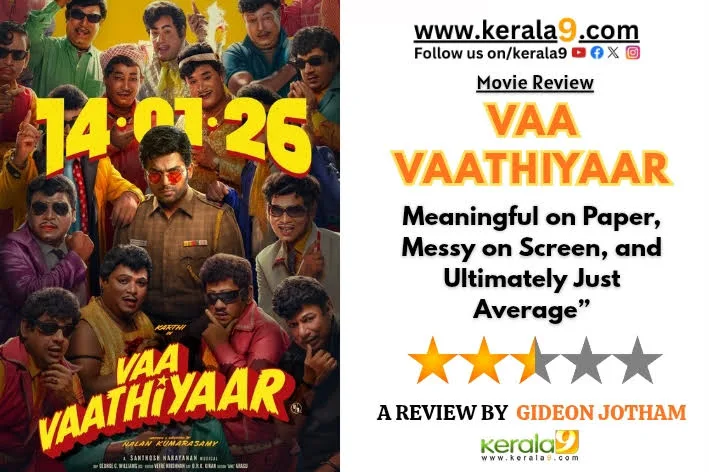
Vaa Vaathiyaar: A film that preaches loudly and listens to nothing, replacing complexity with convenient righteousness.
Film: Vaa Vaathiyaar
Director: Nalan Kumarasamy
Producer: Gnanavel Raja
Production Banner: Studio Green
Language: Tamil
Genre: Social Drama / Fantasy
Runtime: 2 hrs 10 mins
A review by Gideon Jotham
Positives
- Performance
- Music
- Intent
- Control
- Idealogy
- concept
- Psychological connection
Negatives
- Predictability
- Screenplay
- Convenience
- Direction
- Repetition
- Not everyone’s cup of tea
Story
Vaa Vaathiyaar is built on a high-concept idea rooted in nostalgia, hero worship, and moral inheritance. The story begins with a symbolic coincidence: a die-hard MGR devotee witnesses his idol’s death on screen at the exact moment his grandson is born. From that day, the child is raised as a moral extension of MGR’s ideology honesty, discipline, and social justice.
As the boy grows into adulthood, reality intervenes. He becomes morally inconsistent, opportunistic, and far removed from the ideals imposed on him. A series of circumstances then push him toward confrontation with injustice, triggering a transformation where he begins to embody the values his grandfather worshipped not just ideologically, but almost mythically.
On the surface, this premise feels ambitious. In practice, the story rarely moves beyond a familiar saviour narrativethat Tamil cinema has repeatedly explored. The ideological arc is predictable: corruption exists, the hero rises, the system resists briefly, and righteousness eventually prevails. There are no major deviations, reversals, or narrative risks.
The film introduces a fantasy element where the protagonist oscillates between his real self and an idealised persona inspired by MGR. While this could have opened space for psychological depth and internal conflict, the story treats it more as a theatrical device than a character-driven necessity. The transitions lack clear rules or emotional grounding, making them feel convenient rather than compelling.
What prevents the story from collapsing entirely is Karthi’s performance, which injects sincerity and emotional continuity into an otherwise mechanical structure. His ability to navigate contrasting shades gives the illusion of character complexity, even when the writing doesn’t fully support it.
Logical issues remain persistent. Power structures weaken too easily, resistance lacks credibility, and moral victories are achieved through rhetoric rather than consequence. The story repeatedly chooses emotional satisfaction over believable progression, undercutting realism for applause-ready moments.
Most critically, the story never questions its own ideology. The protagonist is rarely wrong, never truly challenged, and never forced to pay a price for his choices. This absence of moral ambiguity drains the narrative of dramatic tension and reduces it to affirmation rather than exploration.
Direction
Directed by Nalan Kumarasamy, Vaa Vaathiyaar marks a return after a long gap, carrying the baggage of expectations set by Soodhu Kavvum and Kadhalum Kadandhu Pogum. While traces of his signature wit and rhythmic staging remain, the film exposes a director torn between personal style and commercial obligation.
Nalan’s biggest achievement here is control. The film never feels amateurish or chaotic. Scenes are staged with clarity, performances are kept within tonal limits, and the narrative moves with surface confidence. This technical steadiness gives the illusion of strong direction.
But illusion is the key word.
Where earlier Nalan films thrived on irony, understatement, and character-driven humor, Vaa Vaathiyaar leans heavily into statement-making cinema. The direction prioritizes “moment creation” over storytelling scenes are designed to land applause rather than advance emotional or ideological complexity.
The fantasy transitions, especially when the protagonist shifts personas, reveal this weakness clearly. Instead of feeling psychologically motivated, these moments often come across as cinematic tricks visually loud but thematically thin. The director asks the audience to accept the fantasy without fully grounding it in internal logic, resulting in sequences that feel more like staged spectacles than narrative necessities.
Another major flaw lies in conflict staging. Authority figures and antagonists are framed in deliberately simplistic ways, making confrontations feel pre-decided. The camera often sides too obviously with the protagonist, removing tension instead of building it. Direction here does not allow space for uncertainty and without uncertainty, drama suffocates.
Nalan’s trademark dark humor does appear sporadically, but it feels restrained, almost cautious. It’s as if the film is afraid to fully commit to either satire or seriousness. This tonal hesitation weakens the director’s voice, making the film feel less like a Nalan Kumarasamy work and more like a well-packaged commercial product supervised by him.
Ironically, the director’s greatest limitation is his respect for the hero image. Instead of challenging it, he protects it. Instead of questioning legacy and hero worship, he reinforces it. That choice may satisfy fans, but it undercuts the intellectual sharpness Nalan is known for.
Screenplay
The screenplay of Vaa Vaathiyaar is built on a promising idea but collapses under its own convenience. While the premise allows room for psychological conflict, satire, and moral ambiguity, the writing repeatedly chooses ease over exploration.
The first half establishes characters and ideology efficiently, but not organically. Scenes feel designed to introduce points rather than develop situations. Character motivations are often explained through dialogue instead of being revealed through behavior, making the narrative feel instructed rather than discovered.
One of the screenplay’s major weaknesses is predictable progression. Every turn feels anticipated:
- Conflicts arise on cue
- Resolutions arrive through speeches
- Opposition dissolves without real consequence
This lack of narrative resistance drains tension. The story doesn’t push back against the protagonist it clears a path for him.
The fantasy element, which should have been the screenplay’s strongest asset, is inconsistently handled. The transitions between personas are visually striking but dramatically underwritten. There is no clear internal rule governing these shifts, making them feel like narrative tools rather than psychological necessities. Instead of deepening character conflict, fantasy becomes a shortcut to elevate hero moments.
The second half suffers the most. Rather than tightening conflict, the screenplay begins to repeat itself similar confrontations, similar emotional beats, similar outcomes. Escalation is replaced with accumulation. As a result, the climax feels inevitable, not earned.
Perhaps the screenplay’s most damaging flaw is its refusal to question the hero. The protagonist is rarely wrong, never morally conflicted for long, and always vindicated. This removes dramatic ambiguity and flattens character depth. In a film that pretends to be socially conscious, this is a serious limitation.
Karthi’s performance compensates for many of these weaknesses, masking thin writing with conviction. But performance can only carry a screenplay so far. Strip away the actor’s charisma, and the script’s mechanical nature becomes impossible to ignore.
Music & Background Score
Composed by Santhosh Narayanan, the music of Vaa Vaathiyaar stands out as one of the film’s most effective technical elements and occasionally, its emotional crutch.
Santhosh Narayanan understands the film’s ideological weight and fantasy tone, and his score reflects that awareness. From the opening stretch itself, the background score establishes a mood that oscillates between nostalgia, irony, and restrained heroism. Unlike generic “mass” scoring, the music here carries texture and intent.
The songs are sparingly placed and largely avoid disrupting the narrative flow. Instead of functioning as commercial interruptions, they attempt to extend mood and character emotion. While none of the tracks are instantly iconic, they work within the film’s emotional ecosystem, reinforcing themes rather than overpowering them.
The background score is where Santhosh truly lifts the film. He uses rhythm and tonal variation to differentiate between the protagonist’s internal conflict and his larger-than-life persona. In several sequences, the score adds depth that the screenplay fails to provide, injecting tension and emotional urgency into otherwise predictable scenes.
However, this strength also exposes a weakness.
The music often does the heavy lifting the writing avoids. Emotional peaks feel impactful not because the scene earns them, but because the score insists on importance. In moments where silence or restraint could have added realism, the background music steps in to manufacture intensity.
There is also a slight overdependence on familiar Santhosh Narayanan patterns experimental beats, ironic undertones, and swelling crescendos. While effective, they don’t always feel specifically designed for this film, occasionally reminding us of his earlier works rather than creating a distinct sonic identity for Vaa Vaathiyaar
Performances
Karthi
Karthi is undeniably the backbone of Vaa Vaathiyaar and the film’s single most important asset. Playing dual shades the flawed, grounded Rameswaram and the idealised, almost mythic Ramachandran, he navigates tonal shifts with remarkable ease. What makes his performance stand out is not exaggeration, but control.
In scenes that could have easily slipped into caricature, Karthi opts for restraint. His transitions between realism and fantasy are smooth enough to maintain audience engagement, even when the screenplay doesn’t fully justify them. The confidence with which he switches personas recalls the ambition of classic dual-role performances, though here it is performance not writing that creates clarity.
That said, his portrayal of the MGR-inspired persona occasionally borders on artificiality. Certain mannerisms feel imposed rather than internalised. Still, Karthi’s natural screen presence and emotional intelligence prevent these moments from completely breaking immersion. Without him, this film simply would not function.
Rajkiran
Rajkiran plays the emotionally symbolic role of the grandfather a die-hard MGR loyalist whose belief system shapes the protagonist’s life. His performance is sincere and rooted, lending credibility to an otherwise ideologically loaded character.
However, the writing limits him. Once his ideological position is firmly established, the character is given little room to evolve. Rajkiran compensates with body language and emotional subtlety, but the role remains more symbolic than dramatic. He represents belief, not conflict and that limits his impact.
Sathyaraj
As the antagonist, Sathyaraj feels underutilised. His presence brings immediate authority, but the character lacks menace and depth. The villainy is written too simplistically, giving Sathyaraj little opportunity to explore nuance or psychological threat.
Even his physical presentation feels oddly restrained, almost sanitized. For an actor known for commanding antagonistic roles, this part feels like a mismatch more functional than formidable. It’s not a failure of performance, but a failure of conception.
Krithi Shetty
Krithi Shetty, making her Tamil debut, is given a role that barely scratches the surface of her potential. Her character exists primarily as emotional support and visual presence rather than a fully realised individual.
She performs competently within these limits, but the writing offers no real scope for expressive range. Even moments that hint at emotional depth are quickly abandoned. This is less a critique of her performance and more an indictment of how poorly written female characters are in the film.
Supporting Cast
Actors like Karunakaran and others deliver serviceable performances, mostly confined to functional roles exposition, reaction, or light comic relief. None are allowed to leave a lasting impression, largely because the screenplay doesn’t demand more from them.
Final Verdict
Vaa Vaathiyaar is a film driven more by conviction than complexity. It carries an ideologically charged premise, an experienced director, and a powerful lead performance yet never fully commits to exploring the uncomfortable questions it raises.
What works in the film works largely because of Karthi. His controlled, dual-shaded performance gives emotional continuity to a narrative that is otherwise predictable and structurally safe. Santhosh Narayanan’s music further elevates the mood, often compensating for weaknesses in writing and logical progression. The technical polish and confident staging ensure that the film remains watchable throughout.
However, the film repeatedly chooses comfort over challenge. The story relies heavily on familiar saviour tropes, the screenplay avoids moral ambiguity, and the direction protects the hero image instead of interrogating it. Conflicts resolve too easily, systems collapse too conveniently, and ideological victories feel pre-decided rather than earned.
The fantasy element, which could have deepened psychological tension, remains underexplored and inconsistently grounded. Supporting characters are underwritten, antagonistic forces lack credibility, and emotional peaks are often manufactured through music rather than narrative buildup.
In the end, Vaa Vaathiyaar is not a bad film but it is a safe one. It reassures instead of unsettling, affirms instead of questioning, and entertains without leaving a lasting intellectual or emotional aftertaste.
A film that wants to inspire, but never risks discomfort.
A film that believes sincerity is enough, even when depth is missing.
Rating: 2.5 / 5
A Review by Gideon Jotham