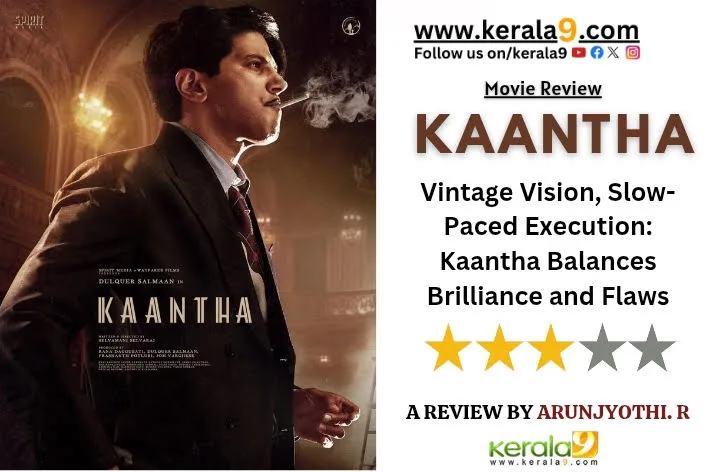
Kaantha Review: ONE WORD Vintage Vision, Slow-Paced Execution: Kaantha Balances Brilliance and Flaws
A Review by Arunjyothi R
LANGUAGE: TAMIL
DURATION: 163 Minutes
DIRECTOR: SELVAMANI SELVARAJ
GENRE: Period Drama Thriller
•POSITIVES:
1: Direction
2: Dulquer Salmaan
3: Performance of actors
4: Cinematography
5: Art Direction
6: Music and Background Score
•NEGATIVES:
1: Storyline
2: Screenplay could have been better
3: Slow paced
4: Duration of the film
STORY:
Set in the evocative black-and-white era of the 1950s, the film traces the rise of MK Mahadevan (Dulquer Salmaan), an actor moulded into stardom by the celebrated filmmaker Ayya (Samuthirakani). What begins as a relationship built on trust and artistic ambition slowly turns into a power struggle. Ayya, who believes he crafted Mahadevan’s entire career, expects lifelong obedience, while Mahadevan, now confident in his own star value, begins to break free. This widening rift eventually derails their passion project, Santha, leaving it abandoned halfway.
Years later, a determined producer succeeds in bringing the two estranged talents back together to revive the unfinished film. Into this tense reunion steps Kumari (Bhagyasree), a new actress chosen as the leading lady. Her presence gently stirs the emotional landscape: Mahadevan, despite his commitments at home, finds himself drawn towards her charm, while she shares a close, almost protective bond with Ayya. The delicate triangle ignites old egos, new insecurities, and unresolved wounds, creating an atmosphere thick with friction on the sets.
As filming progresses, the simmering tensions erupt into devastating consequences, altering the destiny of everyone involved. The story then unravels the mystery behind the unexpected incident that shakes the production, questioning whether Santha will ever reach completion. It also explores how Mahadevan confronts his own conflicted emotions, his loyalty toward the man who launched him, and the price he pays for blurring the line between personal longing and professional duty.
REVIEW & ANALYSIS OF THE FILM:
Kaantha opens with remarkable ambition, immersing the viewer in the monochrome world of early Indian cinema with stunning visual precision. The film meticulously recreates the charm of the 1950s, pulling us into a filmmaking culture built on raw passion, towering egos, and unspoken hierarchies. Yet, for all its stylistic finesse, the film struggles to sustain momentum over its lengthy runtime. A movie can look like a visual treasure, but without emotional grip, the experience becomes distant—and this is where Kaantha begins to wobble.
The early portions move at an unhurried pace, taking their time to establish the mentor-protégé spark between Mahadevan and Ayya. While the detailing is admirable, the narrative unfolds with such leisure that the first hour feels stretched beyond necessity. The interval payoff undoubtedly shakes things up, promising a rejuvenated second half. But soon after, the narrative veers into whodunit territory, and the transition feels oddly misplaced. What begins as a layered artistic drama suddenly shifts gears into a crime-driven track, and this genre switch does not blend as seamlessly as intended.
The biggest hurdle is the uneven execution. Once the murder angle takes centre stage, the screenplay begins circling around familiar beats. Scenes featuring the investigation—though boosted by Rana Daggubati’s confident presence—lack the urgency and intrigue expected from a strong mystery. Instead of elevating the drama, these portions dilute the immersive tone the film had carefully established in the beginning. The nearly three-hour duration amplifies these shortcomings, making the viewer more conscious of the film’s pacing issues.
Debut filmmaker Selvamani Selvaraj deserves credit for attempting something creatively daring rather than opting for a safe, formulaic debut. Recreating a bygone era and exploring the psyche of artists from that time is an uphill challenge. He certainly displays command over composition, character moments, and atmosphere. However, his storytelling falters when the script demands tighter coherence. The second half feels weighed down by repetitive emotional exchanges and prolonged setup, causing the overall engagement to wane.
Some narrative threads—especially those tied to the central crime and the emotional stakes around it—feel underdeveloped. The film builds anticipation for big revelations, but when they arrive, they don’t quite land with the desired impact. Rana’s role, though fiery, feels somewhat detached from the vintage tone, creating an unintended tonal imbalance. Still, the final act redeems parts of the screenplay with a neatly staged closure that reconnects the dots and offers a satisfying emotional release, even if it could have benefited from sharper writing.
Where Kaantha truly shines is in its performances. Dulquer Salmaan delivers a deeply textured depiction of Mahadevan, capturing the man’s brilliance, flaws, and internal chaos with striking authenticity. Bhagyashree Borse is captivating as Kumari, portraying innocence layered with emotional maturity. Samuthirakani brings gravitas as the seasoned filmmaker battling time, ego, and irrelevance. Rana Daggubati’s flamboyant cop injects unpredictability into the narrative, even if the script doesn’t fully support the character’s arc.
On the technical front, Kaantha is breathtaking. Dani Sanchez-Lopez’s cinematography is a visual triumph—each frame is crafted with devotion, transporting the audience into a period seldom explored in Indian cinema. Jakes Bejoy’s background score elevates the mood, blending nostalgia with tension. The production design, soundscape, and costume choices all contribute to a world so authentic that you forget you’re watching a film crafted in the present day. Kaantha could have trimmed several indulgent stretches, especially in the first half, to keep the narrative tighter and more engaging. A few repetitive emotional beats and the prolonged investigation portions could have been trimmed to maintain the film’s momentum. The overall duration feels unnecessarily long, with several portions dragging and making the film feel noticeably stretched. The pacing dips often, and the extended runtime introduces a sense of lag that slows down an otherwise promising narrative.
CONCLUSION:
Overall, Kaantha emerges as a film brimming with artistic intent, technical finesse, and standout performances, especially from Dulquer Salmaan, but it struggles to maintain a consistent emotional grip due to its overstretched runtime and wavering narrative focus. The film’s rich period detailing and visual craftsmanship deserve applause, yet the lagging pace and uneven second half prevent it from fully realising its potential. Would I recommend it? Yes—but only for viewers who appreciate slow-burn dramas, vintage aesthetics, and character-driven storytelling. For the regular audience expecting a tight, gripping narrative, Kaantha may feel too drawn-out and inconsistent. It’s a film worth watching for its craft and ambition, but best approached with measured expectations.
RATING: 3/5
A Review by Arunjyothi. R