
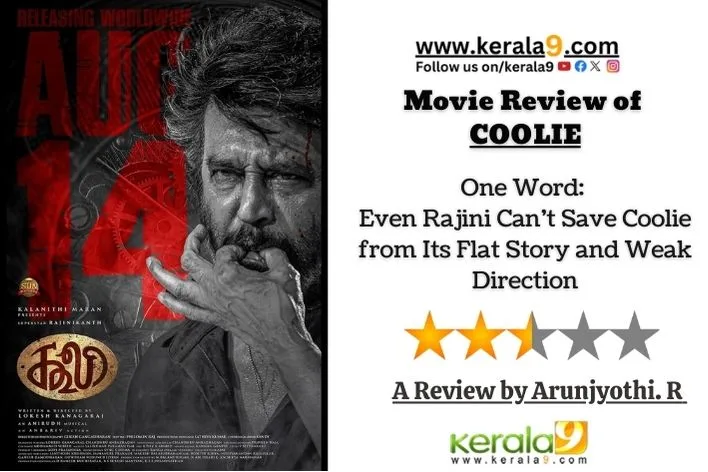
Coolie Review: Even Rajini Can’t Save Coolie from Its Flat Story and Weak Direction
ONE WORD: Even Rajini Can’t Save Coolie from Its Flat Story and Weak Direction
A Review by Arunjyothi R
LANGUAGE: Tamil
DURATION: 02 Hours 49 Minutes
DIRECTOR: Jokes Kanagaraj
GENRE: Action Thriller
•POSITIVES:
1: Making Quality
2: Screen Presence of Rajinikanth
3: Negative Shade Performance of Nagarjuna and Soubin
4: Performance of Sruthi Hassan
5: Music and Background Score
6: Cinematography
7: Production Design
•NEGATIVES:
1: Average Direction
2: Predictable Storyline
3: Clumsy screenplay
4: Action Sequences
5: Editing and Duration of the film
6: Second Half
7: Cameo Appearances Lacked Impact
8: Less High Moments
STORY:
In Coolie, Rajinikanth steps into the role of Deva, a charismatic figure who runs a sprawling mansion in Chennai. His world takes a dark turn when his closest friend, Dr. Rajasekharan (Satyaraj), is brutally murdered. Determined to uncover the truth, Deva’s journey leads him to the coastal city of Vishakhapatnam — a territory ruled by the ruthless Simon (Nagarjuna), a kingpin in the high-stakes smuggling trade. Joined by Rajasekharan’s courageous daughter Preethi (Shruti Haasan), Deva embarks on a dangerous mission to untangle the web of betrayal and vengeance lurking behind his friend’s death.
REVIEW & ANALYSIS OF THE FILM:
WHAT ARE THE POSITIVES:
1: From a purely technical standpoint, Coolie boasts high production values that are hard to ignore. The sets are lavish, the costumes are detailed, and the overall visual treatment gives the film a grand cinematic appeal. Every frame feels crafted with intent, reflecting the budget and the resources that went into making it. Even when the narrative falters, the making quality maintains a level of polish that holds the audience’s attention.
2: Rajinikanth’s charisma remains the film’s strongest magnetic pull. His mere presence lights up the screen, and even in weaker narrative moments, his energy, style, and effortless swag inject life into the proceedings. Whether delivering punch dialogues or simply walking into a frame, he commands the audience’s focus — a reminder of why he continues to be a larger-than-life figure in Indian cinema.
3: Nagarjuna’s menacing charm and Soubin’s unpredictable villainy add a compelling edge to the film’s conflict. Nagarjuna’s calm yet calculating portrayal stands in contrast to Soubin’s more erratic and layered performance, making their characters engaging to watch. Both actors clearly enjoyed exploring their darker sides, and that enthusiasm translates on screen.
4: Shruti Haasan delivers a performance that balances glamor with grit. She brings a certain spark to her role, offering moments of emotional depth while also holding her own in high-energy sequences. Her presence provides a refreshing break from the heavier male-dominated confrontations, and she makes the most of the screen time given.
5: Anirudh Ravichander’s music and background score are among Coolie’s undeniable highlights. The songs carry his trademark infectious energy, while the score effectively heightens key moments. Even when the screenplay struggles, Anirudh’s compositions work overtime to keep the audience engaged — though sadly, the impact is often undercut by the film’s uneven storytelling.
6: The camera work is consistently impressive, with dynamic angles and smooth movements that enhance both action and dramatic scenes. The vibrant color palettes, crisp framing, and clever use of lighting add to the film’s visual appeal, making it a treat for those who appreciate high-quality cinematography.
7: The attention to detail in the production design is commendable. From elaborate set pieces to the authenticity of props and backgrounds, the film succeeds in creating immersive spaces that suit its larger-than-life tone. The world of Coolie feels rich and layered, even if the story unfolding within it doesn’t always do justice to the backdrop.
WHAT DIDN’T WORK OUT:
1: In Lokesh Kanagaraj’s earlier works like Maanagaram, Kaithi, Vikram, and Leo, we saw a refreshing twist on commercial cinema — crafted from a different angle, packed with thrilling elements, and powered by his sharp writing and unmistakable flair for stylish filmmaking. So, when he teamed up with Superstar Rajinikanth, expectations naturally shot through the roof. Sadly, Coolie fails to recreate that signature Lokesh magic, and the cracks begin with Lokesh himself — the writing feels flat, and even the direction never quite rises to his usual standards.
2: The first major setback is the clumsy writing — both the story and the screenplay fail to leave any real impact. The plot is painfully predictable, devoid of high points or genuinely thrilling moments. You can see what’s coming from miles away, and this thin layer of a storyline is stretched far too long, without ever building an emotional connection between characters. The friendship angle between Deva and Rajasekar was meant to be the emotional backbone of the film, but it falls flat — there’s neither warmth nor attachment. Instead, it’s reduced to a few melodramatic dialogues. A long scene where Rajinikanth narrates their friendship is visually pleasing, but it still fails to evoke any genuine emotional bond.
3: Another big letdown is the absence of truly high moments. Yes, there are a few scattered here and there, but nowhere near enough to leave you with a fully satisfying cinematic experience. One of Lokesh Kanagaraj’s trademarks has always been his explosive interval blocks — scenes that leave you on the edge of your seat, eagerly waiting for the second half. After hearing his confident statements in interviews, I genuinely expected a powerful, goosebump-inducing bang at the halfway mark. Sadly, what we get is an “okay-ish” scene — not outright bad, but nowhere close to the adrenaline rush we associate with him. Even the twists and turns sprinkled throughout the film lack bite; they neither shock you nor make you whisper a wow. The core issue circles back to the writing — without strong, well-constructed moments, the film struggles to create the kind of highs that once defined Lokesh’s cinema.
4: The screenplay feels undercooked, with the second half in particular falling apart. Rather than delivering something fresh, it comes across as a mash-up of Lokesh’s past hits and Rajinikanth’s familiar cinematic beats — a pinch of Vikram, fragments of Kaithi and Leo, and traces of Jailer, all blended together into what’s ultimately packaged as Coolie. The character arcs lack consistency, especially when it comes to the hero–villain dynamic. Both the interval and climax confrontations are disappointingly routine, offering nothing beyond the usual hero–villain formula, and they wrap up in uninspired, messy fights. Soubin’s character, which had potential, is reduced to mediocrity — his twists feel forced, logical flaws are everywhere, and the reasoning for his descent into villainy is barely convincing, robbing the film of a stronger antagonist.
5: Coolie may have the gloss of solid production values, but Lokesh Kanagaraj’s direction feels unusually lifeless. In the past, he had an instinct for blending mass appeal with memorable moments, crafting scenes that thrilled and entertained audiences across the board. This time, that magic is absent. The film ends up as the weakest entry in his career, missing the spark and passion that once defined his filmmaking. The narrative moves on a flat line, never building momentum or delivering the electrifying highs we expect from him. The writing doesn’t help either — it’s predictable and thin, with a plot far too lightweight to support the grand ambition of a pan-Indian spectacle. What remains is a film that looks polished on the outside but struggles to leave any lasting impact.
6: The action sequences were underwhelming and, at times, hard to digest. For a star like Rajinikanth, the choreography could have been far better and more impactful. Instead, most fights looked weak, lacked punch, and failed to deliver the intended thrill. The mansion fight in the second half was a total letdown — it carried an important emotional scene, yet the flat execution of the action drained away the emotional impact as well. The first-half fight inside the ladies’ hostel was comparatively better, but still nothing remarkable. The climax face-off between Rajinikanth and Nagarjuna was also below expectations, missing the intensity and satisfaction such a moment demands. Overall, the action lacked creativity, the energy felt low, and the thrills that should have defined these sequences were nowhere to be found.
7: The cameo appearances were completely wasted. Aamir Khan and Upendra appear on screen, but their presence adds nothing to the film. Both characters feel forcefully inserted just to give the movie a pan-Indian, large-scale flavour, and unfortunately, that attempt falls flat. Aamir Khan is introduced as a dangerous gangster, but the way his character is portrayed makes him look amateurish, and the flashbacks tied to him — along with his present-day scenes — end up unintentionally laughable. Upendra at least gets to showcase a bit of action, but even then, there’s no lasting impact. Honestly, even if these two characters were completely removed, the film or its storyline wouldn’t change in the slightest — making them feel like nothing more than a forced marketing addition.
8: Coolie suffers from an overstretched runtime that tests patience, especially in the second half. Several scenes feel unnecessarily prolonged, with repetitive sequences diluting the impact of key moments. A sharper approach from the editor could have easily trimmed out the excess and tightened the narrative flow. By the time the film heads towards its climax, the pacing has already drained much of the excitement. The ending, instead of delivering a tight and impactful finish, drags on with forced drama and predictable turns, leaving the audience more relieved than satisfied when the credits finally roll.
PERFORMANCE OF ACTORS:
If Coolie holds itself together at all, it’s purely because of Rajinikanth’s towering screen presence. His vintage style, old-school swag, and effortless attitude still have the power to light up the screen — but charisma alone can’t save a poorly written role. Deva could have been another iconic Rajini character, yet the flat writing and uninspired direction drain him of memorability. The action scenes are a mixed bag: a few land well, but others are so over-the-top they’re almost laughable, especially with the exaggerated set pieces. Emotional beats work better, particularly the tender moments with Shruti Haasan, but they’re too few to lift the character. Truth be told, this is one of Rajinikanth’s weakest roles in recent years, and a star of his stature deserved far more than what he was given. On the villain side, Nagarjuna brings effortless presence, while Soubin Shahir turns in a neat performance despite his thinly written role, keeping the menace alive till the end. Shruti Haasan is the real surprise package here — delivering one of her finest performances with spot-on emotions and razor-sharp dialogue delivery. Sathyaraj does his job in the background, but without much to talk about, while Upendra and Aamir Khan’s much-talked-about cameos add nothing but names to the pan Indian marketing gimmicks.
MUSIC AND BACKGROUND SCORE:
Anirudh Ravichander’s soundtrack for Coolie roars with unbridled energy, packing his signature mix of mass-appeal hooks and slick, contemporary arrangements. “Monica” stands tall as the album’s crown jewel—its irresistibly catchy refrain and Pooja Hegde’s dazzling screen presence sparked a viral frenzy even before the film hit theatres, with dance covers flooding social media. Numbers like “Chikitu” and “Powerhouse” double down on the high-voltage vibe, delivering thumping beats and playful rhythms.
The music and background score by Anirudh Ravichander are among Coolie’s stronger aspects. His energetic tracks and pulsating score bring life to several moments, and in places, his work single-handedly keeps the film from losing all steam. The mass numbers carry his trademark flair, while the emotional cues — especially in Rajinikanth and Shruti Haasan’s scenes — hit the right notes. However, the weak direction and flat storytelling leave his efforts underutilized. You can sense Anirudh pushing hard to keep the audience engaged, but when the writing offers little to work with, even the best music can only do so much. In the end, his contribution stands out, but it’s a case of great music trapped inside a mediocre film.
CONCLUSION:
Lokesh Kanagaraj’s Coolie had all the hype in the world, but it sadly doesn’t live up to the buzz. While Rajinikanth still lights up the screen with his style and presence, and Anirudh’s songs and background score bring some energy, the movie struggles to keep you hooked. The much-talked-about cameo is exciting at the moment but doesn’t add much to the story, feeling more like fan service than a game-changer. Despite aiming for a grand pan-Indian appeal, the film lacks the depth and emotional grip to truly connect across audiences. The story feels weak, the emotional moments don’t land, and the action scenes, though stylish, start to feel repetitive. In the end, Coolie is a glossy spectacle that flashes star power and style but fails to deliver the thrilling, memorable experience Lokesh Kanagaraj’s fans have come to expect.
VERDICT: Big Hype but little impact, disappointed.
RATING: 2.5/5
A Review by Arunjyothi. R