
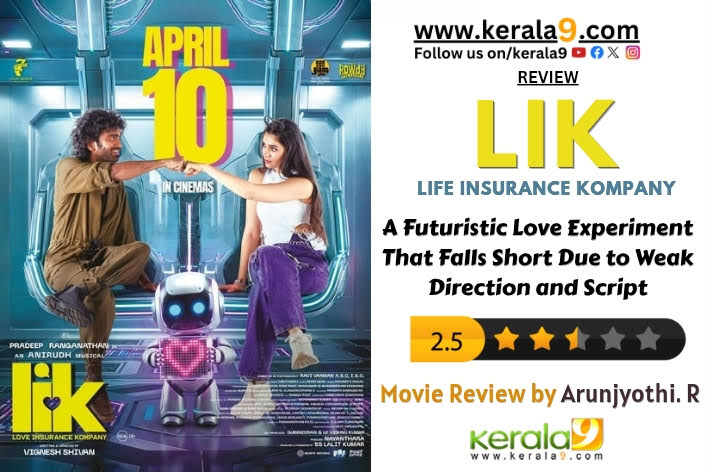
LIK: Love Insurance Kompany
ONE WORD: A Futuristic Love Experiment That Falls Short Due to Weak Direction and Script
LANGUAGE: TAMIL
DURATION: 02 Hours 36 Minutes
GENRE: Sci-fi Romantic Comedy Drama
A Review by Arunjyothi.R
•POSITIVES:
1: Concept
2: Music and Background Score
3: Visual and Production Quality
4: Cinematography
5: Editing
6: VFX
•NEGATIVES:
1: Fully Predictable
2: Weak Screenplay
3: Average Direction
4: Poor Emotional Connection
5: Flat Comedies
6: Failed Love Track
7: Underwhelming performance of actors
STORY:
Set in the year 2040, the story follows Surya (SJ Suryah), a visionary entrepreneur who introduces LIK (Love Insurance Kompany) a futuristic platform powered by an app that evaluates relationships and claims to identify what qualifies as “real love.”
Dheema (Krithi Shetty) lives in a hyper-digital space, completely dependent on her phone and the LIK app for emotional decisions. In contrast, Vasu (Pradeep Ranganathan) comes from an organic world, untouched by technology, where mobile phones and social media have no place.
Their lives intersect when Vasu falls in love with Dheema at first sight. What begins as a pure and instinctive connection soon gets entangled in the influence of technology. Just as their relationship starts to take shape, it abruptly collapses when Dheema walks away, guided by Vasu’s low “love score” on the app.
Refusing to accept defeat, Vasu challenges himself to make her fall for him again within 30 days. His journey evolves into more than just winning her back, it becomes a heartfelt attempt to prove that love isn’t something that can be measured by algorithms, but something that grows naturally through genuine emotion.
INTRODUCTION:
Directed by Vignesh Shivan, the film unfolds in the year 2040, a futuristic setting where technology has deeply entered even the emotional side of human life, reducing relationships into data-driven outcomes. At the core of this world is Love Insurance Kompany (LIK), an app that evaluates love by assigning a “love score” based on behavior, compatibility, and emotional patterns, making people rely more on algorithms than their own feelings. Blending science fiction with a romantic narrative, the film is built on a fresh and promising concept where the idea itself becomes the driving force. With such a unique premise, does the film manage to stay engaging and truly do justice to its idea? Unfortunately, despite the potential, the execution and writing turn out to be disappointing.
REVIEW & ANALYSIS OF THE FILM:
Positives:
1: Interesting Concept
Set in the year 2040, the film presents a futuristic world where smartphones and advanced technology have become an integral part of human life, influencing not just daily routines but even emotional decisions. In this highly digitized environment, relationships are no longer purely organic; they are observed, analyzed, and validated through intelligent systems. At the center of this idea is Love Insurance Kompany (LIK), an app that calculates a “love score” by studying behavior, compatibility, and emotional patterns—attempting to measure something as pure and unpredictable as love through data and logic. This unique blend of a romantic narrative with a sci-fi backdrop feels fresh and intriguing, instantly creating curiosity about how such a world would function. It reflects a bold and imaginative creative vision from Vignesh Shivan, bringing in a concept that stands out for its originality and strong potential.
2: Rich Production and Grand Visuals
The film presents a visually rich and grand portrayal of a futuristic 2040, where every frame reflects a world shaped by advanced technology and modern lifestyle aesthetics. The use of bright, vibrant colors and sleek, well-designed spaces gives the film a polished and premium look, making the future feel both appealing and immersive. The environments are crafted in a way that blends luxury with digital sophistication, creating a setting that feels aspirational yet believable within its sci-fi tone. What stands out is how the sci-fi backdrop is seamlessly integrated into everyday life within the film’s world. From the presence of smart systems to the overall digital atmosphere, the future setting doesn’t feel forced but naturally becomes a part of the characters’ surroundings. The production quality consistently supports this vision, maintaining a sense of scale and richness throughout. This strong visual detailing and thoughtful presentation of a tech-driven future enhance the film’s overall appeal, making the world-building feel engaging and visually captivating.
3: Music as the Saving Grace
With Anirudh Ravichander at the helm, the film’s music emerges as a consistent emotional anchor, carrying a soothing and immersive vibe throughout. The songs flow with a light, breezy charm, making them instantly appealing while still holding on to a certain emotional depth. There’s a clear effort to blend romance with a modern, slightly futuristic tone, and it reflects in the way each track feels purposeful and well-placed, adding to the mood rather than interrupting it. Anirudh’s familiar style—melodic, catchy, and emotionally tuned, gives the film a steady rhythm that keeps the experience pleasant.
The background score works in a more understated manner, gently supporting scenes and maintaining a smooth emotional continuity. It never overpowers, yet it quietly lifts moments, making transitions feel more connected. Dheema Dheema stands out with its soft, dreamy texture, creating a calming theatre experience that lingers with a sense of nostalgia and warmth. Enakena, despite being an older track, blends seamlessly into the film, and hearing it on the big screen adds a deeper emotional resonance, bringing out its pain and intensity at just the right moment. Pattuma adds a fresh layer to the album, and Anirudh’s vocals give it an extra edge, making it more engaging and enjoyable.
In many moments, it is the music that quietly carries the film forward, especially when the engagement dips. Anirudh Ravichander’s compositions maintain a steady emotional flow, filling the spaces with mood, feel, and atmosphere that help the film stay afloat. The songs and background score together create a comforting presence, softening the impact of the less engaging stretches and making the overall experience easier to sit through. At several points, the music almost feels like the saving grace of the film, stepping in to lift scenes that otherwise struggle to hold attention. It adds warmth, emotion, and a certain charm that briefly reconnects the audience to the intended mood. While the film itself may not consistently stay engaging, Anirudh’s work ensures that it doesn’t completely lose its emotional touch, and that remains one of its most noticeable strengths.
4: Quality Technical Aspects
The cinematography, editing, and VFX collectively contribute to shaping the film’s visual appeal, especially in presenting its futuristic 2040 setting. The visuals by Ravi Varman capture a vibrant, stylized world where technology blends seamlessly into everyday life, creating a colorful and modern atmosphere that suits the sci-fi romantic backdrop. Each frame helps establish the digital lifestyle of this world, making the setting feel visually engaging and consistently aligned with the film’s theme. The editing by Pradeep E Ragav maintains a fairly smooth flow, ensuring that scenes transition without confusion and the narrative remains visually easy to follow. It supports the film’s structure by keeping the pace steady and the emotional beats connected, even during uneven moments. The VFX stands out for being pleasing and well-suited to the setting, with good quality work that enhances the futuristic world without drawing unnecessary attention to itself. The digital elements feel naturally integrated, and importantly, there is no sense of over-exaggeration or artificial overload. Instead, the effects remain balanced and believable, adding to the overall visual comfort of the film. Together, these three aspects help the film maintain its visual consistency and prevent it from completely losing its grip in less engaging stretches.
Negatives:
1: Direction That Fails to Capitalize on Its Concept
Director Vignesh Shivan presents a concept with clear ambition, set in a technologically advanced future where human relationships are monitored, measured, and influenced by digital systems. While the premise opens up space for satire, emotion, and commentary on modern love, the execution struggles to bring these layers together in a convincing manner. The film frequently feels like it has an interesting idea at its core but fails to fully develop it into a cohesive cinematic experience. Instead of exploring the deeper possibilities of a world governed by a “love score” system, the narrative often remains surface-level, missing the chance to build stronger emotional or thematic impact.
In terms of storytelling approach, the film leans heavily on star presence and youthful energy, particularly around Pradeep Ranganathan, but the writing does not consistently support him with well-structured or impactful sequences. The relationship dynamics and conflicts are introduced with some clarity, especially the contrast between characters like the protagonist and the system-driven world around him, but the progression lacks depth and tightness. Even though a few individual scenes manage to generate mild interest, they are not strong enough to carry the film as a whole, resulting in an uneven viewing experience.
The initial portions show some promise with a familiar yet engaging setup, particularly in the way the hero’s efforts to connect with the heroine are staged. However, as the narrative moves forward, the grip weakens, and the film begins to lose its rhythm. Several moments come across as forced or underdeveloped, affecting the overall flow and emotional engagement. What begins as an intriguing idea gradually turns into a predictable structure, and the screenplay does not sustain the novelty it initially suggests, leading to a largely underwhelming progression.
2: Weak Screenplay with Emotionally Flat Writing
The script follows a completely predictable path, offering very little surprise or freshness in its progression. Even with a futuristic setup involving a “love score” system and a technologically driven world, the narrative unfolds in a routine manner that feels familiar and easily guessable. The story beats arrive exactly as expected, without any inventive twists or engaging deviations, making the overall flow feel flat and conventional throughout.
The screenplay also suffers from weak construction and inconsistent detailing. Scenes often feel loosely connected, with the writing failing to properly build momentum or add meaningful depth as the film moves forward. Several interesting ideas are introduced but never explored with clarity or impact, leading to a scattered and underdeveloped narrative. This lack of strong structure affects the pacing and reduces the overall grip the film could have maintained.
On the emotional front, the film struggles significantly to create any lasting connection. The love track, which should have been the emotional core, fails to generate genuine warmth or depth, coming across as flat and uninvolving. Similarly, the father–son track, which had clear potential to deliver emotional weight and sentiment, is also handled weakly. Due to poor writing choices and an ineffective directorial approach, these moments never reach their intended impact, leaving both emotional arcs underwhelming and forgettable.
3: Comedy That Fails to Land
The comedy in the film doesn’t manage to work at any level, with humour that feels forced, unfunny, and poorly written. Instead of creating light and engaging moments, the jokes fall flat and fail to bring even basic entertainment value. Many scenes that are clearly designed to be humorous end up feeling awkward and stretched, making the comedy portions more tiring than enjoyable. Even with performers like Yogi Babu in the mix, the potential for effective humour is not realised. His presence, which could have elevated several moments, is undercut by weak writing and uninspired staging. The comedy sequences that were meant to deliver a fun and engaging experience completely fail due to the poor script and mediocre direction, leaving no memorable or impactful humorous moments in the film.
4: Overdramatic Love Track
The love track in the film fails to create any emotional
impact, lacking both depth and genuine feeling. What should have been the heart of the narrative instead comes across as hollow, with the romantic moments not building any real connection with the audience. The chemistry and emotional progression feel underdeveloped, making it difficult to invest in the relationship or feel any sense of involvement in their journey. The reasons behind the separation and the conflicts within the love story are handled in an overly dramatic manner, without the necessary emotional grounding or subtlety. Instead of feeling natural or relatable, the situations appear exaggerated and forced, which further weakens the emotional core. As a result, the entire love track struggles to evoke empathy or attachment, leaving it flat and unconvincing throughout.
5: Underwhelming Performances Across the Cast
Pradeep Ranganathan carries a familiar energy and screen presence that was evident in his earlier works, but in this film it comes across in a more uneven manner. While there is visible effort in his performance, it largely feels average and does not leave a strong or lasting impression. Compared to his previous outings, the vibrant intensity that usually defines his roles appears slightly missing here, even though he still manages to hold attention in parts. Moments like the “love at first sight” sequence and his interactions in the friendship portions, especially with Gouri G Kishan, are handled well and feel more natural. However, the emotional stretches and action-driven scenes do not quite land with the intended impact. Krithi Shetty brings a pleasing screen presence and looks well-suited to her role, but her performance remains fairly average overall. The emotional scenes do not fully connect, and some expressions feel underdeveloped, reducing the depth of her character. Comedy elements involving Yogi Babu attempt to provide light moments, but they do not translate into effective humour despite his effort. In contrast, Seeman delivers a steady and convincing performance, especially in emotional portions, adding a sense of authenticity to his character. Gouri G Kishan stands out among the cast with a strong and controlled performance, handling her important role with confidence and leaving a positive impression through her portrayal.
CONCLUSION:
So overall, LIK (Love Insurance Kompany) had given me a disappointing experience, despite being built on a very fresh and imaginative concept set in a futuristic 2040 world where technology even controls human emotions and measures love through a “love score” system. The idea itself is striking and has strong potential, offering a unique blend of science fiction and romance that initially creates curiosity. The colourful visual presentation and the music by Anirudh Ravichander also add some engaging moments, helping the film stay watchable in parts and giving it its most appealing stretches.
However, beyond this promising concept and musical strength, the film fails to deliver a satisfying cinematic experience. The writing feels uneven, the emotional depth is missing, and both the love track and comedy portions do not land effectively. Even though the core idea keeps it interesting in parts, the storytelling does not support it well enough to maintain consistent engagement. In the end, despite its fresh premise and strong musical backing, the overall experience turns out to be disappointing and does not fully live up to its potential.
RATING: 2.5/5
A Review By Arunjyothi. R