
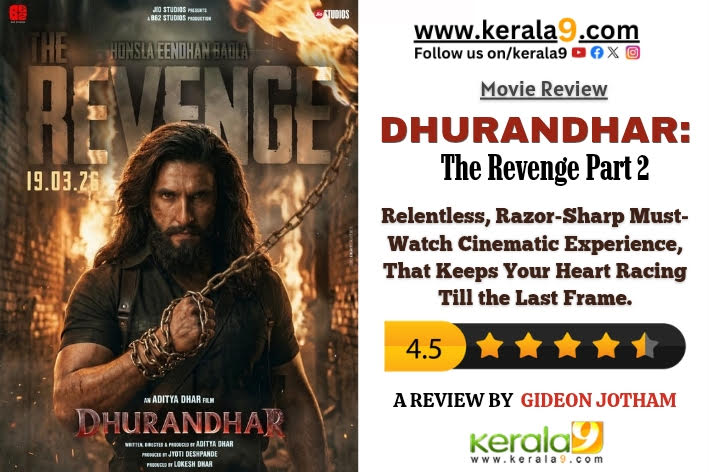
Dhurandhar 2 The Revenge Review – A Relentless, Razor-Sharp Must-Watch Cinematic Experience
Film: Dhurandhar: The Revenge
Director: Aditya Dhar
Language: Hindi
Duration: 3hr 55min
Genre: Political Action Spy Thriller
A Review by Gideon Jotham
Positives
- Engaging
- Intense
- Controlled
- Immersive
- Layered
- Powerful
- Direction
- Script
- Cinematography
- Artwork
- Music and Background Score
- Costumes
Negative:
- Insertion of Propongda
Dhurandhar 2 Story
At a surface level, Dhurandhar: The Revenge is about vengeance, but beneath that, it is a meditation on what grief does to a human being when it is left unresolved, when justice feels distant, and when memory becomes both a refuge and a weapon.
The film begins in stillness. The protagonist isn’t introduced as a “hero,” but as a man anchored in routine, someone whose identity is quietly built around relationships, small joys, and a sense of moral certainty. There is warmth in his world, and more importantly, there is trust in people, in systems, in the idea that life, however flawed, still has an order.
That belief is what the film destroys first.
The inciting tragedy is not just an event; it is a rupture. It doesn’t merely take something away from him; it redefines his relationship with reality itself. What makes this moment powerful is not its scale, but its intimacy. The loss feels personal, almost suffocating, because the film lingers not on the violence, but on the aftermath, the silence in rooms that once held laughter, the absence that cannot be negotiated with.
From here, the story resists turning immediately into a conventional revenge arc. Instead, it allows the protagonist to fracture. His grief is not loud it is internalized, simmering, transforming into something colder and more deliberate. The man we saw in the beginning doesn’t disappear overnight; he erodes. And in that erosion, something else takes shape, someone capable of doing what his former self never could.
As he steps into this new reality, the narrative widens. What initially seemed like a personal tragedy begins to reveal systemic rot, layers of power, influence, and moral compromise. The antagonists are not just individuals but embodiments of a world where accountability is negotiable. This shift is crucial because it reframes his revenge: it is no longer just about settling a score, but about confronting a structure that enabled the loss in the first place.
Yet, the film’s most compelling tension lies within the protagonist himself. Every step he takes forward pulls him further away from who he used to be. His pursuit is methodical, almost surgical, but it comes at a cost, the gradual numbing of empathy, the blurring of right and wrong. The question the story keeps asking, quietly but persistently, is:
When does justice stop being justice and start becoming obsession?
Flashbacks play a significant role here, not as mere exposition, but as emotional counterpoints. They remind us of the man he was, creating a haunting contrast with the man he is becoming. These moments don’t just justify his actions; they complicate them, forcing the audience to sit with discomfort rather than easy validation.
By the time the narrative approaches its climax, the stakes are no longer just external. The confrontation is as much internal as it is physical. Victory, in the traditional sense, begins to feel hollow because the film subtly suggests that revenge doesn’t restore what was lost, it only redefines what remains.
In the end, Dhurandhar: The Revenge doesn’t simply ask whether the protagonist succeeds. It asks something far more unsettling:
Even if he does… what version of him is left to live with it?
Screenplay
The screenplay of Dhurandhar: The Revenge operates with a level of precision and control that is both rare and demanding. Writing a film that spans close to four hours is, in itself, a structural challenge, but what makes this screenplay remarkable is how it transforms that duration into an advantage rather than a burden.
At its core, the writing is built on architectural discipline. This is not a story that unfolds randomly or leans on episodic convenience. Instead, it feels carefully engineered, each act feeding into the next with deliberate intent. The first act lays emotional groundwork with patience, allowing the audience to fully inhabit the protagonist’s world. This is crucial, because when the narrative eventually fractures, the impact is not superficial, it is deeply felt.
What stands out is the screenplay’s commitment to cause-and-effect storytelling. Nothing happens in isolation. Every decision the protagonist makes triggers consequences that ripple forward, shaping future events. This creates a chain reaction where the narrative never feels stagnant; it is constantly evolving, constantly tightening its grip.
The second act is where the writing truly asserts its strength. Many films struggle here, especially those with extended runtimes, often falling into repetition or narrative fatigue. But here, the screenplay avoids that trap through layered conflict design. It doesn’t rely on a single driving force; instead, it introduces multiple threads, personal revenge, systemic corruption, psychological deterioration, all unfolding simultaneously. These threads intersect, collide, and complicate one another, creating a sense of unpredictability.
Equally important is the screenplay’s handling of tension. Rather than depending solely on action, it builds unease through information control, revealing just enough to keep the audience curious, while withholding enough to maintain suspense. Scenes often carry a dual purpose: what is happening on the surface, and what is being implied beneath it. This subtext-driven writing ensures that even dialogue-heavy moments remain engaging.
The pacing deserves particular attention. Maintaining audience engagement for four hours requires more than just plot, it requires rhythmic intelligence. The screenplay understands this. It alternates between high-intensity sequences and quieter, introspective moments, creating a flow that prevents exhaustion. Importantly, these slower moments are not filler; they deepen character psychology, making the eventual confrontations more impactful.
Another key strength is character-driven progression. The plot does not drag the protagonist forward; rather, the protagonist’s evolving mindset drives the plot. As his moral boundaries shift, so does the nature of the story itself. Early decisions feel reactive, almost impulsive. Later ones become calculated, even ruthless. This progression is not abrupt, it is gradual, believable, and unsettling.
The dialogue, while rooted in a mass-appeal framework, often carries emotional and thematic weight. Confrontations are not just about dominance; they are about ideology, pain, and justification. Lines are written to resonate, not just to impress, giving the film moments that linger beyond their immediate impact.
What truly sets the screenplay apart, however, is its ability to sustain narrative engagement over an extended duration without dilution. There is a constant sense of forward motion, an invisible pull that keeps the audience invested. Even when the film takes detours into backstory or emotional reflection, these moments feel integrated rather than disruptive.
That said, such tight control can occasionally feel almost too calculated. The screenplay rarely allows chaos or unpredictability to exist without eventual explanation. For some viewers, this might reduce the sense of organic spontaneity. But within the framework of a large-scale revenge drama, this precision ultimately reinforces the film’s immersive quality.
By the time the story reaches its final act, the screenplay has already done the heavy lifting. The climax does not feel like an isolated peak, it feels like the inevitable culmination of everything that has come before. This is the hallmark of strong writing: when the ending feels both surprising and, in hindsight, unavoidable.
In the end, the screenplay of Dhurandhar: The Revenge is not just “tight”, it is meticulously constructed, emotionally aware, and structurally resilient. It proves that length is not a limitation when the writing is driven by clarity, purpose, and a deep understanding of narrative mechanics.
Direction
The direction of Dhurandhar: The Revenge is defined by control, conviction, and a clear understanding of scale. Handling a four-hour narrative is not merely about staging scenes, it’s about sustaining vision, tone, and emotional continuity across an expansive canvas. What the director achieves here is not just coherence, but command.
From the very beginning, there is a noticeable sense of intentional storytelling. The director doesn’t rush into spectacle; instead, he allows the world and its characters to settle in. This patience is crucial, because it builds a foundation that makes every later escalation feel earned rather than manufactured. The film never feels like it is trying to impress, it feels like it is unfolding with purpose.
One of the most striking aspects of the direction is its ability to balance intimacy with scale. On one hand, there are large, stylized sequences, action set pieces, confrontations, and dramatic peaks, that deliver the expected cinematic highs. On the other hand, there are quiet, almost still moments where the camera lingers on the protagonist, allowing the audience to sit with his emotions. This duality is handled with remarkable fluidity, ensuring that neither aspect overwhelms the other.
The director also shows a strong grasp of visual storytelling. Rather than relying solely on dialogue, many emotions are conveyed through framing, lighting, and movement. The use of shadows, confined spaces, and empty frames subtly reflects the protagonist’s psychological state. As the story darkens, so does the visual tone, creating a seamless alignment between narrative and imagery.
Another key strength lies in performance direction. The lead actor’s transformation feels grounded and gradual, which is a testament to how carefully the character has been guided. Emotional beats are given room to breathe, nothing feels rushed or exaggerated. Even in high-intensity scenes, the performances retain a sense of realism, avoiding the trap of becoming overly theatrical.
What truly elevates the direction, however, is its handling of tension and engagement over time. Keeping an audience invested for four hours requires more than just strong writing, it requires an instinct for when to hold back and when to release. The director demonstrates this instinct consistently. Scenes are allowed to build, sometimes slowly, but always with a sense of underlying momentum. There is rarely a moment that feels unnecessary or disconnected.
The film’s tonal consistency is another achievement. Despite shifting between emotional drama, action, and psychological conflict, the direction ensures that the film never feels fragmented. Everything exists within a unified vision, dark, intense, and emotionally charged.
If there is any limitation, it is that the direction is so controlled, so precise, that it occasionally leaves little room for raw unpredictability. Everything feels designed, calculated to achieve a specific impact. While this works in maintaining engagement, it can slightly reduce the sense of spontaneity.
Yet, this very precision is also what makes the film work on such a large scale. The director never loses sight of the narrative, never allows the film to drift, and never compromises on emotional clarity.
In the end, the direction of Dhurandhar: The Revenge is not just about executing a story, it is about sustaining an experience. It holds the audience, guides them, and refuses to let go, proving that with the right vision, even a four-hour film can feel immersive, cohesive, and relentlessly engaging.
Reel vs Real: The Question of Propaganda
One of the more intriguing aspects of Dhurandhar: The Revenge is how it navigates the thin, often uncomfortable line between cinematic storytelling (“reel”) and ideological influence (“real”). Revenge dramas, by nature, tend to simplify morality, but this film both uses and, at times, challenges that simplification.
On the “reel” level, the film operates within a familiar framework: a wronged individual rises against a corrupt system, confronting powerful figures who appear almost untouchable. This structure is designed for emotional impact, it gives the audience someone to root for and something to feel against. The anger, the injustice, the eventual retaliation, all of it is heightened, stylized, and shaped for maximum engagement.
But beneath this cinematic layer lies a more complex question:
Is the film merely telling a story, or is it shaping a perspective?
The portrayal of power structures in the film leans toward a certain absolutism systems are shown as deeply flawed, sometimes beyond redemption. At the same time, the protagonist’s actions, however extreme, are framed with a sense of justification. This is where the line between narrative and messaging begins to blur. The film doesn’t explicitly preach, but it strongly guides emotional alignment, leaving little ambiguity about who deserves sympathy and who doesn’t.
However, what prevents it from becoming outright propaganda is its occasional awareness of moral cost. The protagonist’s journey is not entirely glorified. There are moments, subtle but significant, where the film hints at the psychological toll of his actions. These moments act as cracks in the otherwise solid “hero vs system” narrative, suggesting that revenge, even when justified, is not without consequence.
The tension between “reel” and “real” becomes most evident in how the audience interprets the story. On one level, it is a cathartic experience, watching injustice being confronted in ways that reality often denies. On another level, it risks reinforcing a worldview where individual retribution replaces institutional justice, which can be a dangerous simplification when translated into real-world thinking.
What’s important is that the film doesn’t entirely close this debate. It presents its world with conviction, but leaves enough emotional residue for the audience to question what they’ve witnessed. Is the protagonist a symbol of justice, or a product of a broken system? Is the system irredeemable, or simply distorted for narrative effect?
In the end, Dhurandhar: The Revenge exists in that grey space. It is not pure propaganda, but neither is it completely neutral. It is a film that uses cinematic intensity to shape emotional truth, and in doing so, invites the audience to reflect on how much of what they feel belongs to the story, and how much they carry back into reality.
Performances
Dhurandhar: The Revenge thrives not just on its scale and writing, but on a densely packed ensemble cast that brings texture, intensity, and credibility to its world. What stands out is how the film doesn’t rely on a single performance, it builds a collective force of characters, each contributing to the narrative’s emotional and ideological weight.
At the center is Ranveer Singh, who delivers a performance that is both physically commanding and emotionally layered. He doesn’t just play a man seeking revenge, he embodies transformation. His shift from vulnerability to controlled fury is gradual and deeply felt. What makes his performance compelling is the restraint; even in explosive moments, there is a sense of internal conflict simmering beneath the surface.
Akshaye Khanna brings a quiet, almost unsettling intensity to his role. His performance is marked by composure and intelligence, making him a formidable presence without needing overt dramatics. He operates in silences as much as in dialogue, and that minimalism works powerfully in contrast to the film’s scale.
Sanjay Dutt adds gravitas that only experience can bring. There is a certain weight and authority in his presence, every scene he occupies feels elevated. He doesn’t overplay; instead, he leans into controlled intensity, making his character feel lived-in and consequential.
R. Madhavan, as Ajit Sanyal, delivers one of the more nuanced performances in the film. He brings measured realism, grounding the narrative when it risks becoming too stylized. His performance feels intellectual and emotionally aware, offering a strong counterbalance to the protagonist’s intensity.
Arjun Rampal, appearing in dual shades (including Major Iqbal), brings a layered ambiguity to his roles. There’s a certain controlled unpredictability in his portrayal, he feels both composed and dangerous, which adds intrigue to his presence on screen.
Among the extended cast, Sara Arjun as Yalina Jamali leaves a strong impression with a performance that carries emotional sensitivity. She brings a certain fragility and authenticity that enhances the film’s emotional core.
Saumya Tandon, as Ulfat, delivers a grounded and sincere performance, adding emotional texture to the narrative. Her character may not dominate screen time, but it adds depth to the world the film builds.
Rakesh Bedi as Jameel Jamali brings familiarity and subtle presence, while Gaurav Gera as Mohammad Aalam adds moments of realism through his naturalistic approach.
Actors like Manav Gohil (Sushant Bansal), Naveen Kaushik (Donga), and Akash Khurana (Devavrat Kapoor) contribute effectively, ensuring that even smaller roles feel purposeful rather than ornamental.
The presence of characters like Uzair Baloch (played by Danish Pandor) and others across the narrative adds to the film’s sense of realism and scale, making the world feel populated and lived-in rather than constructed.
Even the brief appearances, from actors like K. Anshuman Thakur, Sanjay Mehandiratta, Aquib Ali Zarwari, and Vikash Rai, serve the narrative without distraction, reflecting the director’s ability to extract functional, believable performances across the board.
Cinematography
The cinematography operates with a strong sense of mood and psychological alignment. It doesn’t merely capture events, it reflects the internal state of the narrative. In the early portions, frames feel more open, balanced, almost breathable. But as the story descends into darker territory, the visual palette gradually shifts, shadows deepen, compositions tighten, and the world begins to feel more claustrophobic.
There is a deliberate use of contrast and lighting to underline moral ambiguity. Characters are often placed in half-lit frames, suggesting duality, what is seen versus what is hidden. Night sequences, in particular, stand out for their textured use of light, where illumination feels selective rather than natural, guiding the viewer’s attention with precision.
The camera movement is equally purposeful. It avoids unnecessary flamboyance, instead opting for controlled motion, slow pushes, steady tracking shots, and composed frames that allow tension to build organically. When the film does expand into larger, more dynamic visuals, the shift feels earned, amplifying the scale without breaking tonal consistency.
Close-ups are used effectively, especially in emotionally charged moments. The camera lingers just enough to make the audience sit with discomfort, forcing engagement rather than offering easy escape. At the same time, wider frames are used to establish isolation, placing characters within vast or empty spaces to visually reinforce their psychological distance.
Overall, the cinematography is not just aesthetic, it is narrative-driven, evolving with the story and deepening its emotional impact.
Editing
If the cinematography defines how the film looks, the editing defines how it breathes.
For a film that runs close to four hours, the editing is remarkably disciplined and cohesive. The biggest achievement here is sustained engagement, the film rarely feels sluggish, which is a direct result of how tightly it has been cut.
The pacing is carefully modulated. High-intensity sequences are edited with sharp precision, quick, impactful cuts that enhance urgency without creating confusion. In contrast, emotional and reflective moments are given space, with longer takes that allow performances to resonate. This contrast in tempo is what keeps the viewing experience dynamic rather than exhausting.
Transitions between scenes are handled with subtle intelligence. Instead of abrupt jumps, the film often uses visual or thematic continuity to move from one moment to another, creating a seamless narrative flow. This is particularly effective in sequences involving flashbacks or parallel storytelling, where the editing ensures clarity without over-explaining.
Another strength is the handling of narrative density. With multiple characters and intersecting arcs, the risk of fragmentation is high, but the editing keeps everything aligned. Each thread is revisited at the right moment, maintaining coherence while still building tension.
Importantly, the editor understands when to hold back. Not every moment is cut for speed; some are allowed to linger, creating a sense of weight and consequence. This restraint adds to the film’s emotional depth.
If there is a minor limitation, it is that the editing, much like the direction, is highly controlled. There is little room for raw, chaotic energy, everything feels carefully structured. While this enhances clarity, it slightly reduces the feeling of unpredictability.
Background Score
The background score is arguably one of the film’s most powerful tools. It doesn’t merely accompany scenes, it drives them from within.
From the very beginning, there is a noticeable emphasis on tonal atmosphere. Low, brooding compositions dominate the early portions, creating a sense of unease even in seemingly calm moments. As the narrative progresses, the score evolves alongside the protagonist, becoming heavier, more percussive, and increasingly urgent.
What stands out is the use of layered instrumentation. Instead of relying on a single identifiable theme, the score builds itself through textures, deep bass lines, sharp percussive hits, and haunting melodic undertones. This layering creates a sense of constant tension, as if something is always about to unfold.
In high-intensity sequences, the score becomes almost visceral. It doesn’t just heighten action, it immerses the audience in it, syncing with movement and rhythm in a way that makes scenes feel more immediate and impactful. Yet, the film shows restraint where it matters. In emotionally charged moments, the music often pulls back, allowing silence or minimal instrumentation to take over. This contrast makes those scenes feel more intimate and real.
There are also recurring motifs, subtle musical signatures associated with the protagonist’s journey. These motifs evolve over time, mirroring his psychological transformation. By the climax, the score doesn’t just support the narrative, it reflects the culmination of everything the character has become.
Songs
The songs in the film are used sparingly but strategically. Rather than interrupting the narrative, they are woven into it, often serving as emotional extensions of the story.
Some tracks function as reflective pieces, slowing the narrative down to explore loss, memory, and longing. These songs add a layer of emotional depth, giving the audience space to connect with the protagonist beyond his actions.
Others lean into intensity, complementing the film’s darker themes. Even here, the focus remains on mood rather than spectacle. The songs are not just designed to be catchy, they are designed to belong within the film’s world.
Sound Design Integration
What elevates the music further is how seamlessly it blends with the film’s sound design. Background score, ambient noise, and silence are all used in coordination, creating a cohesive auditory experience. At times, the absence of music can be as powerful as its presence, allowing tension to build more organically.
CONCLUSION
Dhurandhar: The Revenge is not just a film, it is an experience of sustained intensity, a rare blend of scale, control, and emotional weight that refuses to dilute itself for convenience. In an era where attention spans are shrinking, this film dares to demand four hours, and remarkably, it earns every single minute of it.
What truly sets it apart is not just its technical excellence or star power, but its clarity of vision. The screenplay remains razor-sharp, the direction unwavering, the performances deeply committed, and the technical craft, from cinematography to background score, works in unison to create something immersive and cohesive. There is a sense that nothing here is accidental; every frame, every pause, every eruption of emotion feels designed with intent.
Yet, beyond all its cinematic strengths, what lingers is the film’s emotional aftertaste. It doesn’t simply deliver revenge, it explores its cost. It doesn’t just present conflict, it makes you sit with its consequences. And in doing so, it elevates itself beyond conventional mass cinema into something far more resonant and introspective.
This is not a perfect film, it is, at times, almost too controlled, too precise, but perhaps that very precision is what allows it to maintain such an unbroken grip on the audience.
In the end, Dhurandhar: The Revenge stands as a testament to what mainstream cinema can achieve when ambition meets discipline. It is bold, immersive, and unapologetically intense, a film that doesn’t just aim to entertain but to consume your attention completely.
Final Verdict And Rating (4.5/5)
A Review by Gideon Jotham.