
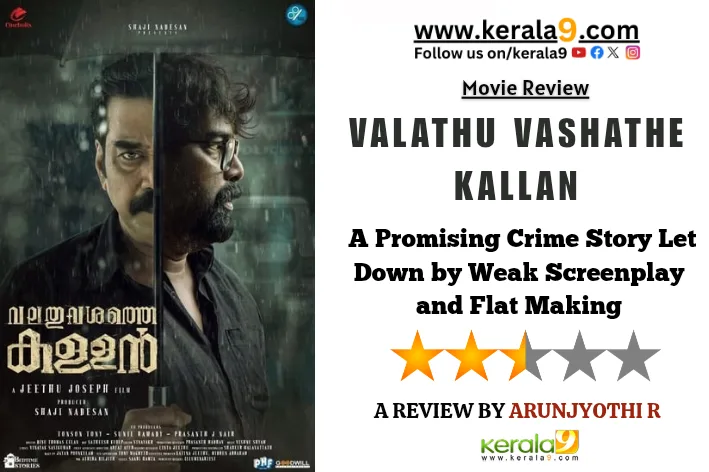
ONE WORD: A Promising Crime Story Let Down by Weak Screenplay and Flat Making
A Review by Arunjyothi R
LANGUAGE: MALAYALAM
DURATION: 138 Minutes
DIRECTOR: Jeethu Joseph
GENRE: Crime Drama Thriller
•POSITIVES:
1: Story
2: Performance of Actors
3: Background Score
4: Second half
•NEGATIVES:
1: Direction
2: Screenplay
3: First half
4: Slow paced
5: Colour grading
6: Editing
STORY:
Valathu Vasathe Kalam starts with a shocking incident—the sudden disappearance of Irene Samuel, a law student and social worker with a strong sense of justice. The case is assigned to CI Antony Xavier, a calm and careful officer known for his sharp approach. As the investigation progresses, hope turns into horror when Irene’s body is found within days, turning a missing-person case into a shocking crime that affects everyone deeply.
The tragedy hits Irene’s father, Samuel, hard. A quiet hacker by nature, he is crushed by the loss and struggles to accept the truth. Unable to wait for answers, he begins his own search for the person behind his daughter’s death, stepping into dangerous situations where right and wrong are unclear. His personal investigation runs alongside the official one, adding more tension to the story.
Just when the investigation seems straightforward, the film takes an unexpected turn. CI Antony Xavier finds himself personally involved, facing a race against time where his duty as an officer clashes with his emotions. With the life of his only family member at stake, the story becomes a tense thriller, where every discovery increases the danger and every choice has serious consequences.
REVIEW & ANALYSIS OF THE FILM:
1: Direction:
Jeethu Joseph is a name that instantly raises expectations, especially when it comes to mystery and crime thrillers. Over the years, he has mastered the art of building tension, planting clever twists, and delivering satisfying payoffs. Naturally, Valathu Vasathe Kalam came with high hopes. The trailer cuts and the casting choices hinted at a solid investigative thriller, promising another engaging ride. Unfortunately, this time, the film doesn’t fully live up to that promise.
The first major drawback lies in the making and direction. While Jeethu Joseph clearly has all the right elements in place for a gripping crime thriller—secrets, twists, time pressure, and moral conflicts—the execution feels surprisingly flat. The film struggles to create an emotional bond with the characters, which is crucial for a story of this nature. As a result, even serious moments fail to leave a strong impact. The first half, in particular, takes too long to set up the main conflict, and this slow build ends up feeling more dragging than intriguing.
Things do pick up in the second half, where the narrative is filled with unexpected developments and a time-bound puzzle that should ideally keep the audience hooked. Twists arrive one after another, and on paper, they sound interesting. However, the tension never really peaks. The film misses that edge-of-the-seat thrill, making several key reveals feel more routine than shocking. Instead of lingering in the mind, the twists pass by with a “that’s okay” reaction.
The emotional core of the film is another missed opportunity. The story demands a strong sentimental connection, especially given its personal stakes, but this aspect is handled in an average manner. The emotions are stated, but not deeply felt, which weakens the overall impact. Even when the film reaches its climax, though the final reveal is decently staged and logically unfolds well, it doesn’t deliver a fully satisfying closure.
2: Script:
Valathu Vasathe Kalam sets itself firmly in the space of a murder mystery crime thriller, and the intention is clear right from the start. The script is shaped with care, giving the investigation a steady flow while introducing personal stakes and moral conflicts. The story begins on an intriguing note and quickly establishes the core mystery, creating curiosity around the crime and the people involved. The incidents are written neatly, and the progression of clues shows clear planning. The time-bound puzzle element adds urgency and fits well within the thriller format, while the ending manages to close the narrative in a fairly satisfying and logical manner.
Despite this strong foundation, the film struggles to maintain suspense at a consistent level. The screenplay does not fully tap into the potential of the story, often slowing down at moments that should have been tense. Several scenes feel stretched, causing a lag that weakens the overall grip of the narrative. Emotional depth, which is crucial in a murder mystery driven by personal loss, remains underdeveloped. As a result, the audience observes the events from a distance rather than feeling pulled into the danger and urgency of the investigation.
The film clearly aims for a cat-and-mouse style thriller, filled with twists, turns, and layered revelations. The second half, in particular, is packed with events and unexpected developments, but the constant flow of information sometimes feels overwhelming rather than thrilling. Predictable stretches also reduce the impact of key moments. While the suspense is present in theory, the execution fails to create that edge-of-the-seat tension that defines a truly gripping crime thriller. The reveal scenes, instead of delivering a rush of excitement, feel restrained and pass without leaving a lasting impression.
Dialogues are mostly simple and grounded, keeping the film away from unnecessary melodrama. They work fine within the investigative portions, but it is in the emotional scenes that the writing truly shines. Conversations involving the father stand out, effectively expressing love, care, and emotional pain, and briefly adding the depth the film otherwise misses. In the end, Valathu Vasathe Kalam remains a decent murder mystery with suspenseful intentions, but the lack of strong emotional engagement and a tighter screenplay prevents it from becoming the impactful thriller it set out to be.
OTHER NEGATIVES FELT:
One of the biggest issues with Valathu Vasathe Kalam is its uneven pacing, which significantly affects the overall viewing experience. The first half is notably slow and takes an extended amount of time to establish the main conflict, making the narrative feel stuck in a loop. Instead of gradually building suspense, the film spends too much time on surface-level detailing, causing several scenes to drag without adding emotional or narrative depth. This slow pacing results in a lag that often turns into boredom, as the audience is not given enough emotional hooks to stay invested. The lack of strong emotional connection between the characters further weakens these portions—relationships are introduced, but not explored deeply enough for the audience to feel their weight. As a result, the tension that should naturally arise from a murder investigation fails to take hold in the early stages.
Several scenes feel unnecessarily stretched, often repeating information rather than sharpening the suspense or revealing new layers to the characters. This repetition creates a sense of stagnation, where the story moves forward in theory but not in impact. Even when the film transitions into the second half—where the pace should ideally tighten and the urgency of the investigation should intensify—certain portions continue to unfold slowly. The emotional depth still feels limited, and the characters’ inner conflicts are not explored enough to raise the stakes. This dilutes the urgency of the investigation and breaks the rhythm expected from a crime thriller, making the film feel longer than it actually is.
The editing plays a key role in this sluggish feel. The first half, in particular, clearly needed sharper cuts to keep the narrative crisp and engaging. While the scene-to-scene transitions are handled neatly and do not feel abrupt, the overall trimming is inadequate, allowing the film to linger too long on moments that do not add much value. The colour grading further adds to the film’s drawbacks. The visual tone feels inconsistent, with dark and inaccurate colour mixing that fails to enhance the mood. Instead of supporting the suspenseful atmosphere, the dull palette makes several scenes look flat and visually tiring. Together, the slow pace, stretched editing, and off-balance colour grading weaken the impact of the film and prevent it from fully functioning as an effective crime thriller.
PERFORMANCE OF ACTORS:
Biju Menon, as CI Antony Xavier, is undoubtedly the backbone of Valathu Vasathe Kalam. He carries the film with ease, and his strong screen presence often becomes the film’s biggest strength. His sharp dialogue delivery adds weight to the investigative portions, while his controlled body language suits the role of a seasoned officer. The tension, urgency, and eagerness to crack the case are well reflected in his performance. Equally impressive is his emotional acting, especially in scenes involving family, where the father–son dynamic is portrayed with warmth and restraint. Even when the narrative slows down, Biju Menon’s performance keeps the film watchable.
Joju George delivers a powerful performance, dominating the screen whenever he appears. His character adds a fresh layer of suspense to the narrative, and he plays it with the right balance of intensity and mystery. The father–daughter bond is portrayed convincingly, making his emotional breakdowns feel raw and genuine. Joju handles the darker shades of his character with confidence, maintaining a brooding tone throughout the film. The way he performs the morally complex portions and emotional scenes makes his character engaging to watch and adds depth to the overall investigation.
Lena, as Theresa Samuel, has limited screen time but makes
a strong impact, especially in the second half. Her phone conversation scene with Biju Menon stands out as one of the more thrilling moments in the film. As a grieving mother, she brings in genuine emotion, particularly in the scene where she comes face to face with her daughter’s death. Her chemistry with Joju George works well, lending credibility to the family dynamic. Lena handles her role with maturity and ensures that her character leaves a mark despite the constraints.
The supporting cast does complete justice to their roles. Leona Lishoy as ASI Vidhya Shekar brings sincerity and confidence to her character, sharing good screen space with Biju Menon and fitting well into the investigation setup. Irshad, as HC Johny Vincent, is effective and dependable, while Vyshnavi Raj as Irene Samuel and K. R. Gokul as Phillip Antony serve their parts convincingly. The teamwork among the investigation officers feels natural, and the interactions add realism to the procedural portions. Overall, the performances stand strong and remain one of the more consistent aspects of the film.
CONCLUSION:
Overall, Valathu Vasathe Kalam feels like a rare misstep in Jeethu Joseph’s otherwise impressive journey as a maker of mystery and crime thrillers. Known for his tight writing and gripping suspense, this time things didn’t quite fall into place for him. Despite having a strong premise and all the required elements for a compelling murder mystery, the film struggles with engagement, emotional depth, and sustained tension. The average screenplay and uneven pacing hold the film back, even though the performances—especially by Biju Menon and Joju George—do their best to lift the material.
I would recommend Valathu Vasathe Kalam mainly for fans of Jeethu Joseph and viewers who enjoy slow-burn investigative thrillers driven by performances rather than thrills. It may not deliver the signature edge-of-the-seat experience expected from the director, but it still offers a few solid moments and a decently executed climax. This time, Jeethu Joseph doesn’t fully hit the mark, making the film a one-time watch rather than a memorable addition to the genre.
RATING: 2.5/5
A Review by Arunjyothi. R