
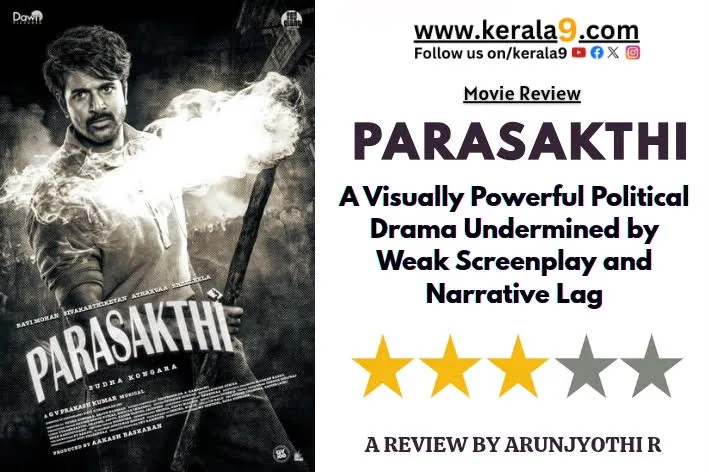
Parasakthi Review in ONE WORD: A Visually Powerful Political Drama Undermined by Weak Screenplay and Narrative Lag.
A Review by Arunjyothi R
LANGUAGE: Tamil
DURATION: 02 Hours 42 Minutes
DIRECTOR: Sudha Kongra
GENRE: Historical Periodical Political Drama
•POSITIVES:
1: Making Style
2: Story & Dialogues
3: Cinematography
4: Performance of actors
5: Screen Presence of Shivakarthikeyan
6: Background Score
7: : Production Quality
8: Art Direction
•NEGATIVES:
1: Lengthy First Half
2: Placement of Songs
3: Duration of the movie
4: Medicore Screenplay
5: Average Romantic Arch
6: Editing
STORY:
Parasakthi is set in 1960s Tamil Nadu during the anti-Hindi imposition movement. The story follows Chezhiyan, a young student who becomes actively involved in student-led protests for linguistic identity and social justice. As the movement intensifies, harsh police suppression leads to violent confrontations, forcing Chezhiyan to face emotional loss and moral dilemmas. After a personal tragedy, he abandons the movement to take responsibility for his family, especially his younger brother. Years later, his brother, now an engineering student, becomes drawn into the same ideological struggle, triggering a series of unexpected and life-altering events.
REVIEW & ANALYSIS OF THE FILM:
Set during the politically turbulent 1960s anti-Hindi protests in Tamil Nadu, Parasakthi attempts to portray linguistic pride, ideological resistance, and the social realities of a defining historical moment through a fictional narrative inspired by real events. The film’s ambition is immediately evident in its choice of subject—one that carries emotional, cultural, and political weight. At its core, Parasakthi seeks to remind audiences of the importance of mother tongue and identity, and this intent is clearly reflected in the story’s foundation and thematic focus. The narrative idea itself is strong, rooted in historical relevance, and holds the potential to create a powerful cinematic statement.
One of the film’s notable strengths lies in its story concept and dialogues. The integration of historical facts with fiction is handled thoughtfully on paper, and several dialogues stand out for their ideological clarity and emotional resonance. Lines emphasizing linguistic pride, cultural dignity, and resistance against imposition are powerful and thought-provoking, often echoing the sentiments of the era. At its best, the film succeeds in articulating why the movement mattered, using words as a tool of resistance. These moments remind the audience of the depth and seriousness of the subject and highlight what Parasakthi aims to communicate.
Director Sudha Kongara’s intention deserves appreciation. Choosing such a bold and politically sensitive subject in contemporary cinema is itself a commendable risk. Her effort to stay respectful to the historical backdrop while shaping a narrative around student-led movements reflects sincerity in storytelling. The making, in terms of conceptual approach, shows discipline and restraint, avoiding unnecessary sensationalism. The film consistently maintains a serious tone, reinforcing its identity as a political period drama rather than a commercial entertainer.
However, despite this strong foundation, Parasakthi begins to falter in execution, particularly in its narrative progression. The most pressing issue is the sluggish pacing, especially in the first half. What should have been a gripping establishment of emotional and ideological stakes instead unfolds at a slow and often disengaging pace. The political tension remains in the background for too long, reducing the urgency that such a subject demands. As a result, the audience struggles to emotionally invest in the movement during the initial stages.
The screenplay emerges as the film’s biggest drawback. While the idea is powerful, the writing lacks the sharpness required to sustain a politically charged narrative. The emotions surrounding the anti-Hindi movement feel restrained and at times superficial, as if the film hesitates to fully embrace the anger, pain, and ideological fire of the era. Instead of deeply immersive dramatic moments, the narrative often relies on predictable confrontations and convenient writing choices, which dilute the overall impact.
The romantic arc in the first half further weakens the film’s momentum. The love track feels forced, poorly integrated, and largely unnecessary to the core narrative. Rather than strengthening character motivations or emotional depth, it slows the film considerably and diverts focus from the political conflict. This dull and drawn-out romance becomes a major reason for the lag, testing the viewer’s patience and weakening the film’s ideological drive.
Editing choices add to these pacing issues. The film’s duration feels excessive, with several scenes overstaying their welcome. Tighter editing could have significantly improved the narrative flow, especially in the first half. The slow narration, combined with an overly stretched screenplay, causes the film to lose momentum at crucial points, making the viewing experience uneven.
Despite its narrative shortcomings, Parasakthi redeems itself to an extent through strong technical craftsmanship. The period detailing is highly impressive, with production design, costumes, and art direction authentically recreating 1960s Tamil Nadu. Every visual element—from streets to protest spaces—feels carefully designed, lending credibility to the film’s historical setting. This attention to detail enhances the film’s seriousness and visual appeal. Cinematographer Ravi K. Chandran’s work further elevates the technical quality. His use of soft lighting, earthy color tones, and classical framing adds a nostalgic texture to the film. Close-up shots effectively capture emotional expressions, while protest and action sequences are shot with clarity and scale. Visually, the film maintains a consistent and polished aesthetic that supports its period identity.
The music and background score play a crucial role in lifting several key moments, particularly in the second half. The background score adds emotional intensity to confrontations and ideological scenes, often compensating for weaknesses in the writing. While the songs themselves are melodically strong, their placement—especially in the first half—feels misjudged and disruptive to the narrative flow, contributing further to the pacing issues.
In terms of performances, Sivakarthikeyan’s screen presence anchors the film. His portrayal carries conviction, particularly in emotionally and politically charged scenes, helping sustain interest even during weaker portions. Ravi Mohan’s antagonist role adds intensity and tension, while Atharvaa brings emotional depth and energy to the protest sequences. Sreeleela delivers a mixed performance, with stronger moments in the climax but a less effective presence in the romantic portions. Overall, while Parasakthi excels in intent, technical quality, and individual performances, its weak screenplay, slow pacing, and underdeveloped emotional core prevent it from becoming the landmark film it aspired to be.
PERFORMANCE OF ACTORS:
Sivakarthikeyan delivers a powerful and career-defining performance as Chezhiyan “Che,” marking a remarkable transformation in his acting journey. This film can undoubtedly be considered one of the best and most career-changing performances of SK, as he moves far beyond his usual screen image and embraces a politically intense, content-driven role with conviction. From the opening scenes to the very end, his acting remains clear, precise, and deeply intense, and what stands out the most is how consistently he maintains this momentum without losing emotional grip. His body language, controlled expressions, and grounded performance bring authenticity to the character, making Chezhiyan feel like a real leader rather than a cinematic construct.
The true strength of Sivakarthikeyan’s performance lies in how he embodies the qualities of a genuine leader—someone who stands at the forefront and guides people in their fight for rights. His revolutionary side is presented in a refreshing and impactful manner, making it both cheering and engaging to watch. The politically charged dialogues are handled with sharp modulation and strong voice control, giving the feel of a leader who speaks with clarity, purpose, and responsibility. Especially in crucial political moments, his way of expressing dialogues carries weight and conviction, leaving a lasting impression. The climax sequence, where Chezhiyan speaks about the importance of one’s mother tongue, is particularly fascinating; the combination of powerful writing and Sivakarthikeyan’s performance evokes a deep emotional response, awakening a feeling that lies hidden within the audience.
The second half of the film further elevates Sivakarthikeyan’s performance through emotionally driven scenes that showcase his acting depth. His emotional transitions are subtle yet impactful, making these moments feel genuine rather than exaggerated. The combination scenes between Sivakarthikeyan and Atharvaa add strong sentimental value to the narrative, especially in the way their bond evolves through shared struggles and political ideologies. Their protest sequences are thrilling to watch and bring intensity and realism to the film’s political core. Overall, the film stands tall as a meaningful political drama, largely powered by Sivakarthikeyan’s extraordinary performance, which firmly establishes him as an actor capable of leading socially responsible and content-oriented cinema.
Ravi Mohan, who has long been associated with romantic and soft-toned lead roles, makes a striking transformation by stepping into the shoes of the antagonist, and the result is nothing short of impressive. His performance as the villain stands out as one of the strongest pillars of the film, and it is safe to say that he is a major reason why the narrative remains engaging till the very end. In a film that occasionally takes a slower dramatic turn in the middle portions, it is Ravi Mohan’s commanding screen presence that keeps the momentum steady. The way he brings a sense of unpredictability and menace to his character adds constant tension to the narrative, making the audience eager to know what he will do next. His villainy is not loud or over-the-top, but deeply intimidating, marked by controlled aggression and a chilling lack of mercy that makes his character both dreadful and fascinating to watch.
What makes Ravi Mohan’s performance even more compelling is the depth he brings to the character’s motives, which adds an extra layer of intrigue rather than presenting a one-dimensional antagonist. The villainous shades he undertakes and the conviction with which he portrays them reflect a confident and mature actor exploring a new territory. His attitude and mannerisms as a police officer are convincingly executed, lending authenticity and authority to the role. The combination scenes with Sivakarthikeyan, especially towards the climax, elevate the film’s intensity, turning their confrontations into some of the most thrilling moments of the movie. The climax fight sequences are staged effectively and benefit greatly from Ravi Mohan’s intense performance, making them impactful rather than routine. Overall, this role stands as one of Ravi Mohan’s best and most career-lifting performances, proving his versatility and opening up a promising new chapter in his acting career.
Sreeleela’s performance comes as a pleasant and surprising revelation in the film. Going into the theatre, there may naturally be doubts about whether she could shoulder such a role with the required emotional depth, but she completely breaks those assumptions with a confident and effective performance. She fits well into the narrative and proves her capability, especially in the climax portions where her acting truly stands out. Her expressions during these crucial moments are impactful, and her dialogue delivery is handled with clarity and emotional strength, significantly elevating the intensity of the climax. While the romantic portions with Sivakarthikeyan remain fairly conventional and do not push new boundaries, their chemistry feels decent and functional within the story’s framework. However, it is her strong presence in the emotionally charged sequences that establishes her as a valuable contributor to the film rather than just a supporting character.
Atharvaa, as Chinnadurai, delivers one of his most convincing performances, bringing both emotional depth and raw intensity to the role of the brother figure. His energy and attitude during the protest sequences feel strikingly genuine, capturing the spirit of real-life resistance with authenticity. The precision in his dialogue delivery and the sharpness of his facial expressions add immense power to these scenes, making them memorable. The combination scenes between Atharvaa and Sivakarthikeyan are particularly effective, as they balance an emotional arc with the thrilling vibe of collective protest. Their bond, affection, and shared ideological drive are portrayed with sincerity, which helps push the narrative forward in a meaningful way. Atharvaa’s emotional scenes are executed flawlessly, without any artificiality, proving once again that he is more than capable of handling strong, layered characters with confidence and maturity.
CONCLUSION:
Parasakthi stands as an ambitious and sincere attempt to portray a crucial chapter in Tamil Nadu’s socio-political history, driven by strong intent, impressive period detailing, and committed performances. The film succeeds in capturing the ideological essence of linguistic pride and resistance, supported by solid dialogues, striking visuals, and technical finesse. However, its impact is significantly diluted by an uneven screenplay, narrative lag, and a poorly integrated romantic track that weakens the emotional core. While Parasakthi deserves appreciation for its subject choice and cinematic sincerity, it ultimately falls short of becoming the powerful, hard-hitting political drama it aspired to be, emerging instead as a film of strong moments overshadowed by flawed execution.
RATING: 3/5
A Review by Arunjyothi. R