

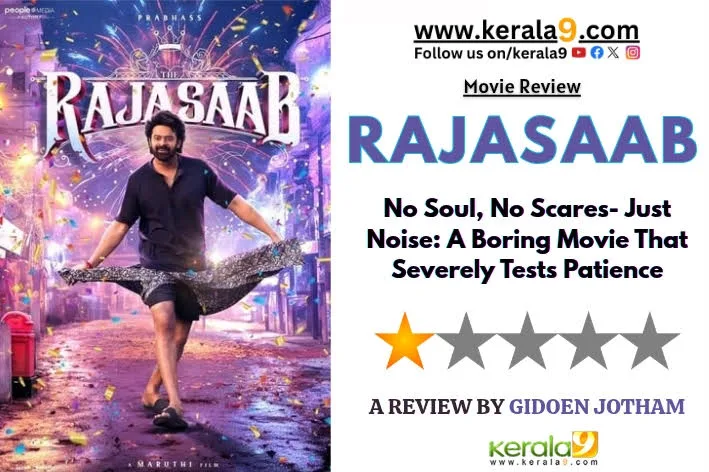
Rajasaab Review: No Soul, No Scares—Just Noise: A Boring Movie That Severely Tests Patience
A Review by Gideon Jotham
Director: Maruthi
Language: Telugu
Genre: Fantasy Comedy Horror
Duration: 3hr 03 mins
Positives
1: Prabhas screen presence
2: Malavika mohan Screen presence
3: Nidhi agraval Screen presence
4: VTV Ganesh
Negatives
1: Story
2: Screenplay
3: Predictability
4: Pacing
5: Limited emotional peaks
6: VFX
7: Sfx
8: Duration of the movie
9: Editing
10: Unworked comedies
Story
The Raja Saab revolves around a seemingly carefree protagonist who inherits (or stumbles into) an old, eerie mansion that carries more secrets than bricks. What begins as a light, almost frivolous setup soon reveals a haunted past spirits bound by unresolved emotions, unfinished justice, and long-buried truths. Instead of treating the supernatural with dread, the narrative approaches it with humor. The ghosts here are not merely entities meant to scare, but characters with personalities, intentions, and emotional weight. The story plays on the contrast between the hero’s casual attitude and the mansion’s dark history, creating comedy from fear and fear from comedy. At its core, The Raja Saab is less about survival horror and more about coexisting with the past. The plot gradually shifts from surface-level gags to a familiar emotional arc involving redemption, love, and closure. While the storyline doesn’t attempt to reinvent the genre, it comfortably stays within a commercial framework, relying on predictability, charm, and situational twists rather than narrative shocks.
The film ultimately chooses comfort over complexity a ghost story meant to entertain, not unsettle; to amuse, not disturb.
Direction
The direction by Maruthi is, quite frankly, the weakest pillar of The Raja Saab. There is a complete lack of tonal clarity. The film never decides whether it wants to be a horror film with comic relief or a comedy wearing a horror mask. As a result, scenes that demand tension are diluted with forced humor, and moments that could have landed as comedy fall flat due to poor buildup. The director seems unsure of the genre grammar he is working with.
Maruthi relies heavily on outdated storytelling techniques predictable setups, spoon-fed emotions, and overused reaction shots. Instead of trusting the audience, the film constantly explains itself, killing any possibility of suspense or surprise. Horror requires control, rhythm, and restraint; comedy requires timing. Unfortunately, the direction fails on both counts.
What’s more disappointing is the absence of vision. There is no strong visual or narrative identity guiding the film. Scenes feel assembled rather than designed. The haunted house, which should have been a character in itself, is treated like a generic set piece with no atmosphere or psychological weight.
In essence, the direction feels lazy and mechanical, more concerned with ticking commercial checkboxes than crafting a coherent cinematic experience. What could have been a playful or inventive genre film instead becomes a confused product, undone largely by its own director’s indecision.
Screenplay
The screenplay of The Raja Saab is where the film truly collapses not because of ambition, but because of carelessness. The narrative structure is painfully formulaic. Every beat feels pre-decided: the introduction, the haunted setup, the comic interruptions, the emotional flashback, and the predictable resolution. There is no sense of discovery. Scenes don’t evolve; they merely arrive, do their job, and exit. Cause-and-effect storytelling is weak, making the plot feel stitched rather than organically flowing. One of the screenplay’s biggest failures is inconsistent tone management. Horror scenes are abruptly undercut by jokes that neither advance character nor plot. Instead of easing tension intelligently, the writing destroys it altogether. Comedy here is not written within situations it is inserted, often breaking immersion.
Character writing is equally shallow. Most characters exist only to serve punchlines or exposition. Their motivations are either rushed or conveniently revealed through lengthy dialogues and flashbacks. Emotional moments feel manufactured because the screenplay never earns them through gradual buildup. The second half suffers the most. What should have been a tightening narrative instead becomes repetitive and dragging, recycling the same conflicts with minor variations. The lack of escalation emotional or narrative makes the climax feel inevitable rather than impactful.
Ultimately, the screenplay mistakes noise for narrative and dialogue for drama. It neither respects genre rules nor challenges them. The result is a script that plays it safe, speaks too much, and says very little.
Performance
Prabhas (lead performance) appears visibly restrained and not in a good way. He brings screen presence by default, but the character gives him nothing substantial to perform. His role oscillates between casual comedy and emotional seriousness without a proper bridge, making his performance feel disconnected. It’s not miscasting; it’s misuse. You sense an actor waiting for a moment that never arrives.
The supporting cast fares no better. Most performances are reduced to loud reactions, exaggerated expressions, and template comic behavior. Instead of character-driven humor, actors are instructed to perform effects shouting, pausing, reacting without emotional grounding. This makes scenes feel artificial and stagey.
Female characters, in particular, are underwritten. Their performances are confined to surface-level charm or emotional exposition, offering little room for nuance. Even when emotional beats appear, they feel imposed rather than lived-in. The biggest issue is performance tonality. Actors are clearly not on the same emotional wavelength some play it like a spoof, others like a commercial drama. This mismatch further exposes the director’s inability to unify performances under a single vision. In short, the cast does what it can, but performances are trapped inside a confused film. There’s no space for depth, no rhythm to react against, and no directorial guidance to elevate acting beyond the functional.
Music & Background Score
The music and background score in The Raja Saab handled by S. Thaman turn out to be another missed opportunity rather than a saving grace.
The songs feel mechanically placed, existing more to satisfy commercial expectations than narrative necessity. Instead of deepening character emotions or advancing the story, they interrupt the flow, especially when the film already struggles with pacing. None of the tracks leave a lasting emotional or melodic imprint; they pass by without resonance.
The background score is where the real damage happens. Horror-comedy thrives on sonic contrast silence, sudden shifts, controlled crescendos but the BGM here is overbearing and monotonous. Rather than creating tension or irony, it constantly instructs the audience on what to feel. Fear is announced loudly, comedy is underlined aggressively, leaving no room for organic reaction.
What’s worse is the lack of thematic identity. There is no recurring motif that ties the supernatural elements together, no musical signature for fear, memory, or emotion. The score reacts to scenes but never defines them. In several moments, it even sabotages potential impact by arriving too early or staying too long. In essence, the music and BGM behave like a crutch for weak writing and direction, instead of elevating the cinematic experience. For a genre that heavily depends on sound design and musical rhythm, this becomes a critical failure.
Final verdict
The Raja Saab is a film that had all the right ingredients but absolutely no control over the recipe. What could have been a fun, stylized horror-comedy instead turns into a predictable, uneven, and emotionally flat experience. Weak direction and a careless screenplay drain the film of tension, surprise, and depth. The pacing issues further dilute engagement, making the runtime feel longer than it should. Performances by Prabhas and Nidhhi Agerwal provide momentary relief, but even their presence cannot rescue a film that lacks narrative conviction. Technical aspects like VFX and sound design, crucial for this genre, fail to create immersion or impact.
In the end, The Raja Saab doesn’t scare, doesn’t surprise, and rarely connects emotionally. It plays safe, speaks loud, and leaves very little behind once the screen fades to black.
Rating: (1/5)
A Review by Gideon Jotham