
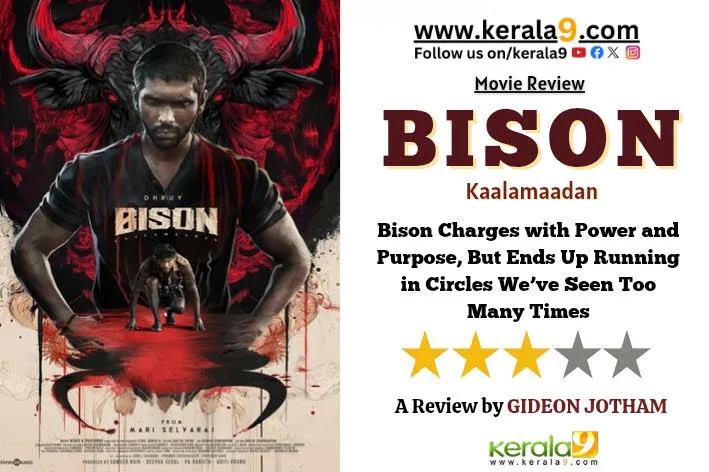
Bison Movie Review: Bison Charges with Power and Purpose, But Ends Up Running in Circles We’ve Seen Too Many Times.
REVIEW BY GIDEON JOTHAM
Film: Bison Kaalamaadan
Director: Maari Selvaraj
Language: Tamil
Duration : 168 minutes
Genre: Political Sport Drama
Positives
1. Cinematography
2. Dialogues
3. Performance of actors
4. Screenplay.
5. Artworks
Negatives
1. Story
2. Predictability
3. Usual colour theory
Story
If Pariyerum Perumal was about the fight for dignity, Karnan about the rebellion for justice, and Bigil about reclaiming respect through sports, then Bison is where all three worlds collide pain, politics, and perseverance merging into one man’s journey.
Maari Selvaraj, once again, returns to his familiar soil a world where caste breathes through the cracks of dreams, and politics hides beneath the banner of pride. But this time, the battlefield isn’t a classroom or a village street it’s the Kabaddi court, a ground where sweat, blood, and identity clash for something larger than victory.
The film opens with thunder an India vs Pakistan National Kabaddi Final. The stadium roars, lights blaze, the nation holds its breath. Amid the chaos sits Dhruv, the protagonist, quietly waiting on the substitute bench. His eyes are restless, his heart louder than the crowd. Somewhere far away, in a small dusty village, his people gather around a projector screen, chanting his name, waiting to see their boy step into the ground.
But fate, as always, remains cruelly silent. A referee’s mistake ties the game, ending in controversy. The headlines scream for a rematch, and the coach, afraid of losing, debates who deserves to play. Amid the noise of ego and fear, Dhruv rises, excuses himself for a restroom break and in that small, symbolic moment, the film transitions into his past.
The flashback isn’t glamorous; it’s raw and heavy. We meet a younger Dhruv a boy whose talent on the Kabaddi field couldn’t erase the label society had stamped on him. Born in a lower-caste family, he learns early that no matter how high he jumps or how hard he tackles, the world still sees the name before the number.
His father, calm and wise, is a man of patience one who believes peace can heal where protest cannot. But Dhruv carries a different fire not loud, not violent, but burning quietly under his skin. The village, divided by caste and pride, mocks his ambition. Every game he wins becomes a reminder that he is crossing invisible boundaries.
Maari Selvaraj draws us deep into this suffocating reality showing how systemic bias slips into every corner: from local Kabaddi selection politics to the playground where friendships die over surnames. The lens lingers on faces that smile in daylight and conspire in the dark.
Dhruv’s love story blooms in this dust a simple, fragile relationship that gives him hope, only to be tested by the same cruel structures that break everything beautiful. Their moments together walking by the riverside, laughing over little things feel like stolen breaths in a world that doesn’t allow love to exist without condition.
As Dhruv’s talent grows, so does the resistance against him. Local politicians use his victories as tools for power, while others try to destroy him through manipulation and betrayal. When a rival player, driven by caste arrogance and personal vengeance, challenges Dhruv, the story shifts from emotional struggle to brutal confrontation.
The second half of Bison bleeds literally and metaphorically. Violence erupts, not for sport, but for identity. Bodies fall, hearts break, and the color red floods the screen a recurring metaphor that Maari has mastered but, this time, perhaps overused. The Kabaddi court becomes a mirror of society the tackles representing oppression, the scores symbolizing survival.
When the narrative returns to the present, Dhruv is no longer just a player; he’s a man who has lived through betrayal, discrimination, and loss. As he steps onto the court for the rematch, the question isn’t will India win? it’s will Dhruv forgive the world enough to play for it?
The final minutes are haunting. The stadium echoes, the crowd roars, but the camera stays on Dhruv’s face scarred, calm, and ready. The whistle blows. Every move he makes carries the weight of generations who were told they don’t belong.
Like Pariyerum Perumal, Bison speaks about identity. Like Karnan, it rages against injustice. And like Bigil, it uses sports as a language of resistance. But beneath all those layers, Bison is deeply human the story of one man learning that true victory isn’t about medals or applause; it’s about surviving in a world determined to see you fall.
Direction
Maari Selvaraj’s direction in Bison is powerful, but familiar. From the very first frame, you can sense his trademark the earthy landscapes, the emotionally heavy silences, the political undertones that breathe through his characters. His control over the craft is undeniable; every frame is purposeful, every pause is loaded with meaning. But the larger question that lingers is have we seen this before?
Much like Pariyerum Perumal, Karnan, and his recent Vaazhai, Bison too travels through the same emotional and visual corridors. The frames look hauntingly similar dusty roads, wounded men, piercing gazes, and color palettes drenched in red and brown. His choice of symbolism, particularly in representing oppression and caste politics, once felt revolutionary. Now, it feels like a pattern he’s too comfortable repeating.
That said, Maari’s ability to connect the audience with pain, struggle, and silent rebellion is still unmatched. His actors don’t just perform; they live the roles he gives them. The way he extracts emotion through the stillness of a character’s face or a long, uninterrupted take shows his mastery over human storytelling.
However, what Bison lacks is evolution. The direction feels like a continuation rather than a leap. The same emotional beats, the same narrative rhythm, the same color-coded metaphors they all work, but without surprise. It’s a film beautifully directed, yet stuck in its own shadow.
In short, Maari Selvaraj directs Bison with conviction, precision, and heart but not with discovery. It’s the work of a filmmaker who knows his voice well, perhaps a little too well.
Screenplay
The screenplay of Bison could have been far more gripping. Maari Selvaraj, known for his layered and symbolic storytelling, seems to have diverted much of his attention toward emotional subplots and caste commentary both powerful, but overextended. While these elements carry strong social relevance, they often overshadow the core of the story and dilute its cinematic tension.
Maari is a director capable of weaving hard truths into seamless narratives, as seen in Pariyerum Perumal and Karnan. But here, the screenplay feels uneven brilliant in moments, yet loosely held together as a whole. The transitions between the Kabaddi sequences and the secondary political drama lack the sharpness needed to sustain engagement.
Instead of deepening the sporting arc or developing the protagonist’s internal journey through strategic narrative beats, the film spends too much time reiterating its message on caste and oppression themes that, while vital, begin to feel repetitive within Maari’s filmography. As a result, the emotional intensity remains high, but the narrative drive weakens midway.
Had Maari focused more on tightening the screenplay crafting stronger conflicts within the sport, elevating the structure of the flashbacks, and giving the characters more layered motivations Bison could have held its audience with greater grip and freshness.
The script carries heart and purpose, but it misses rhythm. In short, the screenplay doesn’t fail it just falls short of what Maari Selvaraj is truly capable of.
Cinematography
The cinematography of Bison stands as one of its strongest pillars. The visual narrative mirrors the tone of the story raw, grounded, and soaked in emotion. Each frame feels lived in, not staged. The lens moves between the dust and the light, capturing the soul of rural Tamil Nadu and the intensity of the Kabaddi court with equal precision.
The match sequences are choreographed and shot with striking realism sweat, soil, and tension fill every corner of the frame. The use of handheld shots immerses the viewer into the chaos, while wide angles showcase the scale of both the sport and the society it reflects. The play of natural light enhances authenticity, especially in dawn and dusk scenes, where the sun itself feels like a silent witness to the character’s struggles.
In contrast, the flashback portions are treated with softer tones and slower movements, creating a visual separation between the past and present. The camera lingers on faces, letting emotions breathe. Every tear, glare, and pause is captured with quiet respect.
However, while the visual quality is undeniably strong, there’s a lingering sense of déjà vu Maari Selvaraj’s trademark palette of reds, browns, and golden hues reappears here too. Though it adds visual continuity across his films, it also limits Bison’s identity as a standalone work.
Still, the cinematography succeeds in making the viewer feel the pain, dust, and heartbeat of the story. It is poetic without being pretentious a visual language that speaks louder than the dialogues themselves.
Editing
The editing in Bison is clean, deliberate, and rhythmically consistent. The transitions between the present and flashback portions are fluid, making the narrative flow effortlessly despite its non-linear structure. The film opens with high-energy sports tension and gently slips into emotional memory without abruptness a sign of careful, thought-out editing.
Each segment has its own pace: the Kabaddi scenes are cut fast and sharp to build adrenaline, while the emotional sequences breathe slowly, allowing silence and pain to settle. This contrast keeps the viewer engaged and emotionally aligned with Dhruv’s internal rhythm.
However, the second half occasionally drags especially during the political subplots and revenge stretches. A few sequences could have been trimmed to preserve intensity, as the emotional weight sometimes slows the storytelling momentum.
Despite this, the editing ensures that Bison never loses its emotional focus. The cuts are not flashy; they are functional and sensitive to the tone of the story. The final match sequence, edited with pulsating energy and emotional restraint, stands out as one of the film’s most powerful moments.
In essence, the editing complements the film’s mood tight when needed, tender when required helping Bisonmaintain its emotional pulse from start to finish.
Music
The music of Bison truly rocked and served as the film’s emotional backbone. From the very first Kabaddi sequence to the final act, the soundtrack carries the film with both rhythm and soul. The background score doesn’t just underline the visuals it breathes with them, amplifying every emotion Maari Selvaraj intends to convey.
The composer delivers a perfect blend of rustic folk and modern orchestration. The drums thump with raw energy during the match scenes, echoing the heartbeat of the sport, while the softer instrumentals in the flashback portions tug gently at the audience’s emotions. The music moves seamlessly between rage and tenderness, mirroring Dhruv’s journey from humiliation to pride.
The songs, too, stay rooted in the soil lyrical, haunting, and honest. They connect deeply with the film’s setting and themes, never feeling forced or commercial. One can feel the pulse of the land, the pain of the people, and the hope within despair through every note.
In short, Bison’s music is both energetic and emotionally resonant it uplifts the narrative when words fall short and ensures that the film’s emotions reach beyond the screen, straight to the heart of the listener.
Performance of Actors
Dhruv Vikram as Kittan
His portrayal captures the internal and external struggles of his character, balancing vulnerability with resilience. Critics have lauded his nuanced acting, noting his ability to convey complex emotions without resorting to melodrama.
Anupama Parameswaran as Rani
Anupama Parameswaran portrays Rani, Kittan’s love interest. Her performance adds warmth and tenderness to the film, providing a contrast to the intense themes explored. Her chemistry with Dhruv Vikram is palpable, and she brings a sense of hope and humanity to the narrative
Pasupathy as Velusamy
Veteran actor Pasupathy plays Velusamy, Kittan’s father. His portrayal is marked by quiet strength and wisdom, offering guidance and support to his son. Pasupathy’s performance adds depth to the film, grounding the story in familial bonds and generational struggles.
Lal as Kandasamy
Lal takes on the role of Kandasamy, a pivotal character whose actions significantly influence the story’s progression. His performance is both commanding and nuanced, effectively conveying the complexities of his character’s motivations.
Rajisha Vijayan as Raji
Her performance is subtle yet impactful, contributing to the film’s exploration of community dynamics and personal aspirations.
Azhagam Perumal as Kandippan
Azhagam Perumal plays Kandippan, a character whose presence adds to the film’s exploration of societal structures and individual agency. His performance is marked by restraint and depth, enhancing the film’s thematic richness.
Ameer as Pandiaraja
Ameer portrays Pandiaraja, a character whose actions and decisions play a crucial role in the unfolding drama. His performance adds intensity to the narrative, reflecting the film’s focus on conflict and resolution.
Final Verdict: 3 / 5 
Bison is a familiar journey through caste, politics, and sports, told with Maari Selvaraj’s characteristic emotional intensity. The film shines in its performances, cinematography, and music, with Dhruv Vikram delivering a heartfelt portrayal of struggle, resilience, and quiet rebellion. The visuals are raw and immersive, the score energizes the narrative, and the dialogues resonate with honesty.
However, the story and screenplay feel predictable, treading paths Selvaraj has already explored in Pariyerum Perumaland Karnan. The direction, while competent and visually consistent, doesn’t break new ground, and the secondary subplots sometimes dilute the core narrative.
In essence, Bison is emotionally powerful but narratively familiar a one-time watch for its performances and visual storytelling, yet slightly held back by repetition. It’s a film that touches the heart but doesn’t fully surprise the mind.
Rating: 3 / 5