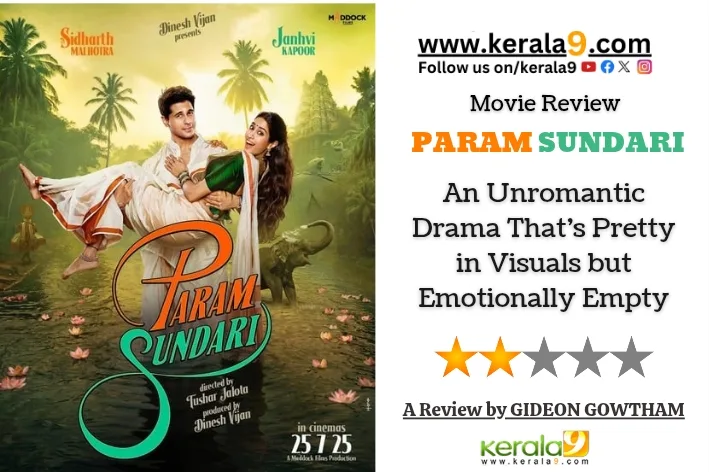
Param Sundari Review -An Unromantic Drama That’s Pretty in visuals but Emotionally Empty
Director : Tushar Jalota
Duration: 136 minutes
Language: Hindi
Genre : Romantic Comedy.
POSITIVES
1: Cinematography
2: Performance of some actors
NEGATIVES
1: Story
2: Performance of some actors (over acting)
3: No Emotional connection
4: Under developed arc
5: Dialogue
6: Comedy
STORY
The story revolves around a millionaire’s son who is portrayed as an ambitious yet immature entrepreneur. He has failed at multiple startups, burning through his father’s money, and is on the verge of losing his final chance. His father, tired of the failures, plans to sell off the company. This sets up the central conflict in desperation, the son pitches a new idea: an app that can scientifically find a person’s true soulmate.
On the surface, it feels like a fresh, modern concept. But the way it’s executed makes it predictable right from the start. His father, skeptical but willing to give him one last shot, sets a condition: prove the app works within 10 days by finding your own soulmate.
From here, the film moves into its romantic track. According to the app’s algorithm, his soulmate turns out to be Janvi Kapoor, a Malayali woman who manages a traditional residential home. She is written as simple, grounded, and deeply rooted in her culture, in direct contrast to the hero’s flashy, privileged life. This clash of personalities had great potential, but the film never really explores it beyond superficial banter and cliché interactions.
As the hero tries to win Janvi over, the audience is dragged through a mix of staged comedic situations and predictable romantic gestures. While Janvi slowly begins to soften towards him, her life comes with a catch she has a childhood friend to whom she has been emotionally bound since her early years. Their families have long dreamed of their marriage, making her loyalty to him almost inevitable. This creates a ticking clock for the hero: he has 10 days to not only prove his app works but also convince Janvi to choose him instead of her destined partner.
Just when it seems like the story might dig into this conflict, comes the twist: the hero discovers that the app developer, the very foundation of his project, is a fraud. The science behind his “soulmate finder” collapses, leaving the hero disillusioned. This is the film’s big emotional turning point, and it should have been the strongest moment of the narrative. But instead of exploring the gravity of this betrayal, the film moves past it too quickly.
The hero, wracked with guilt, confesses everything to Janvi that their entire relationship was sparked not by fate, not by love, but by an experiment tied to his startup. For a brief moment, the film feels raw and human. Janvi, deeply hurt, tells him to leave her life. It’s not dramatic or loud; it’s simply rejection, delivered with the weight of betrayal.
This could have been the point where the film redefined itself diving into redemption, forgiveness, or even the hero learning that love cannot be engineered. But instead, the story slides back into formula, leaving the audience with an ending that feels rushed and predictable. What should have been a poignant reflection on love and honesty becomes just another boy-meets-girl, boy-loses-girl, boy-gets-girl narrative.
Screenplay
Fundamentally, this movie follows the classic three-act model setup, confrontation, and denouement. On a prima facie level, this might seem acceptable; however, the problems exist in its delivery.
The first act introduces a privileged young man and his failed business endeavors. It sets up the premise but does not create a sense of urgency or a strong hook that would interest the audience in his story. The idea of a “10-day soulmate challenge” suggested by his father feels more like a forced plot device than a strong dramatic construct.
The second act, in which he meets Janvi and sets out to capture her heart, is the point at which the film should build tension and emotional investment. Sadly, instead of going deeper, we see shallow interactions. The comedy scenes are self-conscious about their purpose to be funny but don’t quite work. The humor is boisterous instead of witty, and instead of flowing naturally into the story, it is risible as awkward padding.
The conversation is another major weak point. The Malayalam spoken in the film is not authentic; even locals could be stumped into not being able to recognize it as their own language. This inconsistency ruins immersion and creates a separation, especially since the story is supposed to depict the culture of Kerala.
By the third act, the moment of discovery that the app creator is a con artist could have been the clincher. It could have propelled the story further, making the hero realize his inadequacies and actually work towards love. Unfortunately, the script rushes through this critical realization. The emotional consequences of the protagonist’s revelation and Janvi are realized but not explored fully. What should have been the emotional heart of the story simply becomes yet another plot device.
In summary, the screenplay appears to have been crafted to fulfill formulaic requirements rather than to foster authentic drama. There exists a lack of emotional complexity, an absence of organic character development, and no memorable moments that linger after the film concludes. While it adheres to a three-act structure, it overlooks the fundamental element that truly matters: capturing the audience’s emotional investment.
Direction
The direction can best be described as average. The film moves from one act to another without much flair, relying heavily on its glossy visuals rather than strong storytelling. There are moments where the staging and shot choices suggest promise, but they don’t translate into emotional weight or audience engagement.
What hurts more is the projection of Kerala and its people. Small details, like showing a cab driver casually drinking kallu (toddy), feel like cheap stereotypes rather than authentic cultural reflections. Worse, the film even pokes fun at Kerala’s 96% literacy rate one of the state’s proudest achievements in a way that comes across as mocking rather than humorous.
The language, too, becomes a victim. The Malayalam spoken on screen feels so distorted that even native speakers found it difficult to follow. For a film that leans on regional flavor, this is a major misstep; instead of celebrating the culture, it alienates the very audience it claims to represent.
Another disappointing element is the portrayal of female characters. Instead of being written with strength or individuality, they come across as underdeveloped and sometimes even disgracefully caricatured. The female leads are either bound by stereotypes or used as props to further the hero’s arc, leaving little room for their own voice.
Overall, the direction seems to prioritize style over substance, resulting in a film that looks polished on the outside but lacks sensitivity, depth, and respect for the cultural backdrop it portrays.
Cinematography
If there is one department where the film truly excels, it is the cinematography. Every frame looks carefully composed, and the visuals carry a polish that the story itself lacks. The camera work captures vibrant colors, smooth movements, and striking landscapes, making even the most ordinary moments look cinematic.
The lighting is handled with precision bright and lively during romantic sequences, subtle and atmospheric during emotional confrontations. The visual texture feels consistently rich, creating a mood that the screenplay often fails to support.
Each part of the film visually stands out, and in many ways, the cinematography works overtime to hold the audience’s attention. Even when the writing falters, the visuals offer something pleasing to look at, giving the film its only real sense of grandeur.
In short, the best part of the movie is its cinematography. It’s stylish, immersive, and easily the highlight of an otherwise underwhelming experience.
Performances
The acting in this film sits somewhere in the average zone. No one delivers a breakthrough performance, but at the same time, it isn’t outright unwatchable either.
The hero, despite lacking emotional depth in heavier scenes, does manage to bring a certain energy to the lighter portions. His charm works in parts, even if it doesn’t fully carry the story. The heroine, though underwritten, has a natural screen presence in a few moments, especially the emotional confrontation, she does manage to connect.
The supporting cast is a mixed bag: some characters are played too loud, leaning into overacting, while others quietly balance the tone. Now and then, a secondary role sparks a moment of authenticity that reminds you what the film could have been.
So while the performances don’t leave a lasting mark, there are scattered moments where the acting feels genuine and engaging. Somewhere in between, it’s good just not consistent enough to elevate the whole film.
Final Verdict
This is a film that had an interesting premise on paper technology meeting love, tradition clashing with modernity but it stumbles in execution. The direction is average, the screenplay predictable, and the performances land in the “just okay” zone. The biggest saving grace is the cinematography, which consistently delivers stunning visuals and keeps the film from sinking completely.
But weak storytelling, forced comedy, and cultural misrepresentation pull it down. Somewhere in parts it feels good, but as a whole, it never rises above mediocrity.
Rating:
Verdict: A visually polished film that fails to connect emotionally.
A Review by Gideon Jotham