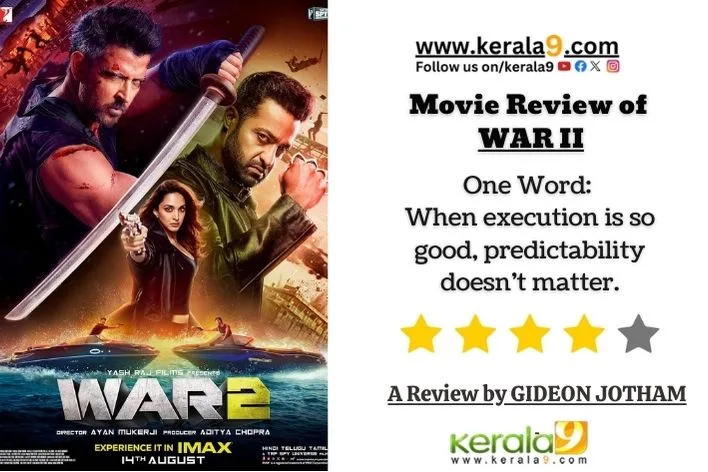
War 2 Review: When execution is so good, predictability doesn’t matter
A REVIEW BY GIDEON JOTHAM
LANGUAGE: HINDI
DIRECTOR: AYAN MUKERJI
SCREENPLAY: SHRIDHAR RAGHAVAN AND ABBAS TYREWALA
PRODUCER: ADITYA CHOPRA (YRF)
RUN TIME: 173 MINUTES
GENRE: SPY ACTION THRILLER
CAST: HRITHIK ROSHAN, Jr NTR, KAIRA ADVANI
POSITIVES:
1: DIRECTION
2: SCREENPLAY
3: CINEMATOGRAPHY
4: EDITING
5: PERFORMANCE OF ACTORS
6: SOUND DESIGN
7: FIGHT CHOREOGRAPHY
NEGATIVES:
1: STORY (PREDICTABLE)
2: SOME VFX
SUMMARY:
The movie begins in the neon-glazed streets of Japan, where one ruthless kill establishes the tone for the rest of the movie. Kabir (Hrithik Roshan), a top RAW agent, is on a perilous assignment to take down a clandestine league of rich power-brokers, the sort of individuals who function above governments, running countries from the shadows. Their next step is nothing less than disastrous: kill India’s Prime Minister and install their own puppet PM.
But Kabir’s battle is not only with them, but also with his own nation’s opinion. In India, he’s not viewed as a hero but as a traitor, an unstable guy who’s gone rogue. To take him down, RAW dispatches one of its finest operatives (Jr NTR) to track him down. That follows is a merciless game of chase, disguise, and changing loyalties, where trust is a commodity no one can afford.
From the streets of Istanbul to the center of India, the tale combines globe-trotting adventure with the individual stakes of loyalty, betrayal, and sacrifice. And at its heart, WAR 2 poses one mighty question: how far would you go to defend your country if it meant allowing the entire world to believe you were the enemy?
Direction
The direction of WAR 2 is a rare example of precision meeting artistry. Ayan Mukerji doesn’t just shoot scenes, he sculpts them. Each frame feels like it has been designed with a lot of patience and craftsmanship, making sure the visual language mirrors the emotional beats of the story. It’s the kind of direction where you can pause at any random moment and see a shot that could hang on a wall as a poster.
What makes it even more impressive is how Mukerji balances massive, globe-spanning action with quiet, character-driven moments. The large-scale sequences are staged with such clarity that you always know where you are and what’s at stake, yet they never lose their human core. The smaller moments, a glance, a silence, a hand brushing against a table are just as impactful as the explosions and fight scenes.
The set work and art direction feel almost alive. Props aren’t just decoration; they’re storytellers. A half-empty glass, a scuffed briefcase, the texture of a wall, these things contribute to the mood and foreshadow what’s about to happen. That’s the beauty of Mukerji’s direction: you’re not just reacting to the present scene; you’re anticipating the next. The placement of objects, the way the camera lingers a second longer, the shift in lighting they hint at what’s coming, almost inviting the viewer to predict the next move. And when the payoff arrives, it feels both inevitable and satisfying.
In comparison to War 1, which thrived on its stylish speed and constant unpredictability, WAR 2 takes a more layered approach. Mukerji gives you just enough visual and emotional cues to sense the direction the story is heading, but not enough to spoil the surprise. It’s a delicate game of letting you think you’ve figured it out, only to twist the knife when you least expect it. Where Siddharth Anand’s War 1 was a roller coaster with sudden drops, WAR 2 feels like a high-stakes chess match, each move deliberate, each consequence earned, and each frame loaded with meaning.
Screenplay
The screenplay of WAR 2 by Shridhar Raghavan and Abbas Tyrewala is a masterclass in how to combine adrenaline-fuelled action with story depth. Right from the first frame, the script draws you in not through gratuitous exposition, but by placing you directly in the tension and letting the world reveal itself around you. The pacing is purposeful but energetic; each scene seems to have a definitive reason for being, whether it’s moving the plot along or increasing our knowledge of the characters.
Each twist is approached with the skill of a perfectly executed chess move. When the plot turns on a betrayal discovered, an alliance made unexpectedly, or an unseen agenda revealed it doesn’t come across as a gimmick added in an attempt to shock the audience. Rather, the set-up has been done subtly in previous scenes, so the surprise is built both from and into the revelation. The layering is where the script shines: even in the most action-heavy sequences, there’s an emotional thread that references back to the motivations of the characters.
Yes, there are times when an experienced viewer can anticipate the next step. But in WAR 2, predictability isn’t a deficit; it’s a dramatic device. The authors know that sometimes it is not necessary to be shocked in order to be thrilled. You see the direction of a scene, sense the tension leading up to it, and when it arrives, the payoff is so precise that it gives you a different form of satisfaction, the satisfaction of having been right but being entertained nonetheless.
One of the most successful aspects of the screenplay is how it makes us feel like participants rather than helpless witnesses. The dialogue is razor-sharp, full of subtext, and frequently has a double meaning that only reveals itself after the fact. Even when the scenes are quieter and more dialogue-reliant, there is always an undertone of calculated maneuvering, a feeling that each word uttered is hiding something or accomplishing something.
Compared to War 1, this writing is more mature and textured. While the first movie lived on shock moments and swift changes of pace, WAR 2 exploits its twists more judiciously but more powerfully. It’s less about keeping up with the audience around each bend and more about involving them in a tapestry of alliances, treasons, and moral compromise. That adjustment in style makes the tale feel richer and more emotionally resonant, without losing the thrill of a spy-action thriller.
Ultimately, it’s a screenplay that is aware of its own strengths: it’s assured in its pacing, cutting in its structure, and not afraid to slow down just enough to make the tension boil before the next explosion. By the end of the credits, you feel the cumulative impact of every choice made both by the characters and by the writers.
Story
The story of WAR 2, credited to Aditya Chopra, treads familiar ground for Indian cinema. The core premise, a high-stakes mission to stop a powerful conspiracy, layered with themes of loyalty, betrayal, and patriotism is something we’ve seen in countless Bollywood, Tollywood, and even Kollywood films. The emotional beats, the ideological conflicts, and the central “spy vs spy” tension have all been explored before, sometimes more than a hundred times across the industries.
However, what makes WAR 2 feel fresh despite the familiarity is not the originality of the plot, but the sheer conviction with which it’s executed. The OG performances from Hrithik Roshan and Jr NTR inject the story with an energy that transforms well-worn tropes into something gripping. Hrithik’s portrayal of Kabir brings a perfect balance of charisma and emotional depth. You believe in his internal conflict just as much as you believe in his ability to win a brutal fight. Jr NTR, on the other hand, is a force of nature. His presence radiates strength, yet his eyes communicate the subtle vulnerabilities of a man caught between duty and doubt.
Kiara Advani adds a vital layer to the story. While her screen time is more focused, her role isn’t just ornamental; she serves as an emotional anchor in a world of deception and violence. Her character’s interactions bring out shades of humanity in both Kabir and Jr NTR’s character, showing us that even in a film about power and politics, personal connections still matter.
What really works in the story is how it takes these familiar beats and elevates them with tension, scale, and emotional stakes. The narrative doesn’t reinvent the wheel, but it paints the wheel with sharper colors, faster motion, and a stronger grip on the audience. In a way, WAR 2 proves that sometimes it’s not about telling a story we’ve never heard before, it’s about telling it with such precision, energy, and heart that we want to hear it again.
Cinematography
If WAR 2 is a visual feast, then its cinematography is the master chef behind it. From the first scene in the neon-lit streets of Japan to the sun-baked rooftops of Istanbul and the sleek glass towers of India’s urban heart, every frame feels like a work of art. The lighting is not just functional, it’s emotional. Warm tones bathe the moments of trust and connection, while colder, harsher palettes define the scenes of suspicion, conflict, and betrayal. This careful control of light doesn’t just make the film beautiful; it shapes how we feel about each scene before a single word is spoken.
The camera work is equally deliberate. Sweeping aerial shots establish grandeur and scale, while tight close-ups bring us into the characters’ most vulnerable moments. The action sequences are a perfect marriage of choreography and lens movement fast, fluid, and yet never chaotic. You can see every punch, every glance, every shift in body language, all thanks to how cleanly the cinematography captures it.
There’s also a keen sense of spatial storytelling. The placement of characters within the frame often hints at the power dynamics between them, a subtle visual cue that adds another layer of meaning to the story. Reflections, shadows, and even the negative space in a shot are used to foreshadow events, making the cinematography feel like an active participant in the narrative rather than just an observer.
For me, this is a clear 10/10 and if I could, I’d give it 15, because it’s worth an extra 5 just for the way light has been used as a storytelling tool. It’s not just about showing the audience what’s happening; it’s about making them feel it, frame by frame. The end result is an experience that lingers in your mind long after the credits roll.
Editing
The editing in WAR 2 is as sharp and seamless as it gets. Every cut feels purposeful; there’s no wasted frame, no unnecessary lingering, and no rushed moment that cheats the audience out of tension. The transitions between scenes, whether jumping across continents or shifting from explosive action to quiet character beats, are smooth enough that you never feel jolted out of the story.
What stands out most is how the editing keeps the adrenaline high without ever becoming disorienting. In action sequences, the cuts are quick but not chaotic; you can follow every movement, every reaction, every subtle shift in momentum. During the slower, emotional moments, the pacing is allowed to breathe, letting silences and glances do their work.
The balance between speed and clarity is what makes the editing feel “OG” ; it’s confident, precise, and completely in tune with the film’s rhythm. It’s the kind of work that doesn’t draw attention to itself, but without it, the film wouldn’t hit nearly as hard.
Actors Performance
Hrithik Roshan (Kabir)
Hrithik Roshan doesn’t just play Kabir he breathes life into him. You can see the years of pain, loyalty, and sacrifice etched in his eyes. In one scene, a silent glance says more than a page of dialogue could. In another, his movements in combat feel like poetry written in speed and precision. What’s beautiful about his performance is how he balances the physical and the emotional one moment he’s breaking bones, the next he’s breaking your heart. Kabir isn’t just a spy here; he’s a man who has carried too much for too long, and Hrithik makes you feel every ounce of that weight.
Jr NTR
Jr NTR walks into the film like he owns the frame and in many ways, he does. There’s a quiet storm in the way he carries himself, a sense that he’s constantly calculating his next move. Then, when he decides to strike, it’s pure electricity. But what really makes his performance memorable is the humanity he brings to the role. Beneath all the power and precision, you catch glimpses of doubt, empathy, and even vulnerability. He’s not just Kabir’s opponent, he’s his equal, his mirror, and in some ways, his rival in humanity as much as in skill.
Kiara Advani
Kiara Advani may not throw punches or leap off rooftops, but her presence is no less impactful. She’s the film’s heartbeat in moments where the tension could otherwise consume everything. There’s a quiet strength in her performance: the way she listens, the way she reacts, the way she draws the humanity out of both Kabir and Jr NTR’s character without even trying. She’s not a side note in the story; she’s the bridge between the chaos and the characters’ inner worlds.
Final Verdict
WAR 2 isn’t just another entry in the YRF Spy Universe it’s proof that even a familiar story can feel thrilling when told with conviction, craft, and heart. Yes, the core premise has been seen before in Bollywood, Tollywood, and Kollywood, but the magic here lies in how every department fires on all cylinders. Ayan Mukerji’s direction turns every frame into a piece of visual storytelling. The screenplay blends adrenaline and emotion with surgical precision. The cinematography and lighting make the film a visual feast, while the editing ensures that the pace never drops below “gripping.”
And then there are the performances of Hrithik Roshan as Kabir, Jr NTR, and Kiara Advani, each bringing a unique energy that lifts the film beyond its genre expectations. Together, they turn what could have been just another spy-action thriller into an experience that makes you feel the weight of every choice, every betrayal, and every moment of loyalty.
This is a film that entertains without insulting your intelligence, and thrills without losing its emotional core. It’s a reminder that great cinema isn’t always about inventing something entirely new, sometimes it’s about taking something known and delivering it so well that it feels brand new again.
If you love action, espionage, and stories where the heart beats as loud as the gunfire, WAR 2 is a must-watch and it’s best experienced on the biggest screen you can find.
Rating: ★★★★ (4/5)
A REVIEW BY GIDEON JOTHAM