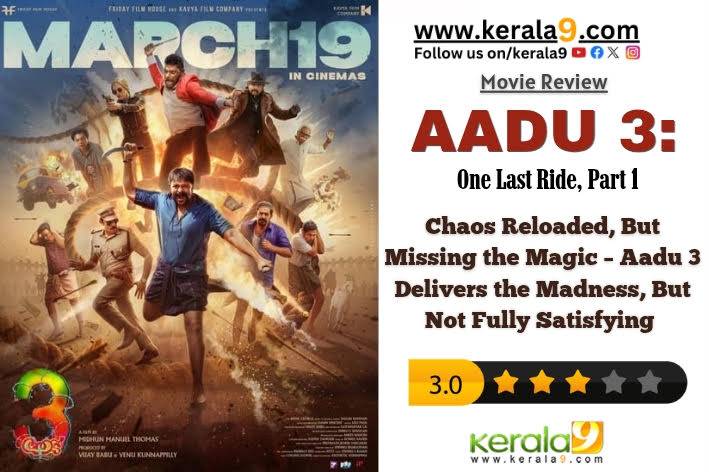
AADU 3 Part 1 Review: Chaos Reloaded, But Missing the Magic – Aadu 3 Delivers the Madness, But Not Fully Satisfying
ONE WORD: Chaos Reloaded, But Missing the Magic – Aadu 3 Delivers the Madness, But Not Fully Satisfying
LANGUAGE: MALAYALAM
DURATION: 02 Hours 50 Minutes
GENRE: Fantasy Comedy Drama
•POSITIVES:
1: Direction
2: Story and fantasy concept
3: Comedies
4: Performance of actors
5: Cinematography
6: Background Score
7: Art Direction
8: Second Half
•NEGATIVES:
1: Predictable
2: Duration of the film
3: Screenplay could have been better
4: Slow first half
AADU 3 Part 1 STORY:
The film moves between two different time periods, connecting the present-day life of Shaji Pappan and his gang with a past rooted in the 1700s. In the current timeline, Pappan once again lands in trouble when he crosses paths with Satan Xavier’s men, who are involved in a plan targeting a bridge. What initially appears to be a routine conflict soon turns into something much bigger, as the bridge is revealed to have a strange and personal link to Pappan’s past. As the narrative shifts across timelines, the story brings in elements like rebirth, parallel identities, and a layer of fantasy that ties everything together. The presence of his longtime rival Dude, along with a new external group, adds to the confusion and escalates the situation further. What follows is a chain of chaotic events where past and present overlap, leading to a mix of humor, conflict, and unexpected twists, giving the film a broader and more ambitious narrative setup.
AADU 3 Part 1 REVIEW & ANALYSIS OF THE FILM:
POSITIVES
1. Direction:
The direction shows a certain level of control, but it doesn’t fully capitalize on the potential of the film’s premise. While the filmmaker manages to keep the narrative from completely derailing, the grip often feels inconsistent rather than firm. There are moments where the storytelling works effectively, especially when blending fantasy with humor, but these highs are not sustained throughout.
The tonal balance between fantasy and comedy, although interesting on paper, feels uneven in execution. At times, the film leans too heavily on comedy, undercutting the weight of important scenes that could have added depth or tension. The director seems more comfortable staging humorous sequences than handling narrative intensity, which results in a lack of emotional or dramatic impact.
Moreover, the staging of certain key moments lacks sharpness. Instead of building momentum, some scenes feel stretched or loosely structured. While the film never becomes entirely dull, it rarely reaches a level of tight, compelling storytelling that keeps the audience fully invested. Overall, the direction is decent but falls short of delivering a consistently engaging and well-controlled cinematic experience.
2. Story & Fantasy Concept
The core idea of combining a dual timeline narrative with a time travel concept is ambitious and intriguing. However, the execution doesn’t fully match the strength of the concept. While the integration of familiar characters into this fantasy setup is handled in a somewhat convincing manner, the writing often plays it safe, avoiding deeper exploration of its own ideas.
The time travel element, which should have been a major highlight, feels underdeveloped and is introduced more as a convenient plot device rather than a well-built narrative foundation. Instead of adding complexity or emotional weight, it mostly serves to create momentary excitement without long-lasting impact.
Additionally, the screenplay relies heavily on sudden occurrences and convenient transitions. While these moments keep the narrative moving, they also expose a lack of strong structural depth. The continuity is maintained at a surface level, but when examined closely, the progression feels less organic and more constructed.
Another drawback is the predictability in key portions of the plot. Despite the fantasy angle, many developments follow familiar patterns, reducing the sense of surprise. The film hints at a larger universe and leaves room for a sequel, but this setup feels more like a missed opportunity than a fully satisfying narrative arc. In essence, the story has a strong foundation and plenty of scope, but the writing doesn’t fully explore its potential, resulting in a film that is engaging in parts but not consistently compelling.
3. Comedy
Comedy remains the backbone of the film, staying true to the essence of the franchise. The humor is not just situational but also character-driven, which makes it more effective. Interestingly, even during intense or crucial moments, the film smartly injects comedy, making the experience unique and highly entertaining. Characters like Dude, Pappan, and Shammer consistently deliver laugh-out-loud moments. Their presence ensures that even serious scenes don’t feel heavy, maintaining a light-hearted tone throughout. The film successfully uses comedy as a narrative tool rather than just an add-on.
4. Performances
The performances elevate the film significantly:
Jayasurya as Pappan delivers a solid performance, perfectly retaining the character’s signature traits and energy. His consistency helps anchor the film. Vinayakan as Dude is a standout performer. He effortlessly balances humor, intensity, and unpredictability, making his character both entertaining and intriguing. His timing and screen presence add immense value. Sunny Wayne as Sathan Xavier gets more scope in this installment and utilizes it well, maintaining the comedic rhythm effectively. Vijay Babu as Sarbath Shammer continues his usual entertaining streak, making good use of his screen time with impactful comic moments. Dharmajan Bolgatty as Captain Cleetus steals the show. His comic timing, expressions, and ability to sustain humor from start to finish make him one of the most memorable aspects of the film. Saiju Kurup as Arakkal Abu was at his best as usual and other actors like Indrans, Sudhi Koppa, Bijukuttan, Aju Varghese, Bhagath Manuel have done complete justice to their respective supporting characters.
5. Technical Aspects
- Cinematography
The visual treatment of the film, especially during the periodic sequences, is impressive. The cinematography effectively captures the mood and enhances the fantasy elements. The visuals are clean, well-composed, and supportive of the narrative, adding depth to the storytelling.
- Background Score
The background score plays a crucial role in enhancing the film’s impact. Each character is accompanied by distinct theme music, which adds both nostalgia and excitement. These musical cues elevate key moments, especially during entry scenes and important plot developments, making them more engaging and memorable.
- Art Direction
The art department deserves appreciation for its effort in recreating the period settings. The sets are designed neatly and blend well with the narrative. The attention to detail helps in making the fantasy world more believable and immersive.
- CGI
Considering the requirements of the story, the use of CGI is handled decently. While not extraordinary, it is convincing enough to support the narrative without becoming distracting. The visual effects serve their purpose effectively within the film’s scale.
6: Second Half
The film truly picks up pace in the second half. Compared to the first half, it is more engaging, faster, and packed with interesting developments. The narrative shifts into a more thrilling mode while still retaining its comedic essence. This balance between humor and progression makes the latter half more enjoyable and impactful.
NEGATIVES FELT:
1. Predictability
Despite building itself on a fantasy-driven premise with elements like dual timelines and time travel, the film surprisingly falls into familiar narrative patterns. Many of the twists that are meant to create impact can be seen coming from a distance, reducing the sense of surprise. Instead of subverting expectations, the writing often follows a safe route, making certain key moments feel routine rather than exciting.
This predictability becomes more noticeable because the film promises complexity but doesn’t fully deliver on it. The audience is rarely challenged or caught off guard, which slightly weakens the overall engagement. With a concept like this, there was ample opportunity to create layered storytelling, but the film settles for straightforward progression instead.
2. Duration
The film suffers from an overstretched runtime that affects its overall sharpness. While there is enough content to justify a decent length, the lack of tight editing makes several portions feel unnecessarily prolonged. Certain scenes linger longer than required, and a few sequences could have been trimmed without affecting the narrative. This extended duration particularly impacts the pacing in the earlier portions, where the film takes time to find its rhythm. A more disciplined edit could have made the storytelling more crisp, enhancing both the entertainment value and narrative flow. Instead, the film occasionally feels indulgent especially the first half makes the momentum slow.
3. Screenplay
The screenplay is where the film shows its biggest limitations. While the story idea has strong potential, the writing doesn’t fully translate that strength onto the screen. Several scenes feel underwritten, lacking the depth and detailing needed to make them truly impactful. Transitions between key moments often feel convenient rather than organic, giving the impression of a loosely structured narrative. Emotional beats are not explored deeply, and dramatic moments sometimes pass without leaving a lasting impression. The film also relies heavily on its comedy to carry the narrative, which, while effective in parts, cannot completely compensate for the lack of a tightly woven screenplay. With more refined writing—especially in terms of structure, character development, and conflict building—the film could have achieved a much stronger narrative impact.
4: Slow First Half
The first half of the film struggles with pacing issues, taking considerable time to establish its world, characters, and narrative direction. While this buildup is necessary to some extent, the execution feels inconsistent, with several scenes not contributing significantly to the overall progression.
The shift between timelines, which should have been an engaging narrative device, works only partially. While a few of these transitions feel interesting and spark curiosity, others come across as just average, lacking the impact needed to hold strong attention. This inconsistency makes the flow feel uneven—at times engaging, but at other moments just “okay,” without creating any real excitement. There is a noticeable lack of urgency in the storytelling during this phase. Even though the comedy elements help maintain a watchable tone, they don’t fully compensate for the slow momentum. The film doesn’t become boring outright, but it also doesn’t reach a level where the audience feels completely hooked.
This results in a mixed experience—watchable, mildly engaging in parts, but not consistently compelling. The contrast becomes more evident when compared to the second half, which is far more dynamic and focused.
CONCLUSION:
So overall, Aadu 3 feels like a film caught between ambition and identity. It tries to grow bigger, louder, and more complex, but in doing so, loses some of the raw, carefree madness that once made the franchise so much fun. Midhun Manuel Thomas tries to scale up the vision, but somewhere along the way, the film drifts away from the chaotic charm that once defined it. That said, it’s not a dull ride. The humor still clicks, the characters still entertain, and the second half brings in the energy the film initially lacks. You keep waiting for it to fully take off—and while it never quite reaches that high, it gives enough moments to stay invested. Overall, a film that promises more than it delivers, but still manages to entertain in its own messy, uneven way — a one-time watch with flashes of fun.