
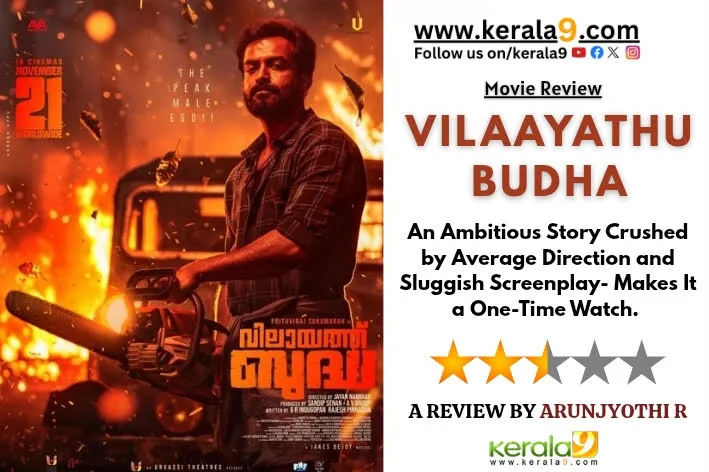
Vilayath Budha Review ONE WORD: An Ambitious Story Crushed by Average Direction and Sluggish Screenplay- Makes It a One-Time Watch.
A Review by Arunjyothi R
LANGUAGE: MALAYALAM
DURATION: 02 Hours 56 Minutes
DIRECTOR: Jayan Nambiar
GENRE: Action Thriller
•POSITIVES:
1: Story
2: Prithviraj Sukumaran
3: Performance of actors
4: Music and Background Score
5: Cinematography
•NEGATIVES:
1: Direction
2: Screenplay
3: Duration of the film
4: Editing
5: Lagging at many points
6: Weak emotional arch
7: VFX
STORY:
Set in the rugged landscapes of Marayur, Vilaayath Budha unfolds through the life of Double Mohanan, a man whose reputation is split between fear and admiration. Known for his deep involvement in the illicit trade of sandalwood, Mohanan moves through the village like a shadow—dangerous to many, yet a symbol of daring ambition to others. At the same time, his heart is drawn to Chaitanya, a strong-willed woman who runs her jaggery enterprise with fierce independence and fearlessness.
Not far from Mohanan’s world stands Bhaskaran Master, a former teacher who has nurtured an exceptionally rare fragrant sandalwood tree in his courtyard. This tree is not just a plant for him—it’s tied to an old wound that he guards with pride and silence. When Mohanan comes across this precious tree, he sees his next big opportunity. But for him, the chase is not just about money; it’s also a chance to settle an old score with the very man who once guided his school days.
What follows is a gripping duel of pride, vengeance, and survival. The tension between Mohanan and his former mentor intensifies as their motives collide, raising the question: can Mohanan overpower the past and claim what he desires, or will the weight of old grudges crush his plans?
REVIEW & ANALYSIS OF THE FILM:
Vilaayath Budha begins with a foundation that instantly sparks curiosity. The premise holds enough dramatic weight to promise a captivating emotional journey, even if the storyline isn’t groundbreaking. What makes the film initially appealing is its attempt to explore the complex human emotions hidden beneath a seemingly straightforward conflict. The intention is visible, and at times, the emotional textures do resonate, but the execution never fully shapes them into something memorable.
The film is inspired by a widely appreciated novel, known for its tense, atmospheric storytelling. The original work offers a gripping blend of suspense, character depth, and moral ambiguity. While the adaptation manages to brush against a few of these strengths, it struggles to carry them through to the finish. The final act, especially, feels like a steep downfall. The movie introduces several interesting personalities, yet their arcs remain underutilized. This is a classic case of a strong narrative foundation being let down by an inconsistent cinematic translation.
One of the biggest hurdles here is the transformation of the novel into a functional screenplay. Many literary adaptations stumble at this stage, and Vilaayath Budha unfortunately joins that list. The pacing is unusually lethargic, the storytelling lacks energy, and the interest the opening scenes build gradually dissolves. What starts as a promising setup collapses midway, almost like a structure that appears sturdy but crumbles due to weak support underneath. The dullness of the narrative rhythm further prevents the story from reaching its potential impact.
The script had all the required ingredients to evolve into a gripping thriller, but the writing never sharpens itself enough to achieve that. Instead of digging deeper into character motivations or emotional complexities, the film repeatedly falls back on predictable genre staples. There’s an unmistakable absence of intensity in the storytelling. Despite having the right atmosphere and premise, the film limits itself to formulaic choices, leaving little room for innovation or emotional depth.
The movie’s first half is passable, though not engaging enough to pull the audience fully into its world. But the second half slows down drastically, stretching scenes far beyond necessity. Several moments that were designed to be emotionally strong feel muted and hollow. A tighter, more disciplined runtime would have significantly improved the experience. Even the dialogue writing seems uninspired, making several scenes feel flat and disconnected from the seriousness the film demands.
One of the most crucial issues arises in the climax. The final stretch, intended to deliver the emotional and dramatic high point of the story, falls shockingly short. The twist, instead of surprising or stirring the audience, comes across as unpolished and even amateurish. Character emotions are expressed without conviction, and the scenes meant to hold weight are staged without depth. This lack of precision drains the climax of all emotion and suspense.
The screenplay tries to preserve the layered texture of the novel but fails to translate that complexity effectively. The narrative becomes unnecessarily heavy due to an over-reliance on literary-style exposition. Some emotional beats are rushed, some are overstretched, and several promising secondary characters receive minimal development. The imbalance in pacing and character focus further pulls the film away from achieving its intended intensity.
The central emotional conflict—the core rivalry and ego-driven tension between the two men—never rises to its full potential. Prithviraj has previously headlined films that brilliantly showcased such confrontations, but here, the staging lacks bite. The direction does not deliver the gravitas or raw energy required for such a theme. The filmmaking feels oddly detached, with scenes stitched together in a way that often feels forced. If a visionary filmmaker like Sachy had helmed this project, the thematic intensity might have been elevated beyond measure. Instead, the film lacks authenticity in its transitions, its dramatic staging, and its emotional peaks.
However, the shortcomings are substantial. The direction lacks clarity, the screenplay feels half-baked, the film drags far longer than necessary, and the editing—despite having clean transitions—fails to maintain rhythm. VFX work looks unrefined, and several action sequences appear exaggerated and overly cinematic. Emotional arcs remain weak, and many crucial scenes fail to land with the intended force. Numerous moments feel disconnected, making the film’s journey uneven and tiring.
Yet, amidst these shortcomings, there are bright spots. The storyline itself remains undeniably compelling. Prithviraj Sukumaran’s performance becomes the primary driving force, keeping the audience anchored through even the tiring portions. His dialogue delivery is sharp, emotional scenes are handled with finesse, and his romantic and action sequences show controlled commitment. The soundtrack by Jakes Bejoy brings warmth and atmosphere, although one or two songs feel misplaced. The background score, however, successfully sustains tension and gives life to many scenes that would otherwise fall flat. The cinematography is another major asset, offering stunning forest shots, atmospheric night sequences, and expressive close-ups that capture the mood beautifully.
Shammi Thilakan turns out to be one of the film’s strongest assets, carrying his role with remarkable precision and emotional weight. His performance subtly echoes the legacy of his legendary father, bringing a natural intensity and sharpness to every line he delivers. Whenever he shares the frame with Prithviraj, the chemistry elevates the scene, making those moments some of the most engaging in the film despite its shortcomings. Priyamvada Krishnan, too, delivers a confident performance. Having already made an impact with her debut in Thottappan, she once again proves her ability to stand firm beside seasoned actors. Her character, bold and uninhibited, complements Mohanan’s recklessness perfectly, adding both spark and unpredictability to their dynamic.
CONCLUSION:
Overall, Vilaayath Budha is a film built on a solid foundation but weakened by its own execution. The story, the performances, and the technical craft show flashes of what the film could have been, yet the inconsistent direction, sluggish pacing, and underdeveloped emotional beats hold it back from reaching its full potential. Prithviraj, Shammi Thilakan, and Priyamvada Krishnan give the narrative the spark it desperately needs, but even their committed performances cannot completely rescue the film from its structural shortcomings. Vilaayath Budha remains a watchable attempt with notable merits, but it ultimately falls short of delivering the gripping, emotionally charged drama that its premise promises.
RATING: 2.5/5
A Review by Arunjyothi. R