
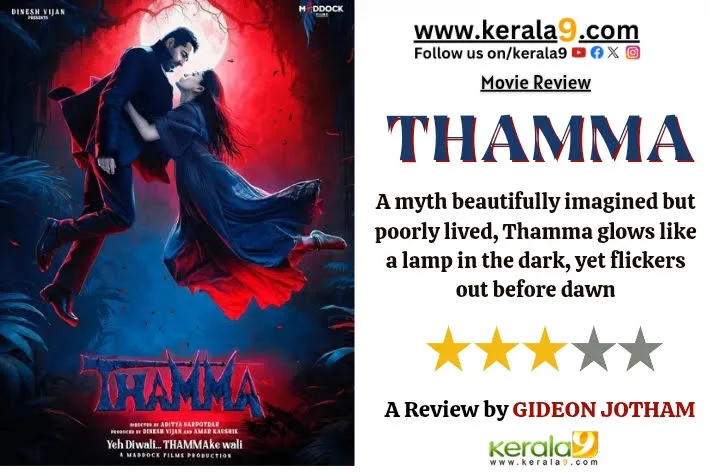
Thamma: “A myth beautifully imagined but poorly lived, Thamma glows like a lamp in the dark, yet flickers out before dawn.”
A REVIEW BY GIDEON JOTHAM
Film: Thamma
Director: Aditya Sarpotdar
Language: Hindi
Duration: 2hr 28 Min
Genre: Horror, Comedy, Romance
Positives
- Story
- Performance of actors
- Screenplay.
- Music and Songs
- Artworks
- 1st Half
Negatives
1. Predictability
2. Link to the other films
3. Cinematography
4. Second half
Story
Long before independence, when white men ruled the land and faith was sold for science, the British dug through the soil of India not for treasure but for truth they could cage. In their arrogance, they unearthed what should have stayed buried the myth of Thamma, a being that wasn’t god or ghost, but the very balance between life and death. Those who tried to understand it vanished into madness, their research sealed in forgotten colonial archives.
A century later, in modern-day India, Alok Goyal (Ayushmann Khurrana), a young historian working for the National Museum, stumbles upon one of those lost British manuscripts. Its pages speak of “Thamma The Blood of the Eternal” a cryptic line that grips Alok’s mind like a curse. He dismisses it as superstition at first, but curiosity becomes obsession. He travels to an abandoned British outpost in South India, where myth and history blur into something far more dangerous.
There he meets Tadaka (Rashmika Mandanna) a woman who seems to know his past before he speaks it. She moves through the village like a ghost in daylight, her presence magnetic, her eyes filled with centuries of silence. When she touches him, Alok feels a pulse that isn’t his own.
Slowly, his world begins to unspool. Mirrors refuse to reflect him. His body rejects the sun. Dreams of old British explorers, blood rituals, and firelit chants invade his nights. The transformation is not cinematic it’s slow, painful, and terrifying. Alok realizes that the manuscript he found wasn’t a record of a myth it was a warning.
As Alok’s humanity fades, he becomes the reincarnation of the very creature the British feared the Thamma. But his awakening also reawakens Yakshaashan (Nawazuddin Siddiqui), the last living Thamma from centuries ago a once-noble guardian now twisted by eternal hunger. Their connection is both ancestral and apocalyptic.
The final act unfolds during Diwali lamps glowing, streets alive as Alok’s body burns from within, torn between his human love for Tadaka and the monstrous instinct calling him to Yakshaashan’s side. The festival of light becomes a battle between creation and decay, between love and hunger, between man and myth.
By the end, Thamma isn’t just a supernatural tale it’s a haunting reflection on colonial greed, eternal punishment, and the dangerous thirst for truth. Alok’s tragedy is that he didn’t find history; he became it.
Direction
Aditya Sarpotdar’s direction in Thamma feels like a grand visual poem trapped inside a confused screenplay. There’s no denying that he is a director with vision his sense of atmosphere, tone, and texture is striking. From the colonial ruins to the candle-lit interiors, from the haunting shadows to the surreal transitions between dream and reality, every frame feels aesthetically alive. But beauty alone cannot hold a film together and that’s where Thamma slowly loses its soul.
Sarpotdar begins the film with a strong foundation: myth meets modernity, love meets legend, and horror meets philosophy. The first act is promising, filled with a sense of mystery and intellectual curiosity. But as the story deepens, the direction begins to wander without purpose. The tension that he builds so carefully never fully explodes; instead, it dissolves into fragments of misplaced subplots and emotional confusion.
There’s a constant struggle in his storytelling as if he’s torn between making an artistic horror film like Tumbbad and a commercial mythological entertainer. This tonal tug-of-war creates a rhythm that feels inconsistent. Some scenes linger too long, milking atmosphere without advancing emotion, while others rush past crucial character moments, robbing the story of its depth.
The romance between Alok and Tadaka, which could have been the film’s emotional heartbeat, is treated like a subplot instead of a central force. Their chemistry flickers in glimpses but never glows not because the actors lack effort, but because the direction never lets them breathe. Moments that demand silence are often drowned by visual gimmicks or misplaced background music.
To his credit, Sarpotdar handles scale well. The world of Thamma feels grand and believable, and the mythological layers are fascinating. But he fails to connect that grandeur with emotional gravity. His eye captures beauty, but his hand forgets to guide emotion. The film looks like it’s about gods and curses yet what it really needed was pain, intimacy, and quiet madness.
By the climax, when the lights of Diwali glow over the chaos of gods and monsters, the audience feels visually stunned but emotionally disconnected. Sarpotdar has built a temple of atmosphere but one without a beating heart.
In the end, his direction in Thamma stands as a reminder that a filmmaker can master the craft but still lose the soul of storytelling. Aditya Sarpotdar gives us a film that looks like mythology reborn, but feels like emotion forgotten.
Screenplay
If Thamma had one fatal flaw, it was not the story it was the way it was told. The film had the bones of brilliance: colonial history, mythical horror, and a love story torn between light and blood. But the screenplay, instead of weaving these layers together, scatters them like broken fragments of a forgotten script.
The first act begins with intrigue Alok’s discovery of the British manuscript, the mysterious Tadaka, and the slow emergence of the myth. For a while, it feels like the film is building toward something grand. But soon, the writing loses focus. Scenes drift without purpose, dialogues become overly symbolic, and subplots emerge without emotional consequence. What should have been a steady descent into darkness becomes a clumsy fall into confusion.
The structure feels rushed in parts and painfully stretched in others. Moments that should breathe Alok’s realization of his transformation, his moral struggle, his love for Tadaka are brushed past as if the film is afraid of silence. Instead of exploring his internal collapse, the screenplay jumps from one visual metaphor to another, mistaking mystery for depth.
The emotional beats are unbalanced. The romance feels half-written, the horror lacks buildup, and the mythology is reduced to scattered exposition. There’s no rhythm between tension and release the story unfolds in bursts, never settling into a consistent tone. Even the dialogues, though occasionally poetic, often sound like they’re written for the trailer rather than the scene.
One of the screenplay’s biggest crimes is its inability to connect emotion with logic. Characters behave erratically; motivations are murky. Tadaka appears and disappears like a symbol rather than a person. Yakshaashan’s backstory, which could have grounded the myth, is delivered too late and too briefly. The result is a film that constantly teases brilliance but never earns it.
There’s also a frustrating lack of perspective. The story begins as Alok’s personal journey an academic’s descent into legend but halfway through, the narrative loses sight of him. The focus shifts aimlessly between mythic backstory, political undertones, and visual grandeur, making the emotional center vanish completely.
What hurts most is the wasted potential. Thamma could have been a rare blend of Indian mythology and gothic horror a story that questions identity, colonial guilt, and eternal punishment. Instead, the screenplay flattens it into a series of visually arresting, emotionally hollow scenes.
By the final act, you realize that Thamma isn’t incoherent because it’s complex it’s incoherent because it’s unfinished.The story knows where it wants to go but not how to get there.
In short, Thamma’s screenplay feels like a sacred text translated without understanding its soul. The myth is there, the world is there, but the heart is missing. And when the writing lacks heart, even the most powerful legends fall silent.
Cinematography and Editing
If Thamma stumbles in writing, it at least tries to redeem itself visually but even that redemption feels partial, uneven, and at times self-indulgent. The cinematography by Pratheep Kaliraja (if we go by the credits) aims for mysticism, grandeur, and texture but often mistakes visual density for depth. The film is bathed in tones of decay sepia, smoke, and desaturated golds trying to recreate a mythic past haunted by colonial echoes. On the surface, it looks impressive; the frames are carefully composed, the lighting symbolic, and the camera movements deliberate. But beyond the beauty lies a sense of disconnection.
The lens constantly tries to tell a story the screenplay forgot to lingering too long on metaphors, ruins, and cryptic imagery. The problem is not the ambition but the execution. The camera romanticizes what it should fear, aestheticizes what it should haunt. As a result, Thamma becomes visually beautiful but emotionally hollow every shot screaming for meaning that never arrives. The transitions between reality and hallucination are blurred, but not in a way that invites the viewer in; they confuse rather than mesmerize.
That said, there are flashes of brilliance especially in scenes involving the forest, the temple ruins, and Tadaka’s appearance. The use of shadows and reflections conveys an otherworldly tension that the writing fails to support. The DP clearly had a vision, but without narrative rhythm, those moments float like paintings in search of a story.
Editing, on the other hand, worsens the film’s imbalance. The cuts are either too abrupt or painfully delayed, leaving sequences hanging in awkward silence or rushing through emotional beats. The pacing never stabilizes it’s as if the film keeps forgetting what mood it’s in. One moment, it’s meditative; the next, it’s chaotic. The transitions between timelines and realities, rather than adding intrigue, often blur the viewer’s comprehension.
The editing also struggles with tone. It doesn’t know when to breathe and when to bite. Key emotional scenes like Alok’s confrontation with Tadaka or his descent into obsession are chopped too short, while less essential sequences are stretched unnecessarily, breaking momentum. The visual rhythm collapses under its own ambition.
In essence, Thamma’s cinematography and editing mirror the film itself filled with intention but lost in translation. Every frame promises poetry, but the cut kills the rhythm before the emotion can bloom. What could have been a haunting visual epic turns into a fragmented gallery of half-realized dreams.
Music and Sound Design
If Thamma falters in story and screenplay, its music and sound design are the closest things to salvation though even here, brilliance is uneven. The soundtrack attempts to mirror the film’s mythic ambition, blending traditional instruments, haunting chants, and subtle electronic textures. Moments of tension, particularly when Alok’s transformation begins, are supported by layers of sound that are ethereal, eerie, and emotionally resonant. These cues give fleeting life to a narrative that otherwise struggles to grip.
The background score often works beautifully during ritualistic sequences, temple scenes, and moments of supernatural suspense. The thrum of drums, low humming vocals, and choral swells immerse the viewer in a world where mythology collides with reality. In particular, Tadaka’s appearances are often accentuated by sound motifs subtle enough to suggest mystique, strong enough to create anticipation.
However, the sound design is inconsistent. In some action sequences or transformational moments, the audio overwhelms the visuals rather than complementing them. Loud crashes, overused crescendos, and sudden musical shifts sometimes distract instead of heightening the tension. Silence, which could have been used as a powerful tool to let the horror or emotional weight breathe, is rarely exploited. There’s very little subtlety in moments that demand it; instead, the soundscape frequently opts for the obvious “dramatic cue” approach.
Songs, where they appear, feel inserted rather than earned. Their placement interrupts the flow of the narrative, breaking the immersion and reducing tension. While each track individually has merit and occasional emotional punch, the overall integration with story and characters is flawed.
In short, Thamma’s music and sound design oscillate between brilliance and overstatement. They occasionally lift the film, offering glimpses of the mythic and supernatural grandeur it aims for, but cannot fully compensate for the narrative and structural weaknesses. The score and soundscape whisper what the story often fails to shout: a haunting, ancient world caught between history, legend, and human frailty.
Performance of Actors
In Thamma, the performances reflect both potential and frustration the actors clearly tried to give life to their roles, but the writing and direction frequently leave them stranded.
Ayushmann Khurrana as Alok Goyal carries the film’s emotional weight, and to his credit, he commits fully to the transformation from a curious historian to a man grappling with a mythic curse. His subtle expressions, hesitant body language, and moments of quiet fear convey vulnerability. However, the inconsistent screenplay and abrupt character shifts leave his performance underutilized Alok’s internal struggle is sometimes lost between rushed transitions and visually striking but emotionally empty sequences. Despite this, Khurrana’s screen presence is enough to make the audience care, even if just slightly, about his fate.
Rashmika Mandanna as Tadaka exudes grace, mystery, and elegance. Her physical presence and controlled expressions add depth to a character that is otherwise thinly written. Tadaka is meant to be the bridge between myth and human emotion, yet the abruptness of her arc and limited dialogue prevent her from fully inhabiting the role. While she shines in visual and mystical moments, the emotional connection with Alok never quite ignites, leaving their romance only partially realized.
Nawazuddin Siddiqui as Yakshaashan is magnetic in brief appearances. He brings menace, gravitas, and an underlying sense of ancient sorrow, but the script doesn’t give him enough screen time or context to make the character truly memorable. His presence hints at immense potential, yet his role feels fragmented, a shadow of what could have been a mythic antagonist.
Supporting cast members village elders, colonial figures, and other mystical beings perform competently but are largely underwritten. Many characters exist to move the plot forward rather than as fully realized humans, leading to emotional detachment in key narrative beats.
Overall, the performances in Thamma are a mix of dedication and frustration. Talented actors attempt to breathe life into a film that rarely allows them the space to do so. Their efforts provide intermittent glimpses of engagement, but the screenplay’s shortcomings prevent the performances from reaching their full impact.
Final Verdict: 3 / 5 
Thamma is a film of ambition and beauty trapped in inconsistency. It promises myth, horror, and romance wrapped in a haunting colonial past, but the narrative never fully delivers. The direction dazzles visually, the performances hint at depth, and the music and cinematography evoke wonder, yet the screenplay collapses under its own weight, leaving characters underdeveloped and the story emotionally hollow.
What could have been a gripping, mythic journey instead becomes a collection of striking images and fragmented ideas. The romance falters, the mythology feels underexplored, and the tension rarely sustains itself leaving the audience more impressed by what they see than what they feel.
Thamma is watchable for its aesthetic ambition and occasional supernatural thrills, but it is ultimately a film where potential outweighs execution. A fascinating myth emerges from shadows, yet the light of storytelling barely reaches it.
A Review by Gideon Jotham