
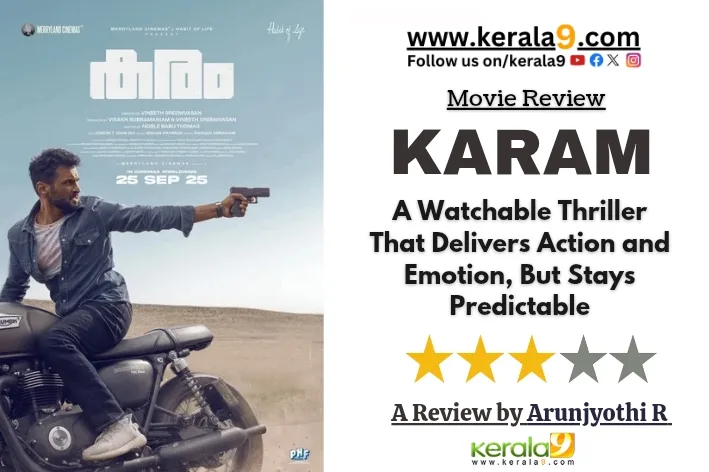
Karam Movie Review ONE WORD: A Watchable Thriller That Delivers Action and Emotion, But Stays Predictable
A Review by Arunjyothi R
LANGUAGE: Malayalam
DURATION: 02 Hours 08 Minutes
DIRECTOR: Vineeth Sreenivasan
GENRE: Action Thiller
•POSITIVES:
1: Direction
2: Action Sequences
3: Cinematography
4: Music and Background Score
5: Performance of actors
6: Production and Technical Quality
7: Editing and Colour Grading
•NEGATIVES:
1: Predictable Story
2: Screenplay
3: Resemblance of Thira
4: Routine Templates of an action thriller
5: Comedy situations felt forceful
STORY:
Karam follows former army officer Dev Mahendran, who is now living a happy life with his wife and child, while trying to move past a troubled relationship with his father and a series of personal tragedies. During a family trip to the city of Lenarco for his wife’s business meeting, Dev unexpectedly crosses paths with his ex-girlfriend, who is trapped in a human trafficking ring. Determined to rescue her, he is forced to confront dangerous criminals and risks not only his own life but also the safety of his family. The film explores how a seemingly simple family trip spirals into a high-stakes battle, showcasing Dev’s courage, resilience, and the lengths one will go to protect loved ones.
REVIEW & ANALYSIS OF THE FILM:
WHAT ARE THE POSITIVES:
1: One of the major positives of Karam is the direction of Vineeth Sreenivasan. He steps away from his familiar feel-good style and confidently experiments with a darker, more action-driven narrative. The making is stylish, technically sharp, and clearly a notch higher compared to his earlier attempt in Thira. In fact, certain portions of Karam do resemble the mood and tone of Thira, but here the execution feels more refined and advanced. The action sequences are staged neatly, and his grip on pacing ensures the film never drags. That said, Karam doesn’t really push you to the edge of your seat. It works well as a solid action thriller, but not as one of the genre’s finest. Still, the direction succeeds in making it engaging enough to enjoy on the big screen, offering a good theatre experience that justifies at least a one-time watch.
2: Karam maintains a balanced momentum throughout, ensuring that the viewing experience never turns dull. While the script does suffer from a sense of predictability, it is Vineeth Sreenivasan’s direction that manages to neutralize this drawback. His controlled narrative flow and stylish execution keep the audience invested, making the film move forward with proper rhythm. The film certainly has its standout moments, but rather than riding on sudden highs or dipping into lows, it travels on a steady, consistent line. This linear graph of storytelling works in its favor, as the continuous flow sustains audience engagement without ever giving a dragging feel. Even when you sense where the story might be headed, the treatment keeps you seated with interest, proving that Vineeth’s craftsmanship elevates an otherwise familiar screenplay.
3: The romantic scenes between Noble Babu Thomas and Audrey Miriam are few, but Vineeth Sreenivasan makes every moment count, showing how a skilled director can make the audience truly connect. Through subtle gestures, meaningful glances, and carefully crafted interactions, he makes us feel the blossoming of their love, the pain of separation, and the lengths one is willing to go for a loved one. Even in a high-stakes action thriller, these scenes stand out emotionally, adding depth to the characters and giving the story a heartfelt dimension. It’s remarkable how just a handful of well-executed moments can make the romance feel so real and engaging, highlighting Vineeth’s ability to weave emotion seamlessly into the narrative.
4: Another strong positive of Karam lies in its action sequences. Since the film is positioned as an action thriller, the fights had a big responsibility to carry the narrative forward, and they do so quite effectively. These aren’t the kind of over-the-top, brutal action blocks that rely on exaggerated stunts, but rather fights that feel grounded, believable, and in sync with the storyline. The choreography is neat, precise, and staged in a way that keeps the audience engaged without ever feeling forced. The momentum of action really kicks in just before the interval and from there continues to escalate till the climax. Each fight sequence adds to the pace and intensity, ensuring that the thriller mood remains intact. The hero’s journey to save his loved one from the clutches of a sex trafficking network is filled with stylish punches, chase moments, and well-timed stunt work. What works best is that the action is not only visually appealing but also emotionally connected to the character’s mission, giving it more weight than just being spectacle. By the time the film reaches its finale, the action has been carried consistently, leaving the audience satisfied with the thrilling quotient it promised.
5: For an action thriller to work, the visuals must enhance the thrill, and in Karam, Jomon T John’s cinematography does exactly that. His frames are stylish, precise, and consistently eye-catching, making the film a treat to watch on the big screen. The clever use of drone shots and wide-angle frames adds more depth and scale to the visuals, giving several sequences an expansive cinematic feel. From start to finish, the visual language perfectly matches the demands of a rescue-driven action thriller, ensuring that the audience is absorbed into the mood and ambience of the story. The second half offers some of the film’s most striking moments — the car chase sequence delivers the kind of adrenaline rush often compared to Hollywood, while the visuals of the fictional land Lenarco are crafted to look authentic and immersive. The rescuing fight sequence, especially the fire accident and gunshot scenes, is brilliantly shot, and the aerial shots amplify the tension while keeping the action visually clear and engaging. Overall, Jomon’s cinematography, with its stylish framing and inventive use of space, stands as one of the strongest pillars of Karam, giving the film a polished and thrilling edge.
6: Music and background score by Shaan Rahman emerge as one of the biggest strengths of Karam. Both the songs and the background compositions are crafted thoughtfully, perfectly aligning with the mood of each scene to enhance thrill, excitement, and emotion. Shaan Rahman’s signature musical style is evident throughout, and he adapts it cleverly to suit the film’s tone. The beats are catchy and immersive, particularly in the track Welcome to Lenarco, where the chorus and instrumentation make for a rich, theatre-filling experience. Another highlight is Uyarnnu Vaa, featuring Fejo’s rap, which adds a fresh and energetic layer to the soundtrack.
Beyond the songs, the background score plays a crucial role in elevating the action sequences, making fights, chases, and tense moments feel more gripping and intense. At the same time, emotional sequences are handled delicately with tunes that tug at the heartstrings without overpowering the scene. Shaan Rahman’s music consistently maintains the right balance between thrill and sentiment, enhancing the cinematic experience from start to finish. Overall, his contribution ensures that Karam is not just an action thriller but also a compelling audio-visual experience, making the film more immersive and engaging.
7: The performances of the actors form another significant positive of Karam. Noble Babu Thomas firmly establishes himself as a promising hero, delivering a performance that is both convincing and intense. Not only did he handle the action sequences with finesse, but as the scriptwriter, it is evident that he fully understands his character’s journey. His portrayal feels natural, whether in high-octane fights or emotional, heart-wrenching moments. The desperation to save his loved one, the struggles he endures, and his willingness to go to extreme lengths to resolve the crisis are all conveyed with authenticity and subtlety, reflecting Noble’s growing maturity as an actor. Audrey Miriam as Sana is equally impressive. Her character acts as a key pivot around which many events of the story unfold, and she delivers her scenes with natural ease and emotional depth, making the audience connect with her instantly. On the antagonist front, Ivan Vukomanović shines as a brutal, merciless gangster. His screen presence is menacing, and he embodies the ruthlessness required for the role with chilling perfection.
8: The production and technical quality of Karam is one of its standout aspects. The film is largely set in Georgia, and the choice of locations adds both authenticity and visual appeal to the narrative. The backdrop of the city and its surroundings enhances the storytelling, making the depiction of sex and human organ trafficking crimes feel more grounded and believable. Every location feels purposeful, contributing to the tension and urgency of the plot. The production quality is consistently high, with no compromises in set design, props, or overall mise-en-scène. Technical aspects such as lighting, sound design, and visual effects are handled meticulously, adding layers to the cinematic experience. The carefully chosen locations not only elevate the aesthetic appeal but also strengthen the narrative, making the film’s dark and intense themes more impactful. Overall, the combination of high production values and technical finesse ensures that Karam delivers a polished and immersive experience for the audience.
9: Editing by Ranjan Abraham is another notable strength of Karam. The cuts are precise and purposeful, particularly during the high-octane action sequences, where every punch, chase, and confrontation flows seamlessly. Transitions between scenes feel natural, maintaining the rhythm of the narrative without any jarring interruptions, which keeps the audience fully immersed in the story. The film’s duration is well-measured, ensuring that the plot moves forward consistently without unnecessary drag. Additionally, the colour grading plays a significant role in setting the film’s tone. The dark, greyish palette perfectly complements the intense and gritty storyline, enhancing the mood and amplifying the tension during critical moments. From the tense action scenes to the emotional beats, the combination of sharp editing and visually appealing grading strengthens the overall cinematic experience. Ranjan Abraham’s work ensures that Karam not only tells its story effectively but also looks and feels stylistically coherent throughout.
WHAT ARE THE NEGATIVES:
1: The first notable drawback of Karam is its storyline, which suffers from a high level of predictability. Once the narrative moves into the main plot, much of the story becomes easy to anticipate—from the unfolding of key events to the motivations behind characters’ actions, and even the arrival of helping hands. This predictability makes the film feel like a routine thriller at times, lacking the element of surprise that keeps audiences truly on edge. That said, the predictability doesn’t completely undermine the viewing experience. Vineeth Sreenivasan’s crisp direction and well-maintained pacing manage to keep the audience engaged, ensuring that the film doesn’t feel dull or stagnant. While it succeeds as a one-time watchable action thriller, the predictable storyline prevents it from reaching the level of a fully compelling, edge-of-the-seat experience.
2: While Vineeth Sreenivasan’s direction keeps the audience engaged, Karam still carries a strong resemblance to his earlier film, Thira. Many aspects—the film’s atmosphere, the unfolding of events, and even the general setting—evoke the same world that Thira created. The storyline and narrative style also mirror his previous approach, giving viewers a sense of familiarity that is hard to ignore. In essence, while Karam is technically more polished, with refined visuals, action sequences, and production quality, it often feels like an upgraded version of Thira rather than a wholly original venture. This similarity does not completely undermine the film, but it prevents it from feeling entirely fresh or innovative. Audiences may appreciate the improved technical finesse, yet the echoes of Thira linger, making parts of the narrative feel somewhat predictable and familiar.
3: The screenplay of Karam is competent and well-structured, but it lacks fresh or innovative concepts. Much like Vineeth Sreenivasan’s Thira, the narrative relies on familiar formulas, making key plot points and the story’s progression fairly predictable. From the way scenes unfold to the eventual resolution, seasoned viewers can often anticipate what is coming next. Additionally, certain sequences and the overall tone evoke the style of classic “Taken”-style detective and rescue action films, which gives the film a familiar global action-thriller flavor but also underscores its lack of originality. While the screenplay ensures that the story remains coherent and engaging, the absence of novel ideas or unexpected twists prevents it from standing out as a truly unique thriller experience.
4: In the second half of Karam, several situational comedy sequences are crammed in between the otherwise tense and thrilling scenes. Personally, I found it hard to connect with these moments, as they felt out of place and somewhat forced, disrupting the overall flow of the narrative. Babu Raj’s character is primarily used for these comic relief segments. While some audience members in the theatre did find them funny, for me, they came across as an unnecessary addition that didn’t land effectively. These poorly integrated comedic moments slightly undermine the intensity of the film, breaking the immersion that the thriller had built up until that point. Instead of enhancing the experience, they feel like filler content, reducing the impact of the high-stakes action and emotional sequences that define the rest of the film.
PERFORMANCE OF ACTORS:
Noble Babu Thomas firmly establishes himself as a promising lead in Karam. His performance is natural and convincing, whether it’s handling intense action sequences or delivering emotionally charged moments. Being the scriptwriter as well, he clearly understands his character’s journey, which shows in the way he portrays desperation, struggle, and determination. From the fight scenes to the emotional beats, Noble brings authenticity and depth to the role, making the hero’s quest to save his loved one feel genuine and engaging. He impresses not just with action but also with his dialogue delivery and emotional depth. His lines are delivered with clarity and conviction, making even simple dialogues feel impactful and natural. In the emotional scenes, especially those depicting his desperation to save his loved one, Noble strikes a perfect balance between intensity and subtlety. He conveys fear, determination, and heartbreak convincingly, allowing the audience to genuinely connect with his character’s journey.
Audrey Miriam, who plays the girl held hostage, delivers a deeply compelling performance. Her portrayal of fear, vulnerability, and resilience is executed perfectly, making the audience empathize with her situation. Despite being caught in a high-tension plot, her acting feels genuine and emotionally resonant. She carries the emotional weight of the story with ease, and her chemistry with Noble Babu Thomas adds a heartfelt dimension to the film. Through her expressions and reactions, she effectively communicates the stakes of the narrative, making her one of the standout performers of Karam.
Ivan Vukomanović delivers a chilling performance as the ruthless antagonist in Karam. His portrayal of a brutal, merciless gangster is intense and convincing, leaving a strong impression whenever he is on screen. He perfectly embodies the menace and unpredictability required for the role, making the hero’s struggle against him feel tense and high-stakes. Ivan’s screen presence adds depth to the conflict and significantly elevates the thriller aspect of the film, ensuring that the audience feels the danger and urgency throughout.
Reshma Sebastian, playing the wife, delivers a solid performance, and her scenes with Noble Babu Thomas, particularly in the second half, are engaging and add emotional depth to the narrative. Manoj K. Jayan, portraying the protagonist’s father, impresses with his intensity and stubborn demeanor, making his presence impactful. Kalabhavan Shajohn shines in his supporting role as the driver who steps in to help, bringing both gravitas and intensity to the character. Baburaj does a decent job in his humor-centric role, though personally, I found it less appealing and somewhat forced. Johny Antony and Swetha Menon, appearing in crucial supporting roles, deliver performances that do justice to their characters, contributing effectively to the overall story.
CONCLUSION:
Overall, Karam leaves a mixed impression. It’s not a groundbreaking thriller, nor is it a disappointing watch—the action, visuals, and performances hold their ground, but the predictable storyline and echoes of Thira prevent it from being truly memorable. For those looking for a stylish, engaging action film with solid performances and thrilling sequences, give it a try—it won’t disappoint. In the end, Karam is a one-time watchable entertainer—good, not great, but enjoyable enough to keep you invested till the end.
VERDICT: Watchable Action Thriller with Predictable Plot That Feels Like Thira
RATING: 3/5
A Review by Arunjyothi. R